
DAY 1
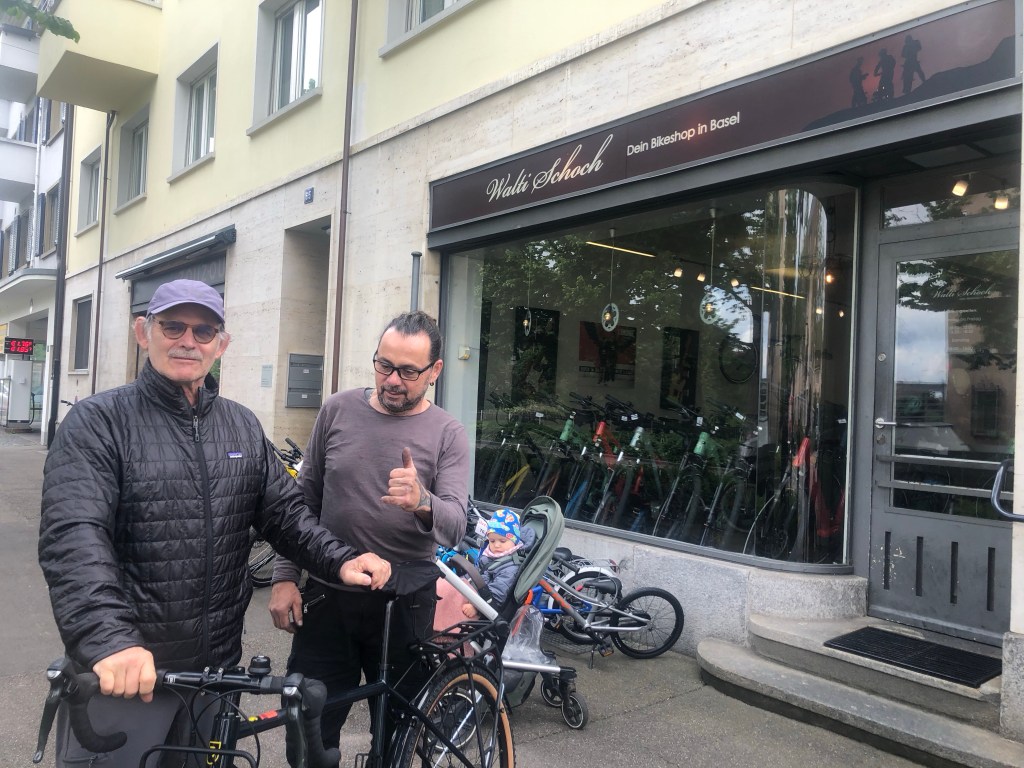
I made it ! and Walti did a great job, just a small saddle adjustment needed. The bike is in good shape.
Thanks to Fanny & Ian & little Emilia for accommodating me for a couple of nights before I leave for Oberalppass. The train journey was a nail-biter…three trains with just 3 minutes change time between train #1 and #2 and between #2 and #3. And on different platforms. I guess in Switzerland you can do it if you run!
Somehow I made the connections. Ah the Swiss, they do know how to operate a train system!
Arriving at Overalppass at elevation about 6000 feet with the hotel barely visible in the Alpine mist, I was the only person getting off the Alpine Express, a cog driven train that hurtles between passes and in and out of really long tunnels, it’s a mechanical miracle, built by the Brits, I believe.
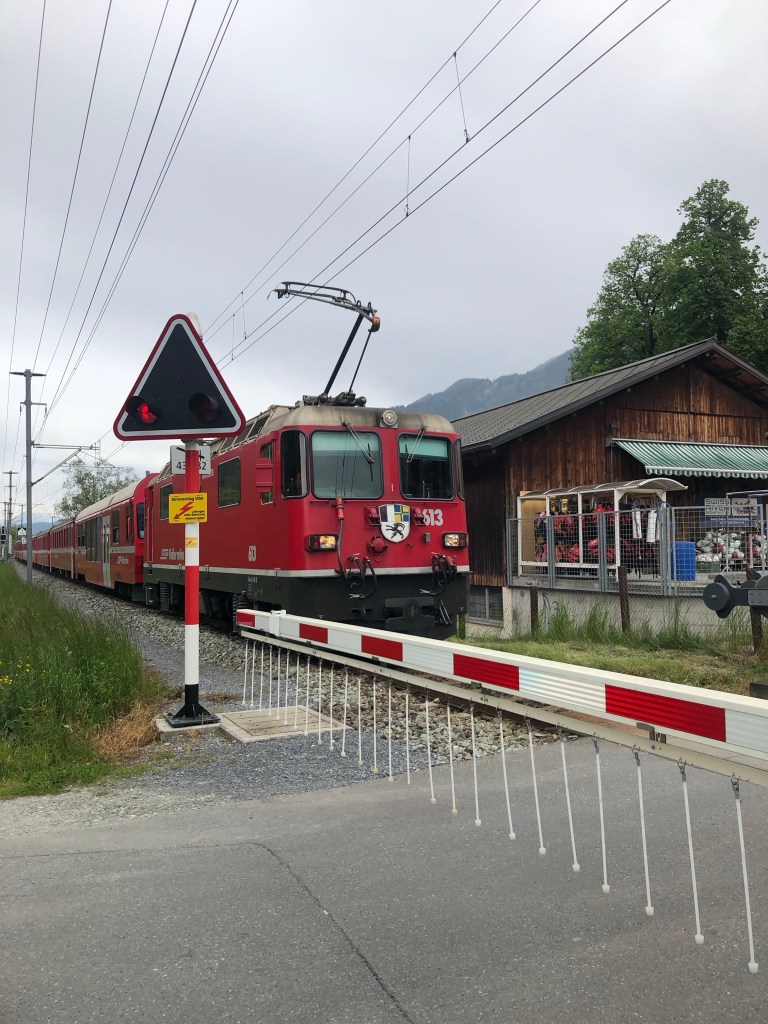
The Alpine Express.
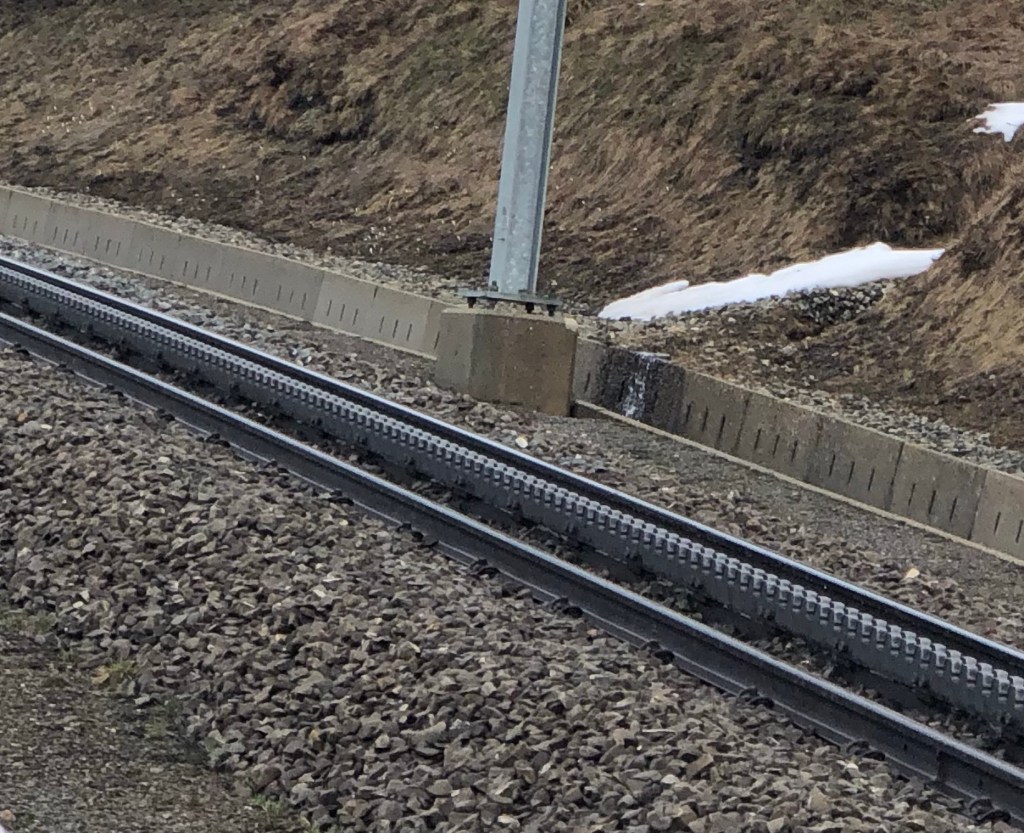
Showing the toothed rack rail.
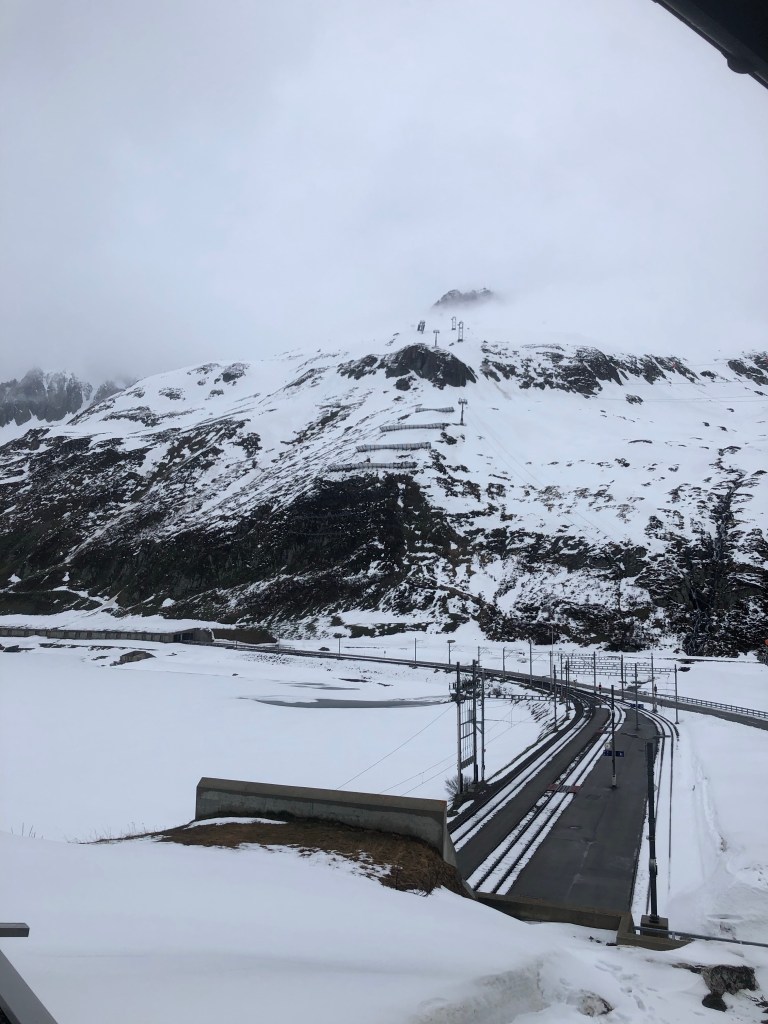
Overalppass Train Station. I was the only one to get off!
Amazingly at the hotel they had my name in their book (yes, book not tablet). I was in!
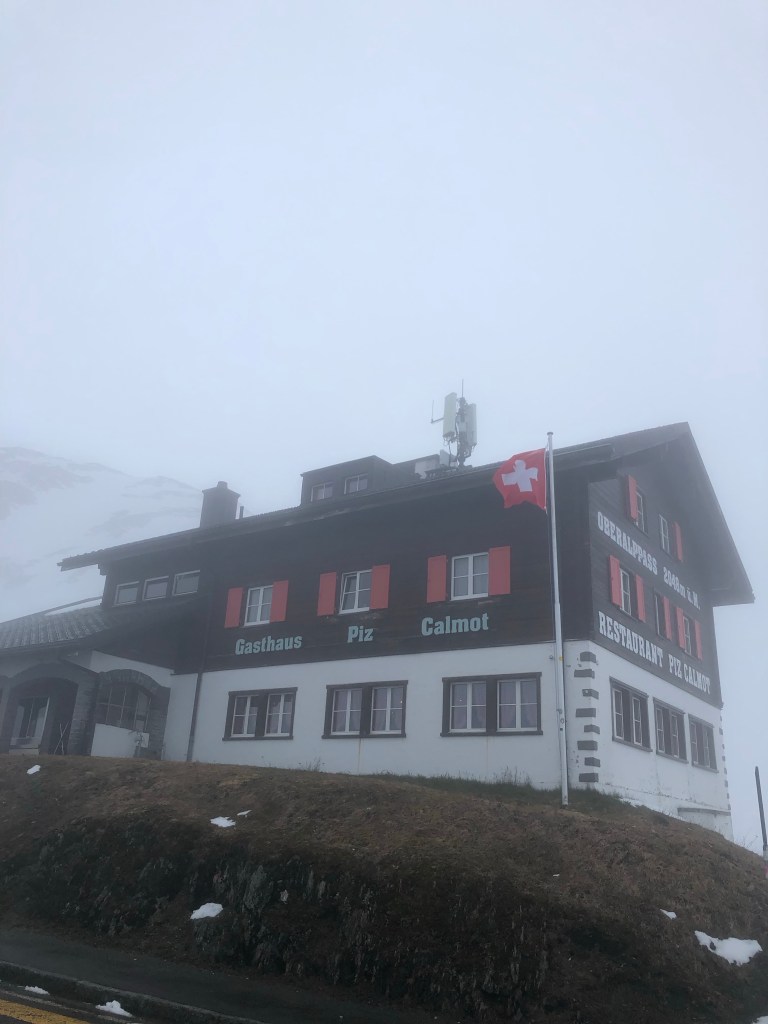
The hotel appeared out of the mist…
It was daunting to get the bike through the snow to the road the next morning and I wasn’t sure at that point if this Rhine bike ride idea was just crazy or what. This road is closed for most of the winter until Spring melt. Sometimes it’s closed in early May! I set off down the slope and for the next hour didn’t see anyone except a lone German cyclist coming uphill the other way who’d set off from somewhere in the Ruhr a couple of weeks ago.
The mist suddenly cleared and for 2 hours I was on the brakes the whole time. Scenery awe-inspiringly beautiful. I stopped numerous times for photos then finally gave up and just enjoyed the run down.
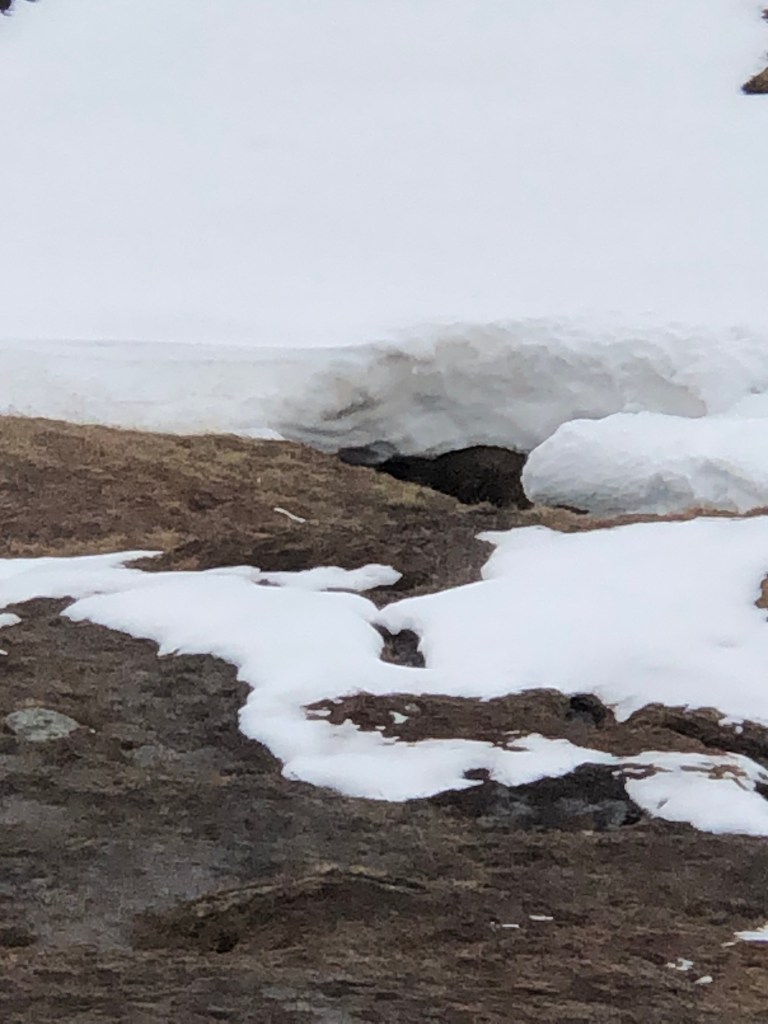
First glimpse of the principle stream which forms the Rhine, dark spot in center.
I took many photos of the river, but this was the first.
Switchbacks and tunnels slowly gave way to a more gradual slope and then there were hillside farms, sheep and Toggenburg goats and cream colored cows, cowbells clanging for the rest of the day.
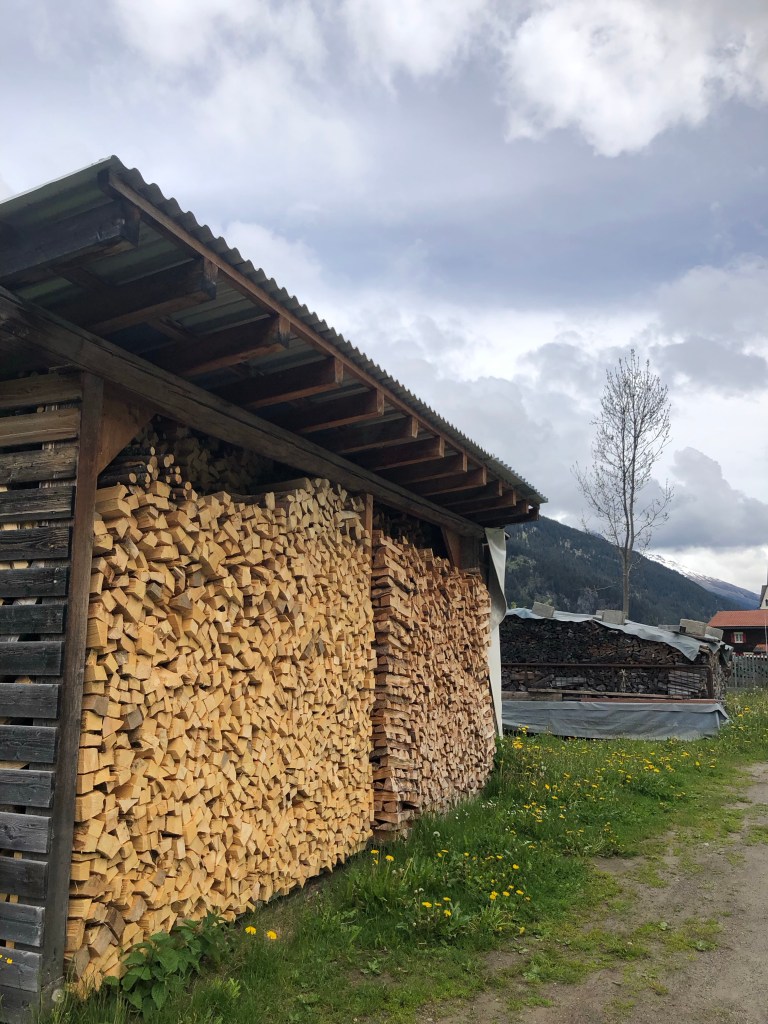
The Swiss also know how to make a stack of wood.
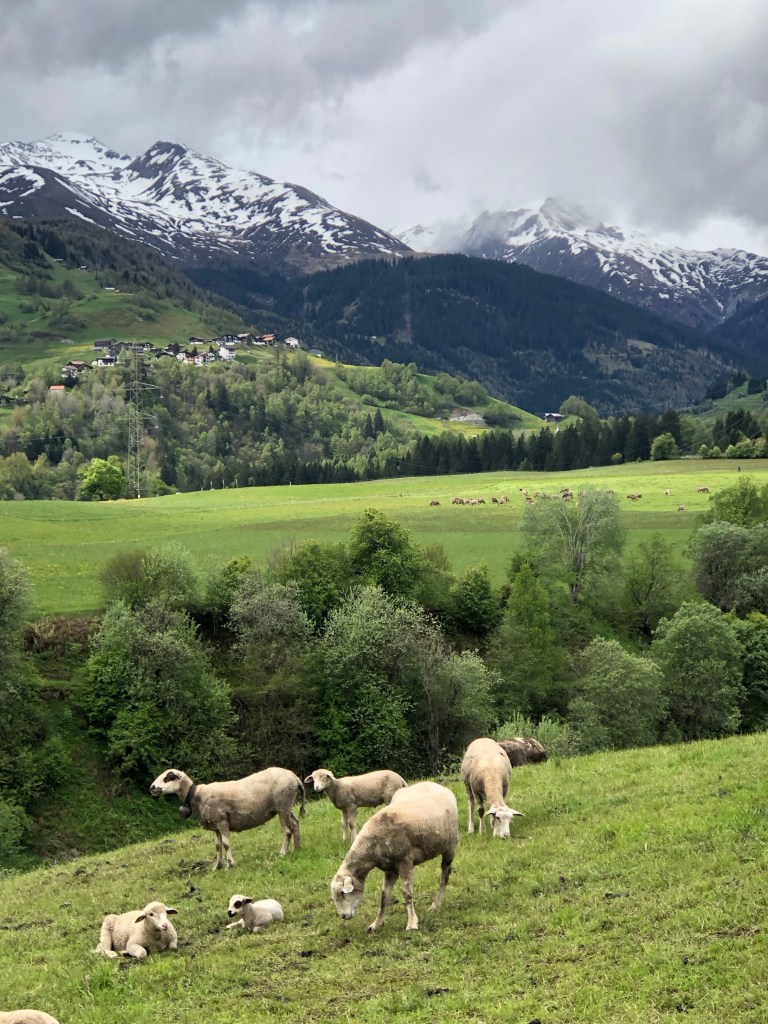
After the snow.
The river widened quite quickly, fast flowing and turquoise or teal or even green. Just as you’d expect.
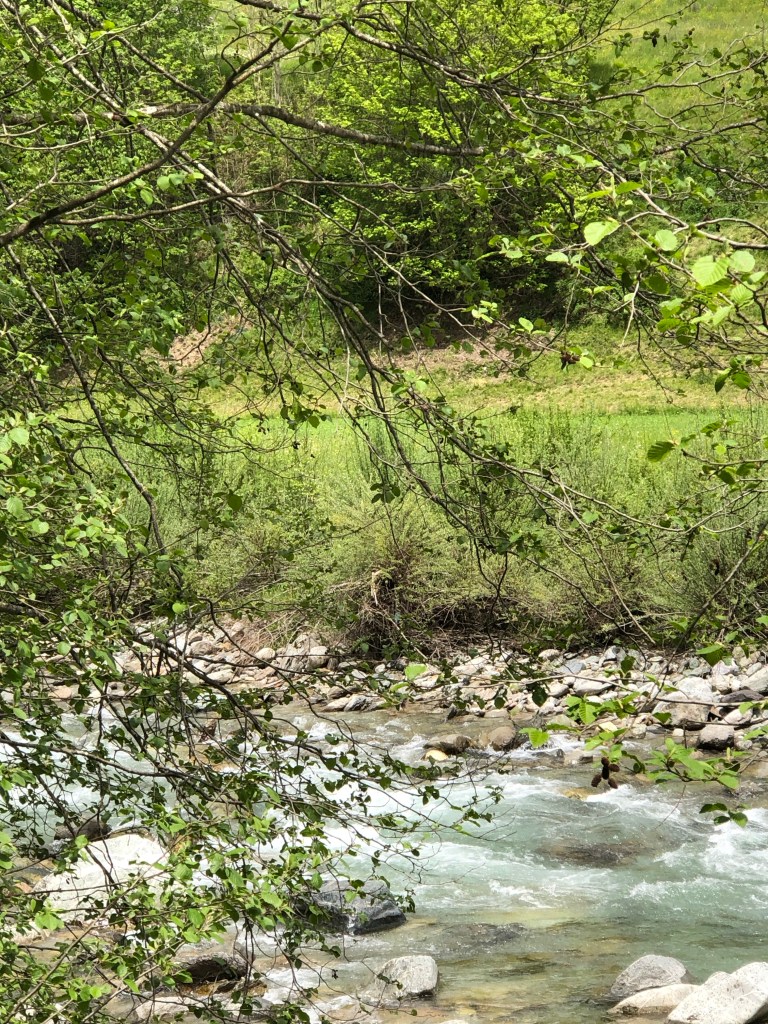
Still a stream.
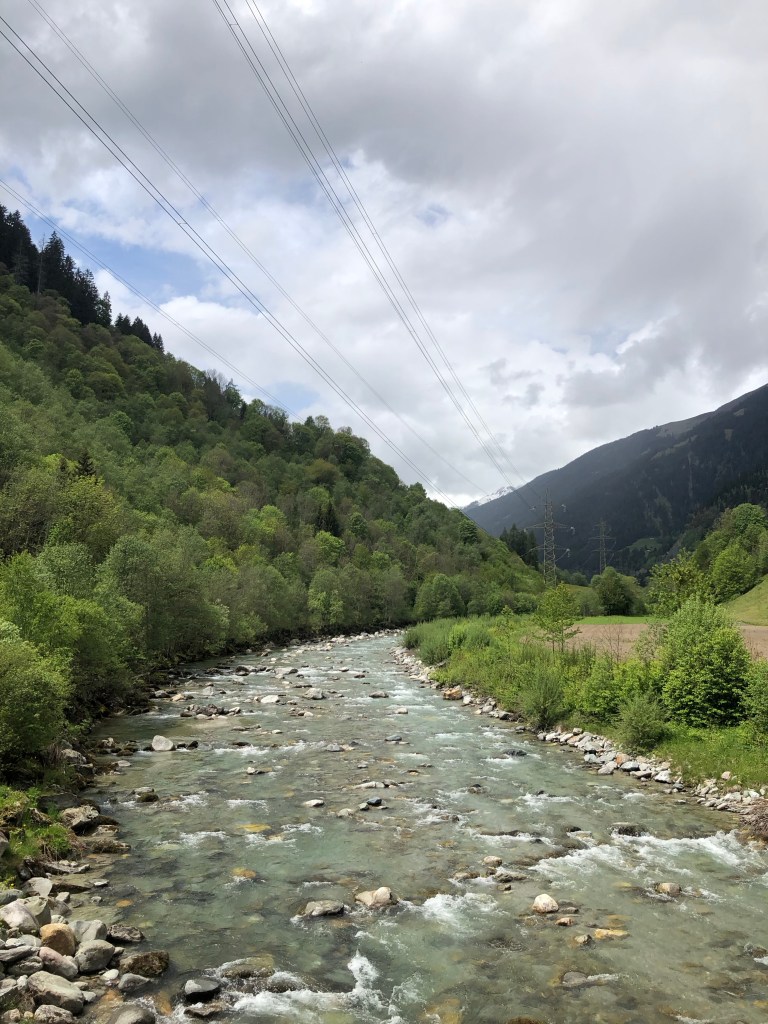
Suddenly a river.
The cycling terrain today was about 40 percent roadway, the rest stony paths or gravel or muddy dirt. Not too well signposted and I used Komoot which does a great job for cycling routes. My usual speed is 12, maybe 15 mph on blacktop but a lot less on rougher surface. Which is why it’s easy to over-estimate your distance when planning. The goal, as in kayak touring, is not the distance.
I’m finding another analogy with kayak touring. Weather apps are great, but you can’t beat local knowledge. A cyclist on the trail told me that the wind coming from the south here brings rain. He was right.
I’m coming to the end of this post. The next one will have more cycling days than this one. Tomorrow I’m heading to the ancient town of Chur, then the Bodensee and Konstanz before looping around and back to Basel.
DAY 2
Today was quite a challenge, the steepest climb of the whole Rhine ride.
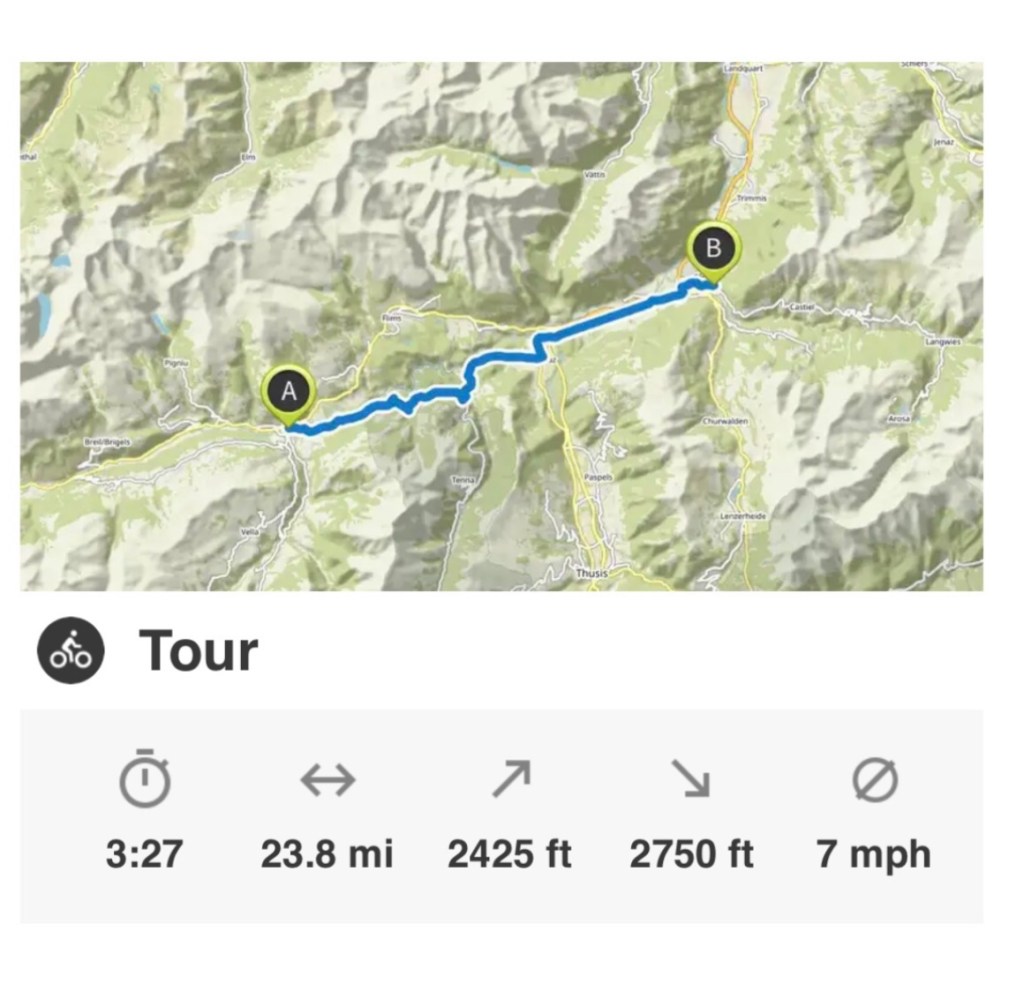
Here is the recorded plot of today’s ride. You can see that for the 24 miles of the ride, the level of the river fell by about 300 feet. The river cuts through a gorge here, one of the largest gorges in Western Europe, I believe. To get past the gorge, the route climbs up one side then down to the level of the river, then up and over the mountain on the other side. So the climb today was about 2400 feet. Which is why my average speed today was only 7mph!! My elapsed time was longer than shown, again I kept stopping for photos and for a breather once in awhile, whew…
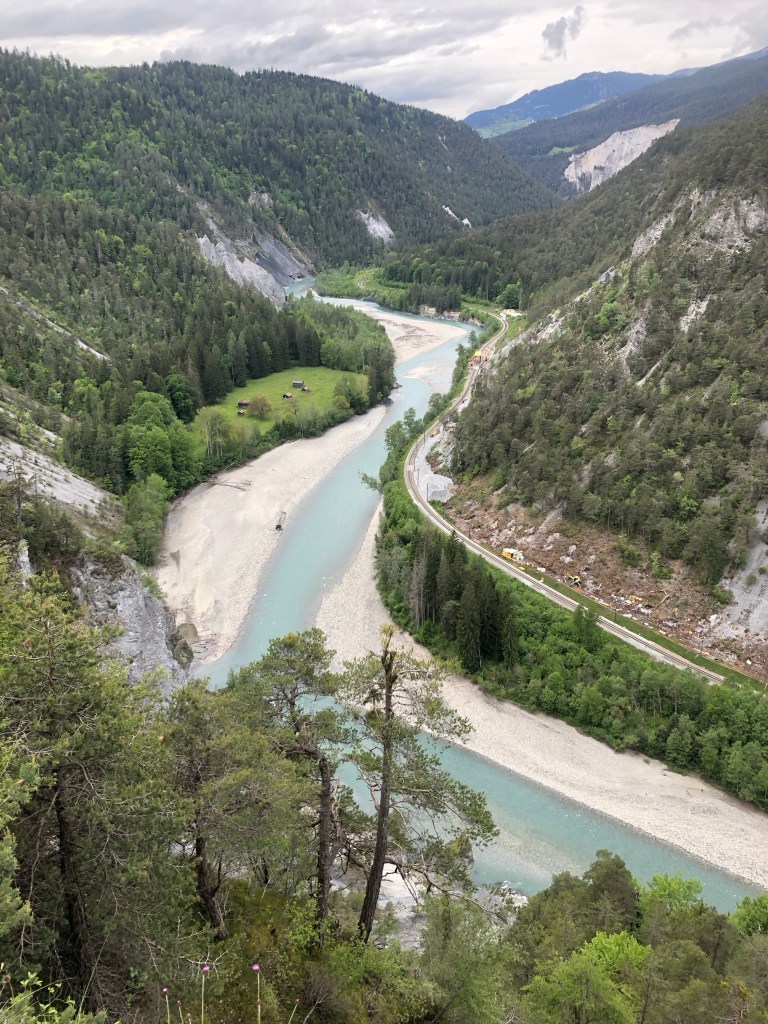
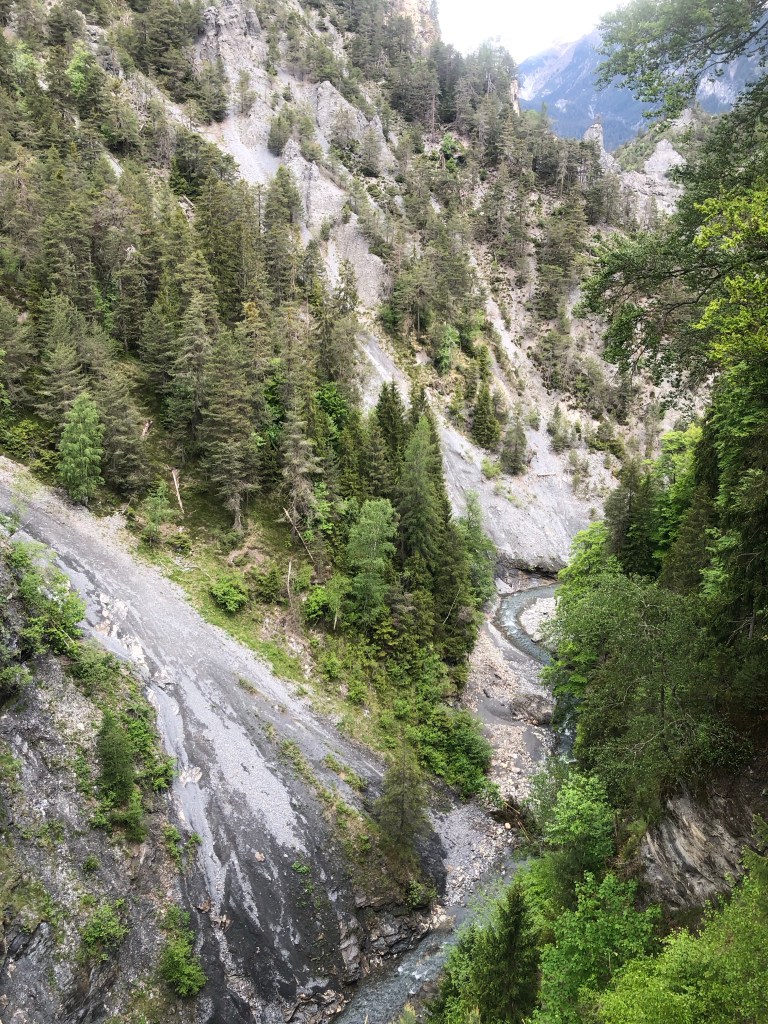
The reward was, of course, the terrain. In the geologic past, this region was once an enormous flood plain, the rocks formed being predominantly sandstone, mudstone and limestone. Relatively recently, geologically speaking, there was a massive landslide which dammed the river creating a lake. Pressure built and the river eventually forced its way through the unstable rock creating the gorge. If I put my amateur geologist’s hat on, this is one example of self evident geological history.
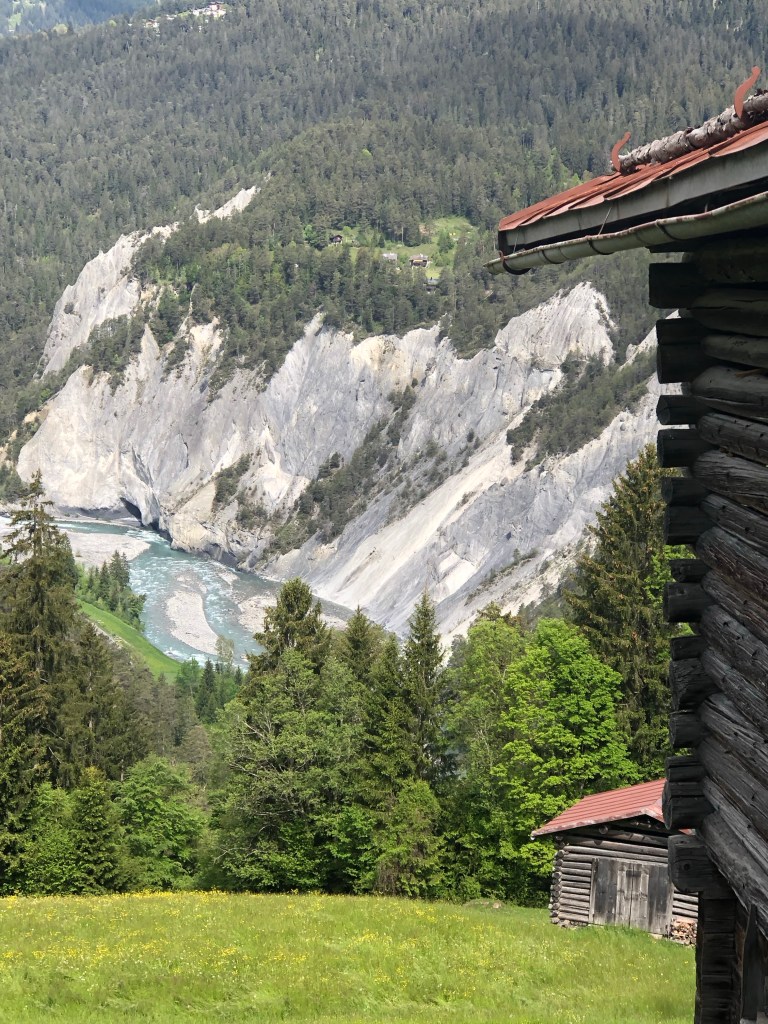
Views up and down the gorge are quite staggering, here are a few more photos, you can see how the river cut its way through the unstable debris.
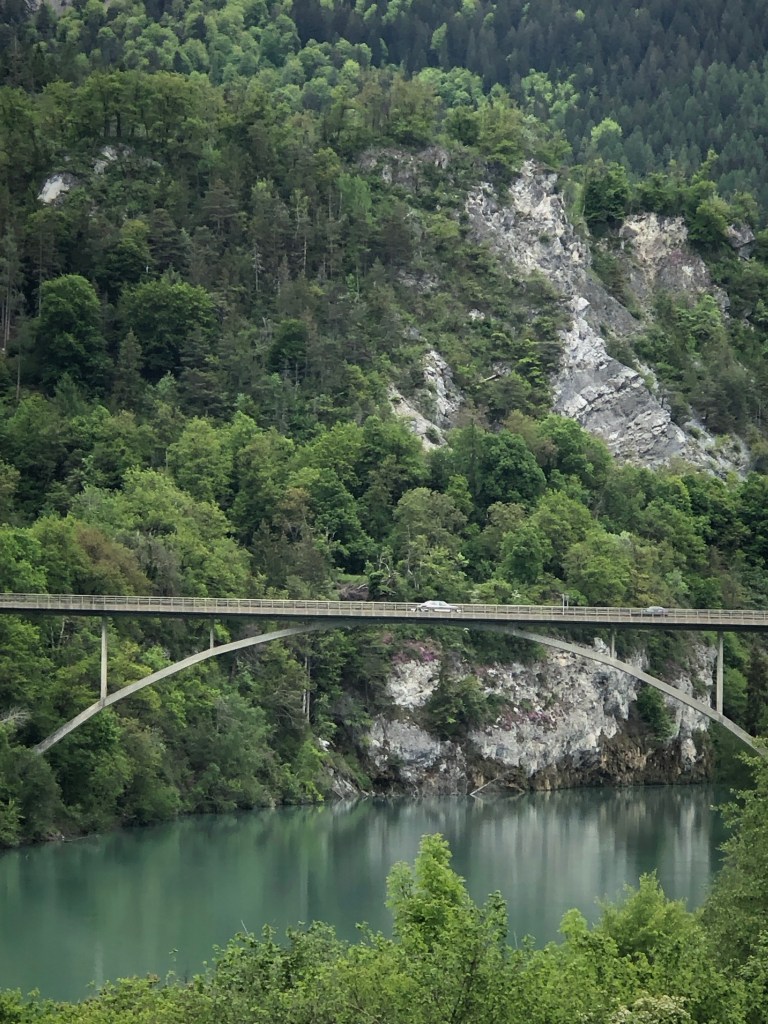
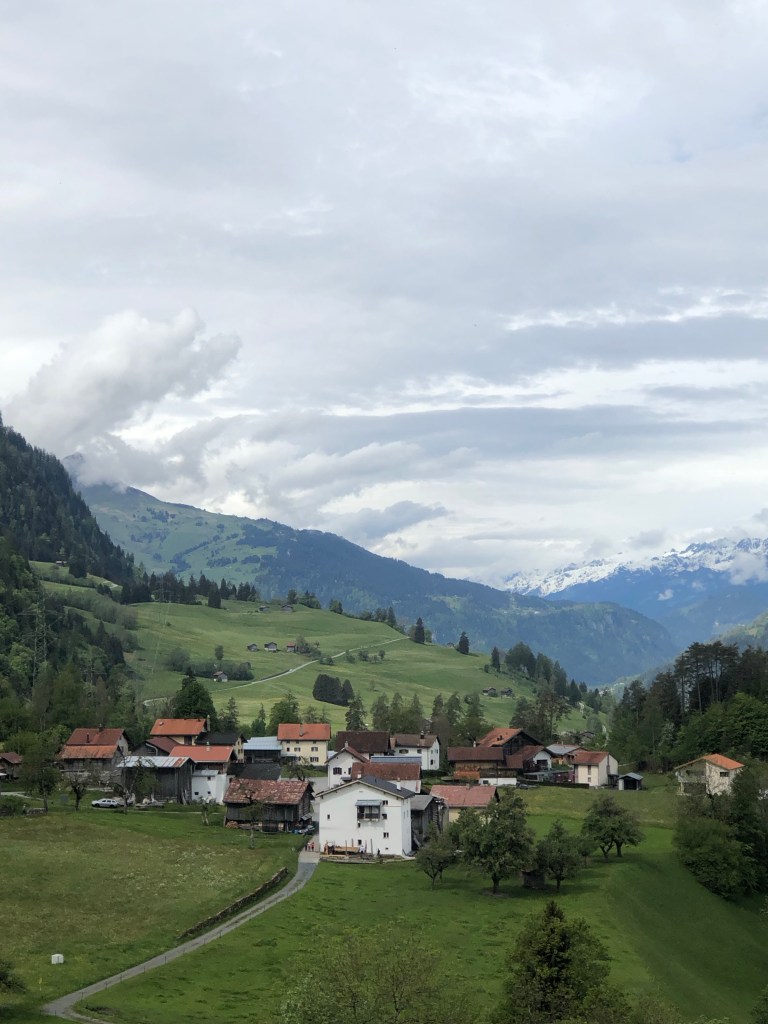
Of course, idyllic scenes like this one of the Swiss countryside, seen for most of the day.
I’ve stopped for the night in the Old Town of Chur, a 1000-year city where the Alpine Express train starts for its journey over the Alps to Italy, staying at the same hotel where Chris and I stayed many years ago.
DAY 3
Today was the easiest cycling day so far. Until it wasn’t – more of that later in this post.
Leaving Drei Koenige Hotel (est. 1790, or thereabouts) in Chur Old Town at 8:30 on a Sunday morning, it was easy and quiet with no traffic to speak of. And my Komoot AI assistant, ‘who’ I’m dependent on for directions had me on the river cycleway in just 20 minutes or so. Twenty minutes of in-city cycling I can take. Except for the fact that ‘her’ voice sounds like a machine, I can’t fault it (‘her’). There is more than one route for this ride, easy to make a false turn & Komoot is always there to put me back on track.
The river now is fast flowing, cutting through sandstone and various rocks made from mud deposits. Outcrops of limestone are seen on the riverbank and later in the day I’ve seen shoals of limestone boulders and small rocks brought down by the current. Here on the outskirts of Chur you see cement plants using limestone close at hand. Further down the limestone ends.
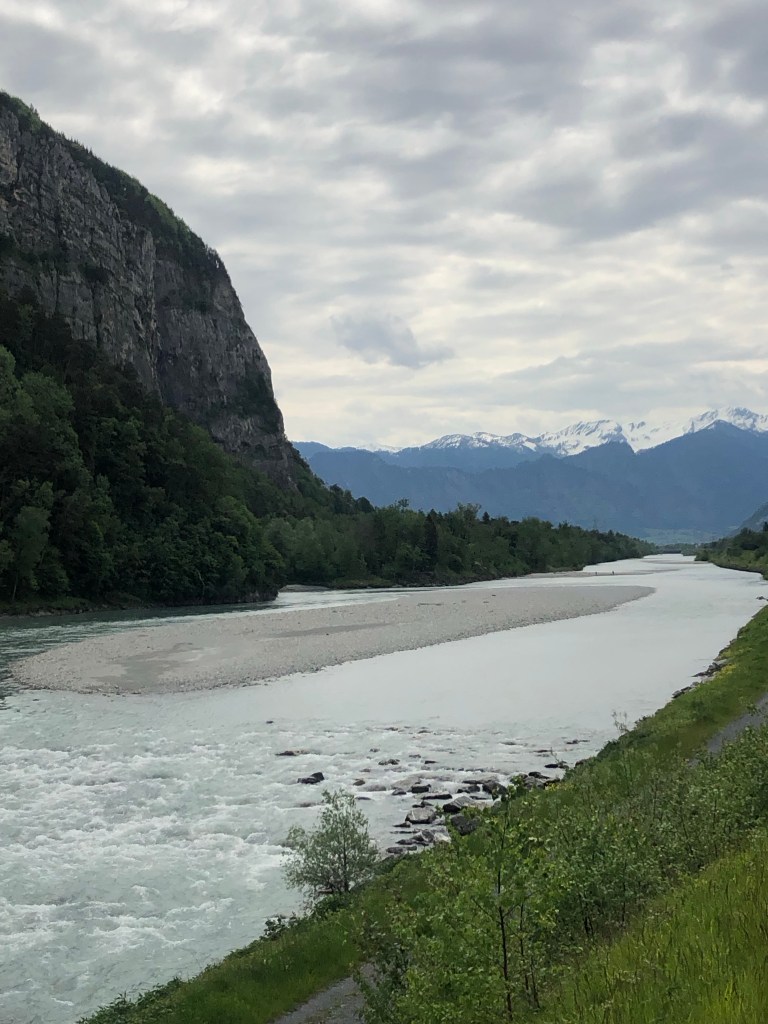
Limestone shoal with outcrop of mudstone / sandstone and others.
The flood plain widens here and mountains on either side are further away with level fields on this side of the river. Alluvial soil. Manicured fields of barley, what looks like rye to me and similar, sowed in perfectly precise, straight lines. Ah, the Swiss and their farmland!!!
Even the non-crop fields have been seeded. I counted six species of wild flowers in one field. But the distribution across the whole field was exact. Planted for insects?, crop for feeding cows?? (We once knew a farmer from Sweden, Lincoln Geiger, living in New Hampshire, who regularly fed wild flowers to his cows, he said it kept them happy!)
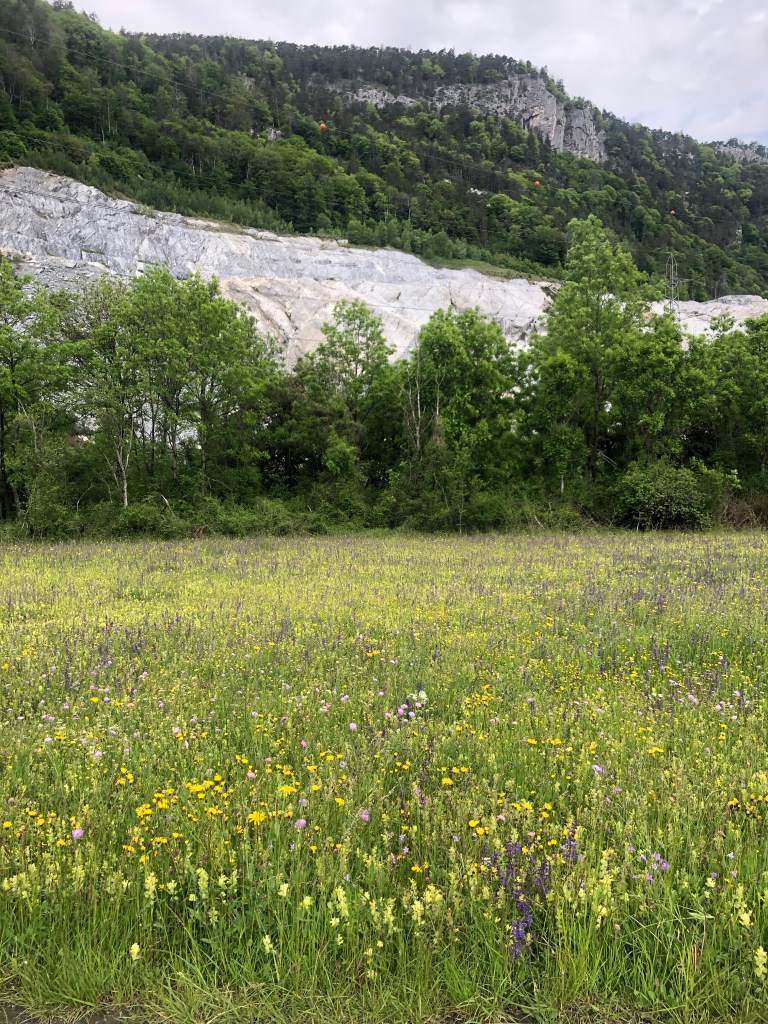
Crop for happy cows?
Cycling the river cycleway has been pretty effortless today in contrast to the last two days and I’ve kept the speed to 12,15 mph , occasionally 18 or so. Lots of Sunday afternoon cyclists, speeders on carbon frames whizz past me at 30, 35 or more, I’d say these are 30% of the bikers here, at least on a Sunday. Most of the rest now have electric bikes, there are some gravel bikers and on this stretch not that many non electric touring bikers like me.
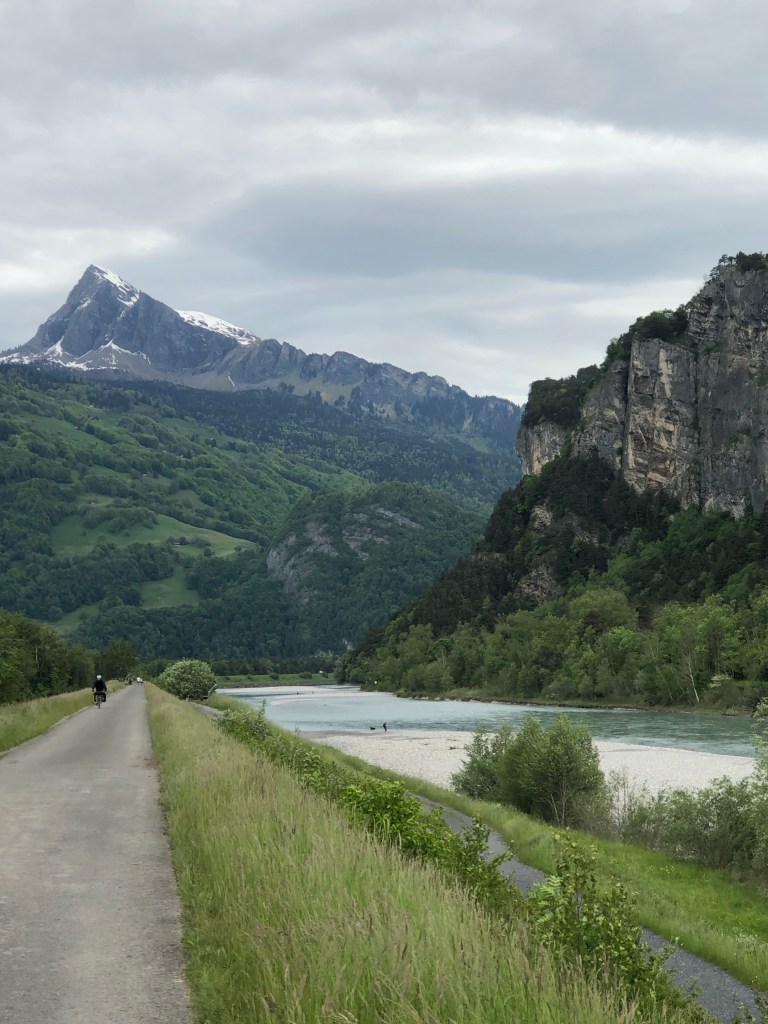
Riverside Cycleway
So…..most of the day went easy. My hotel which I booked yesterday, though technically within the village where I planned to stay when I booked, was about 3400 feet up in the mountains!!!! I knew this was coming when I checked this morning but I did not anticipate how hard this would be to do after a full morning of pedaling. I made it about half way up, I had gone through my 2 liters of water and things were not looking good, it was by now late afternoon, I was running out of steam at 2000 feet and still had a ways to go.
Sometimes you have to do what you have to do…I flagged down a couple of hunters who were coming down the mountain in a pickup and somehow persuaded them to put the bike in the back, turn their vehicle around and transport me and the bike the remaining miles to my hotel / restaurant. They were just great!
I hesitate to show the following photo at the hotel / restaurant, since I didn’t get there under my own steam. Nevertheless, I felt I’d earned it, hah.
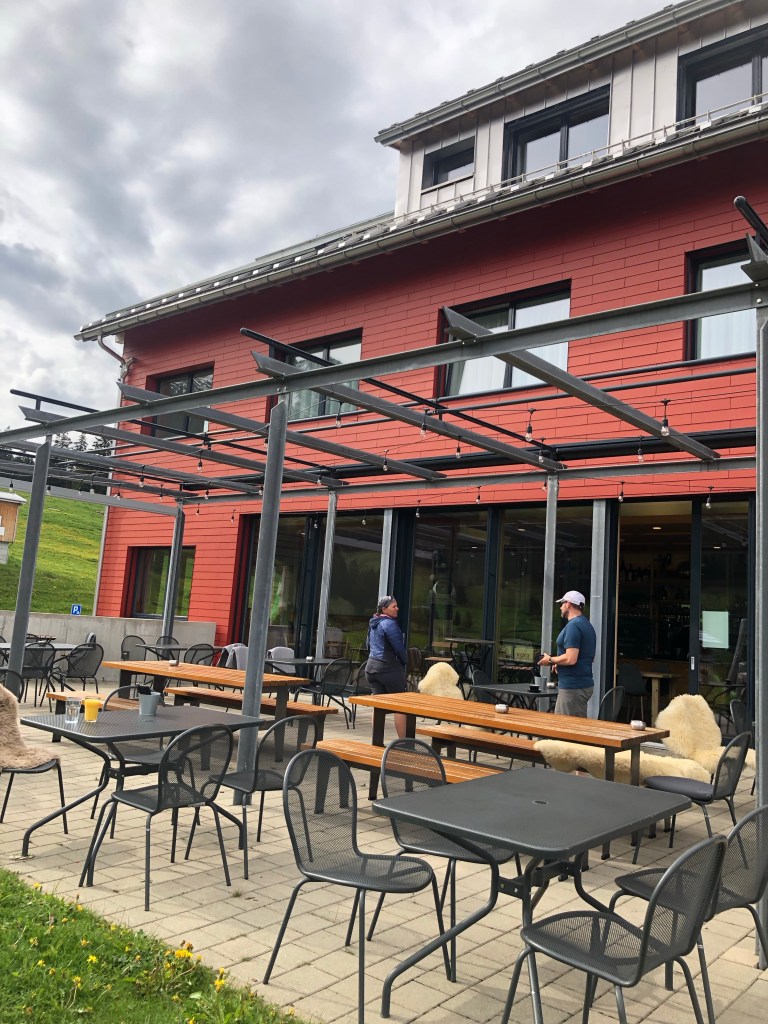
Hotel Restaurant Malvinas at 3400 feet
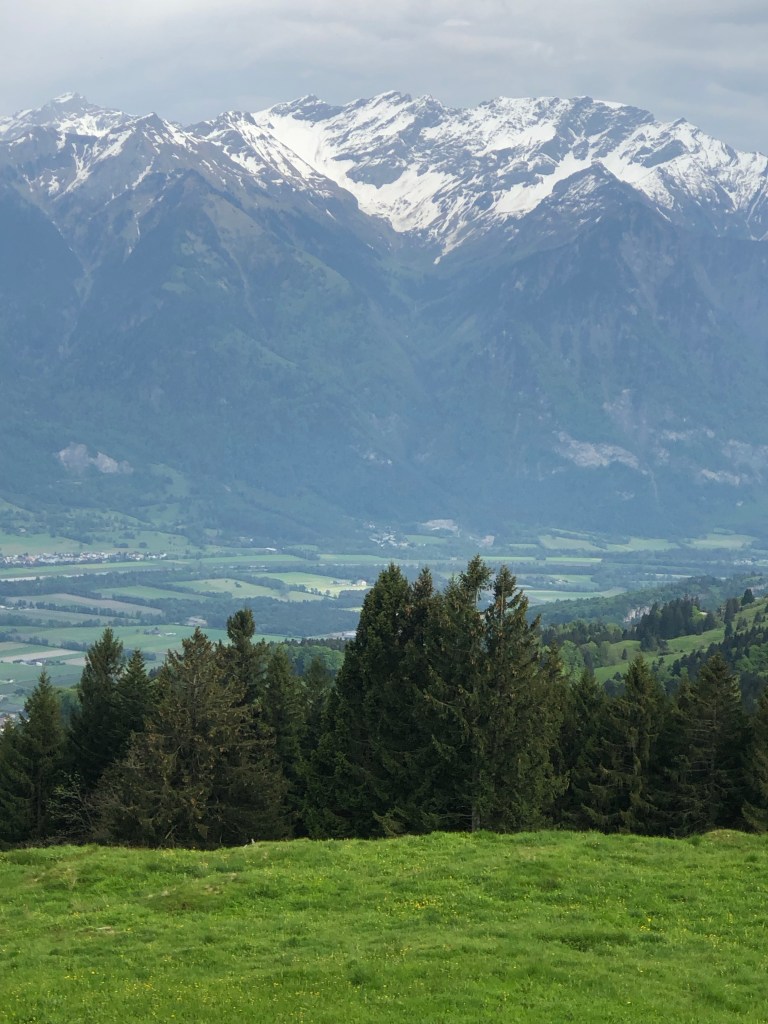
Late Lunch view #1
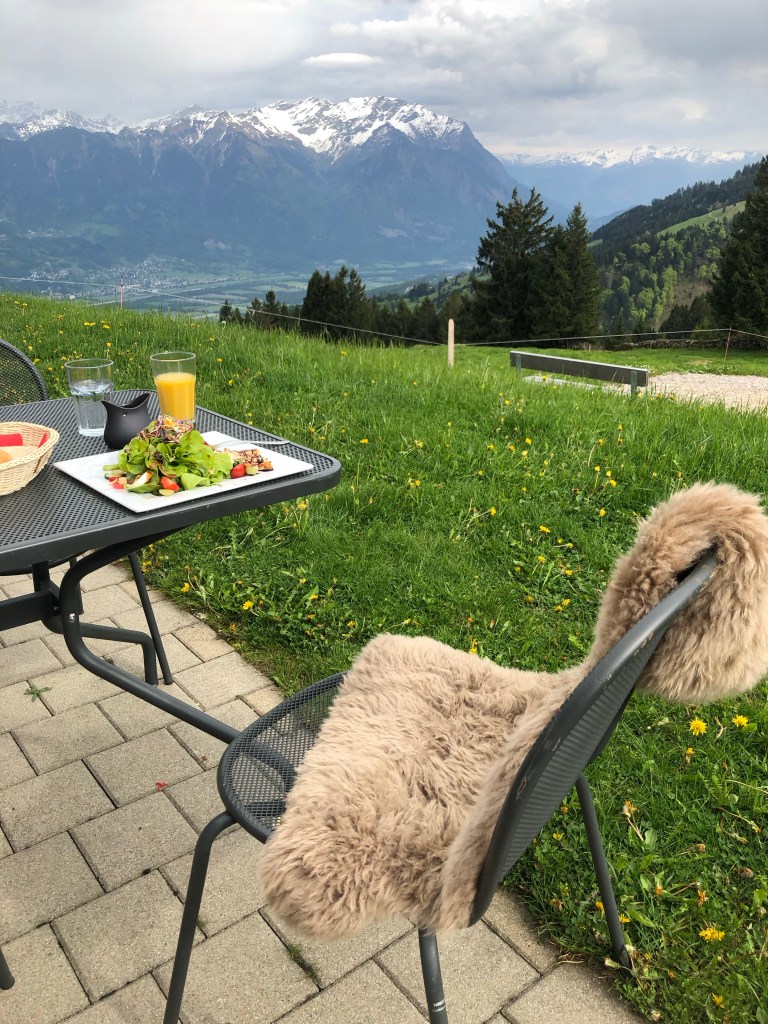
Late Lunch view #2
That’s all for today’s post, I’m taking a well-earned rest. Until tomorrow….
DAY 4
Plain sailing all the way today. Except for a steep and rapid descent, 3700 feet, first thing this morning from the hotel, the path followed the river on an easy navigable path. Getting into Bergenz at the end of the day in traffic with a lot of roadworks wasn’t too much fun but all in all, a great day.
But that ride down the mountain, whew…I’ve cycled a lot on steep hills in Wales, but nothing like this. Fantastic views all the way down but I was glad to get back to the river. On the way down I stopped and chatted with 2 ladies who were weeding in a hoop house. They were growing tea plants! Medicinal tea I’d guess.
My disc brakes held up pretty well, yesterday on my way up I could smell burning rubber from two cyclists braking as they came down at speed. They were using traditional caliper brakes.
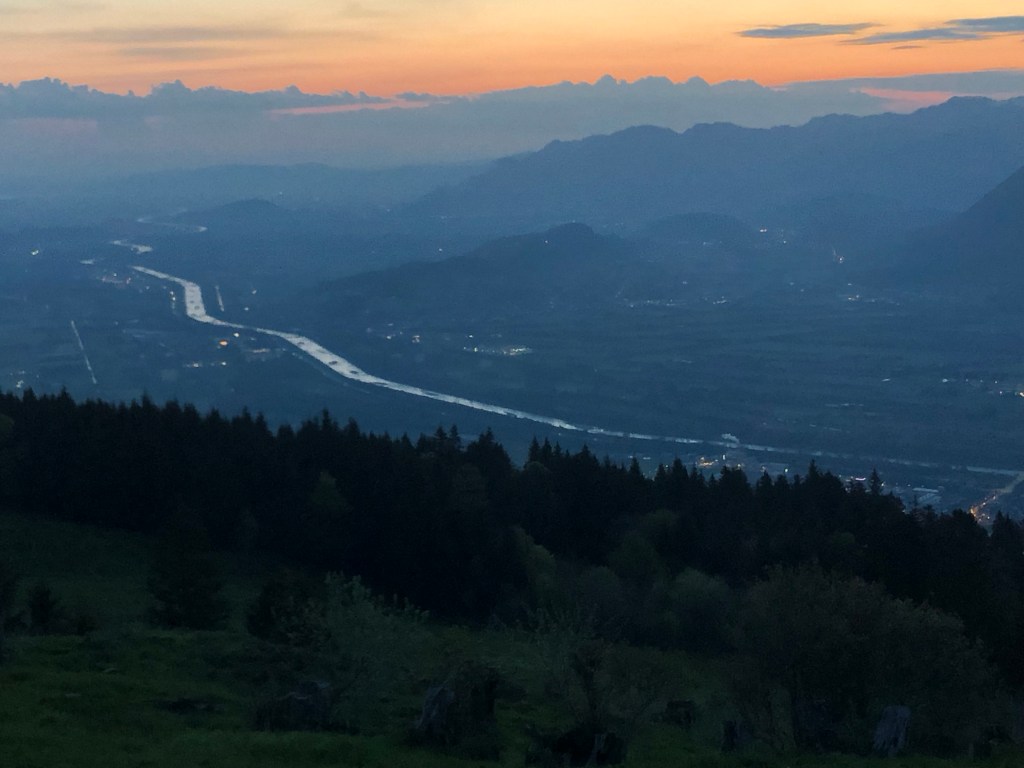
River snaking north towards the Bodensee, photo taken before sunrise from my window.
From up there I saw what looked just like barges on the river like those I’ve seen from a height in the Yangtze. But later I saw they were big clumps of white rocks.
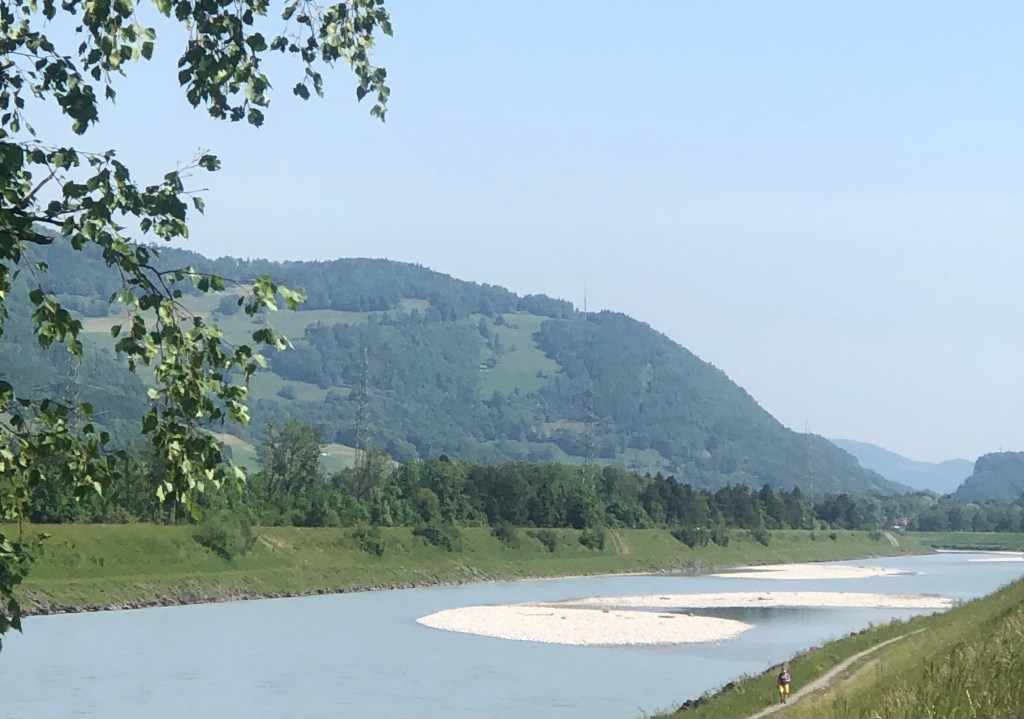
Shoals of limestone.
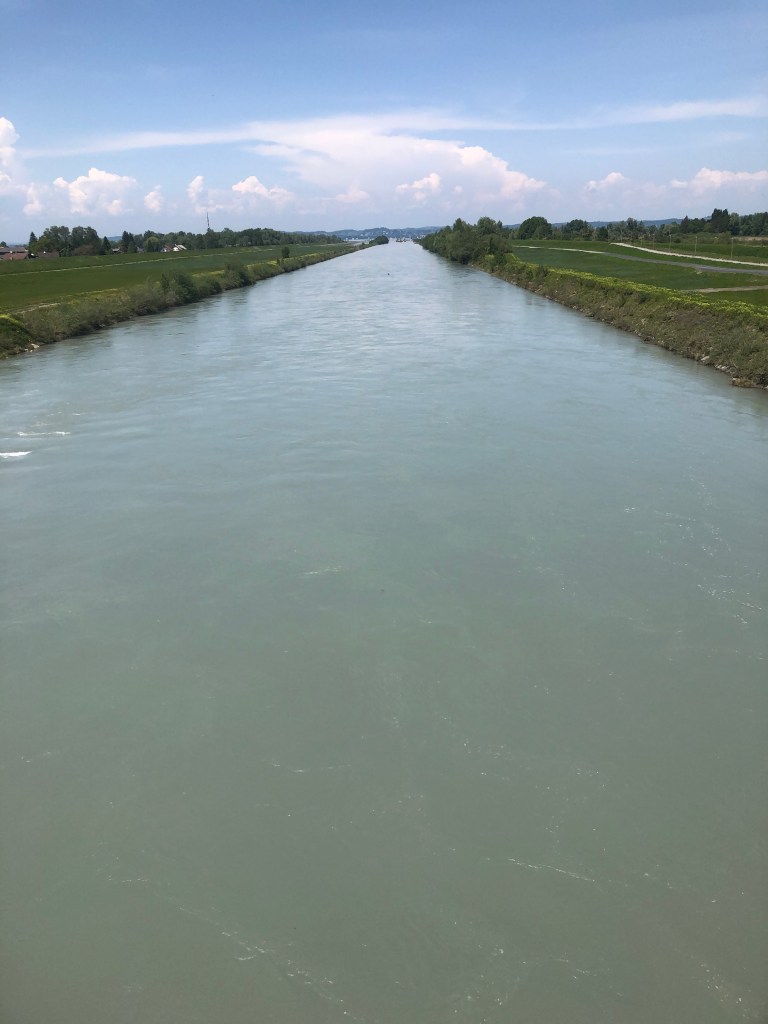
Limestone eventually disappeared altogether and the river starts to look like a canal the closer you get to the Bodensee (also called Lake Constance). They’ve tamed it!
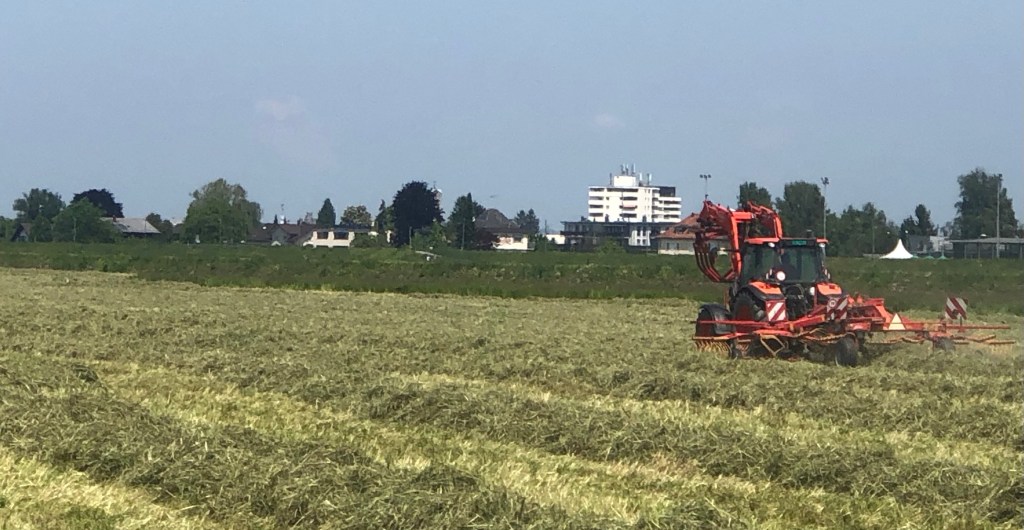
They do precision agriculture here, & not using computer programs. Hands-on. I’ve never seen such straight rows.
Some distance before the lake I left Switzerland for now and cycled into Austria. A little different from Switzerland but hard to say exactly how. Dialects are different, I find it hard to understand because people have not been speaking pure German, instead the local dialect. In Oberalppass it was Romansh which itself has several dialects.
I guess I was right about the feed for dairy cows. Dairy cows here are grass fed, that’s live grass, and farmers here are using electric fences to keep them in meadows of flowers, I saw them munching it.
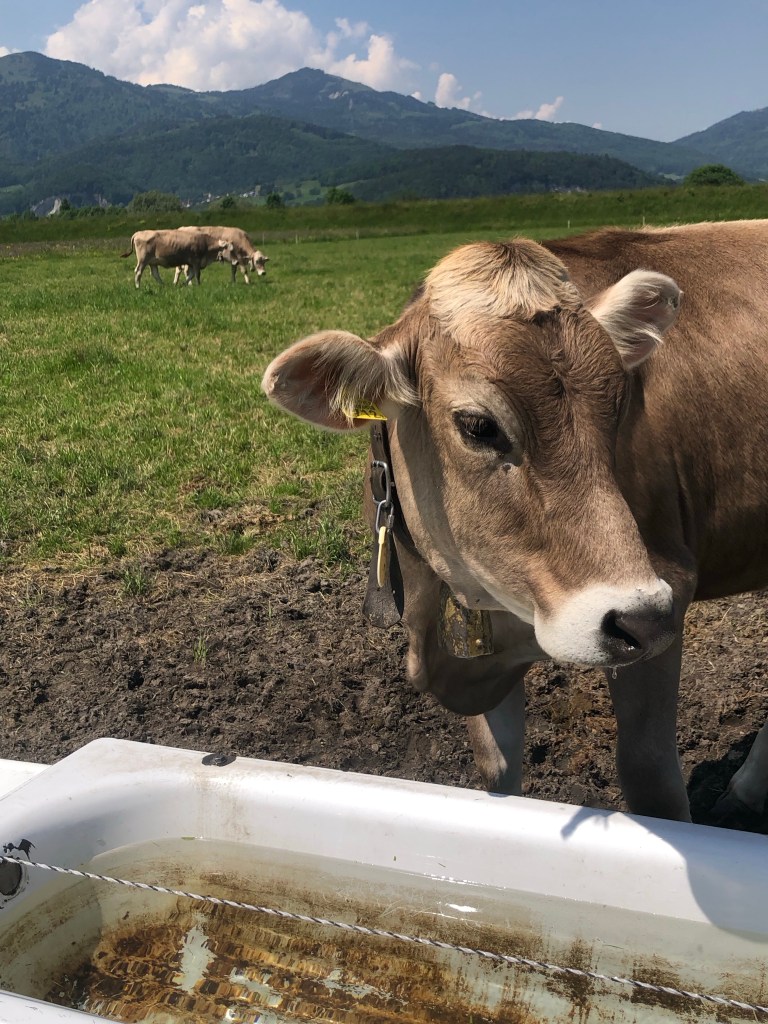
Happy cows
I made pretty good time today, the path surface was mostly back top and though I had a late start from the hotel, I pulled into Bergenz mid-afternoon after a good day.
DAY 6
Today I cycled through mostly agricultural terrain. I left the high mountains a couple of days ago and here on the west side of Bodensee the river becomes broad, deep and fast flowing. All the waters leaving the lake become the Rhine which now is running west towards Basel and when I get there in a couple of days I will have done an eight-day loop.
The soil here is red with small rounded red colored rocks, presumably rich in iron, probably sedimentary and looks very fertile. Crops of onions, spinach, carrots as well as cereals like barley. Some fields have already been harvested.
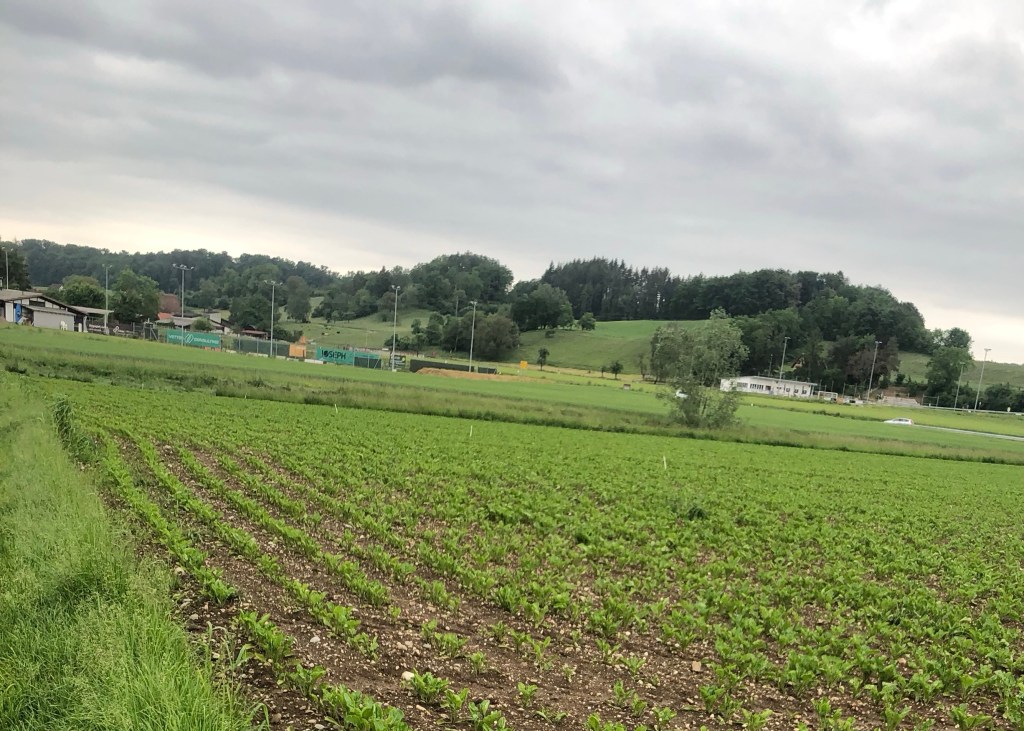
Field of Spinach
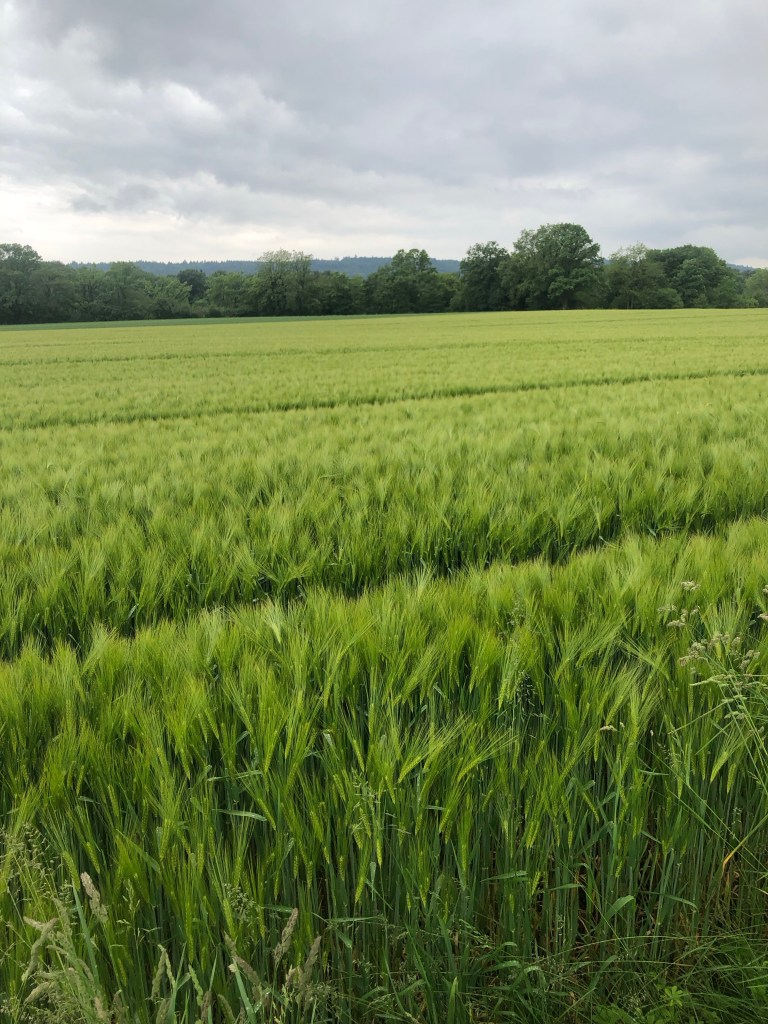
Healthy Barley Crop
I stopped for a break and to compare cycling notes with German cyclists, Christopher and Stephanie, who are riding back to Freiburg. Here they are passing me…
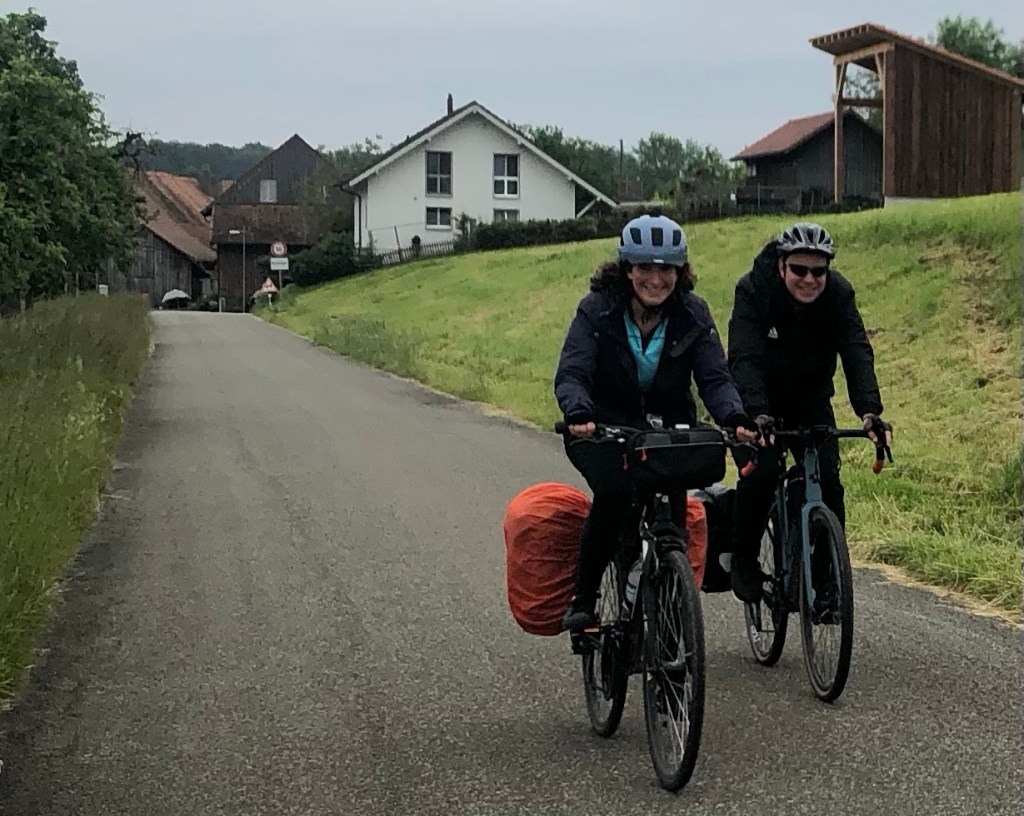
With Ortlieb Panniers, just like me!
My pace today has been really good since it’s been flat and the track surface black top or paths of small stones. On the whole, the most challenging part of this trip so far has not been the pedaling, but the logistics ….booking hotels, packing & unpacking gear, making sure I’m not taking wrong turns, putting rain gear on and off again when the sun comes out. Simple stuff, really.
But I do think I’ve discovered something about pedaling (and you can skip this part if it gets tedious). It’s all about these ‘clipless pedals’ which I mentioned earlier. And this is where it gets a bit physiologically nerdy, or ‘wonkish’ as Paul Krugman would say. (Paul Krugman might also at this point say something like, ‘Now don’t quote me on this’). When cycling, I might be wrong, but I do believe that I’m limited more by lung capacity than by cardiac output or leg muscle strength. My breathing gets labored more than it should, on hills for example, while my heart rate is surprisingly low and my leg muscles are doing fine.
(This could be due to the fact that my lungs are probably a little compromised from that nasty pulmonary embolism some years ago).
This is where I digress…
With clipless pedals, you have a choice. You can use the bottom leg muscles (hamstrings) on the upstroke or the top leg muscles (quads) on the downstroke. Or you can use both together which gives you a much higher efficiency. Hamstrings are larger since they are the muscles you use to bend your knee against gravity when running / walking. Quads are smaller, they’re used to straighten your leg and put your foot back on the ground.
Here’s what I’ve found. My breathing is less labored on hills and rises when I pedal using the upstroke (hamstrings). Actually a lot less labored. That makes some sense as I’ve said, these are bigger muscles. To continue on this idea, it may also be that the muscle fiber types are more oxidative in the hamstrings. Which would explain why I’m not tiring as much, from training I’d guess I have pretty good aerobic capacity. But I’m sure exercise physiologists have this all figured out and I’m covering old ground. Just checked, yep here it is: https://digitalscholarship.unlv.edu/cgi/viewcontent.cgi?article=5286&context=thesesdissertations
But back to today’s ride….animals along the route kept appearing as follows, horses, ducks, a hunting cat and snails & slugs.
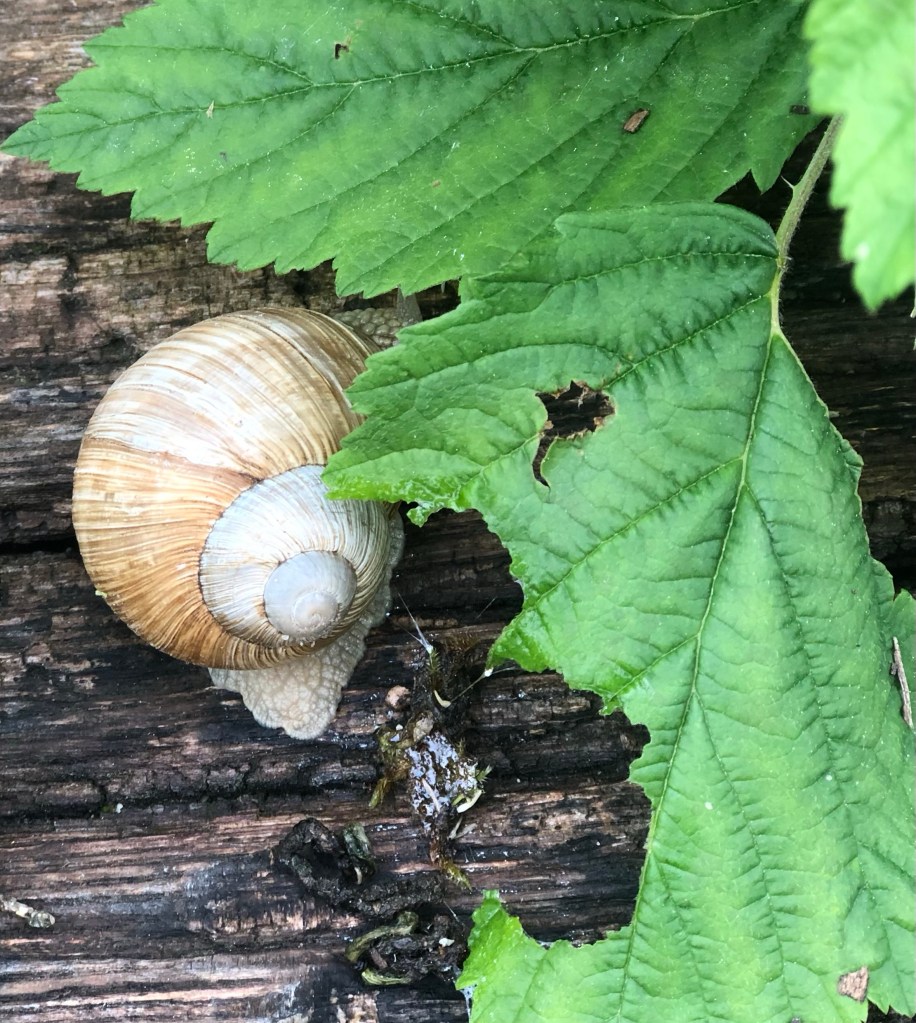
Blackberry leaf Dinner
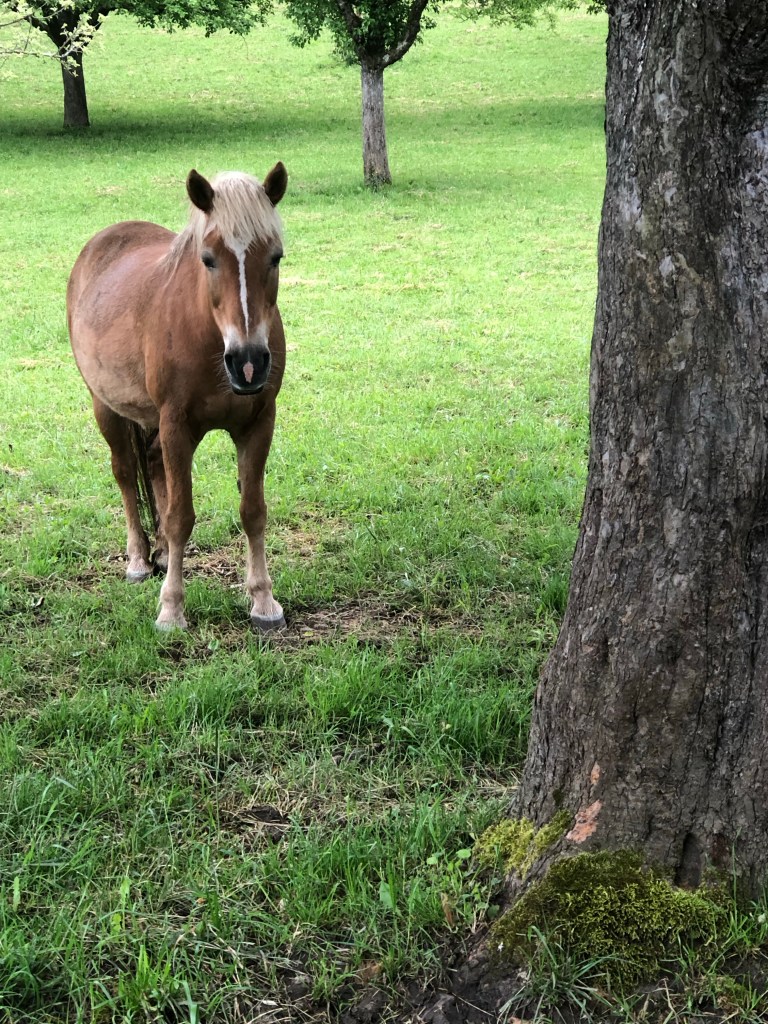
Staring Horse
A number of small lakeside towns, exquisite medieval architecture.
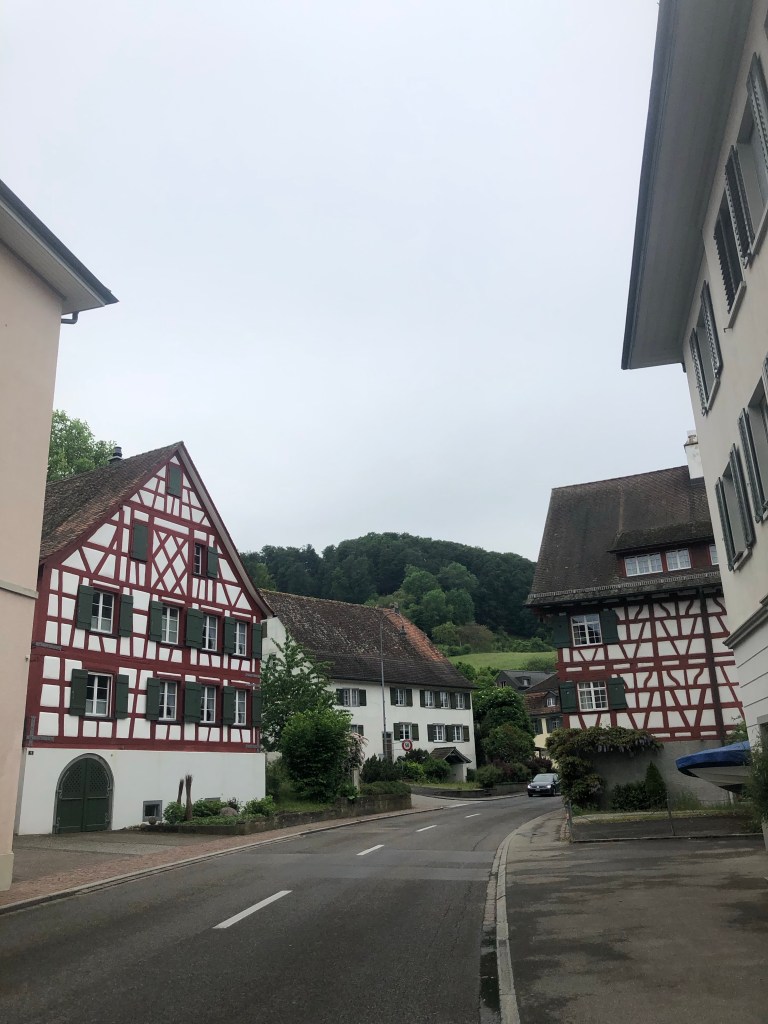
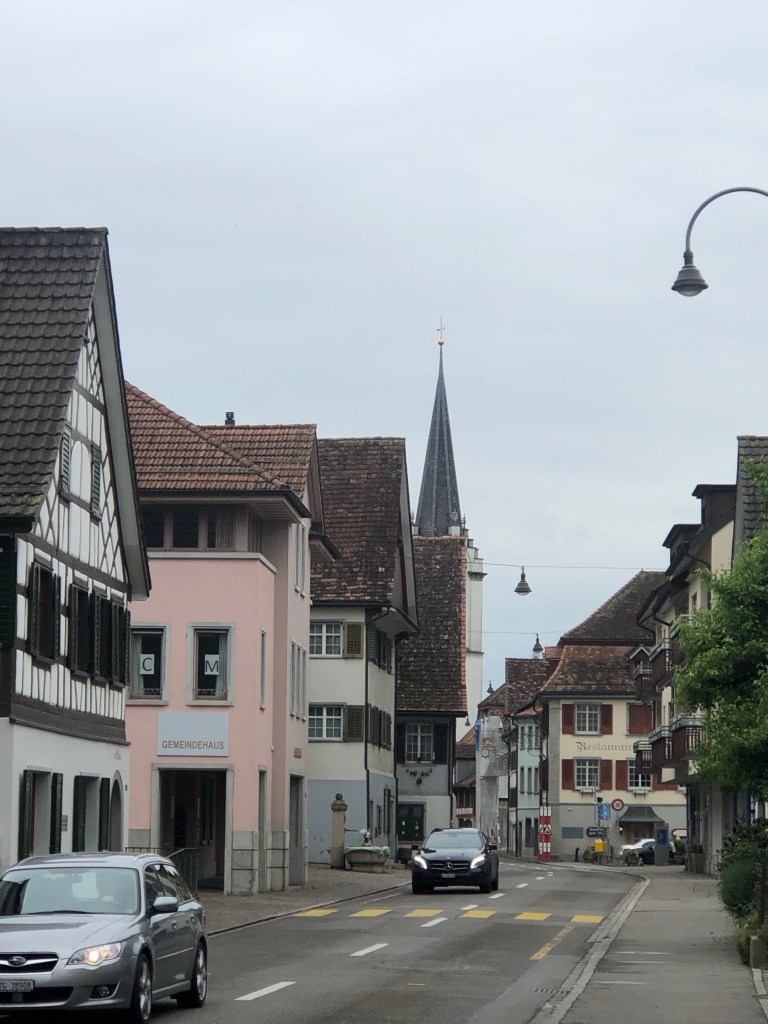
Finally arriving at Konstanz, & splurging on a spa hotel. It’s OK, tomorrow night I have a room at one of those wonderful Rhine campsites, this one is in Germany.
And that’s the end of today’s post., more next time. Adios….
DAY 7
Leaving behind the slightly stuffy Hotel Kronenhof in Schaffhausen with its eye-watering restaurant prices, I made a tactical decision this morning to leave the Rhine for today’s ride. The river loops south then west, I cut due west to reach Waldshut a bit earlier in the afternoon.
I spent the first part of the day climbing out of Schaffhausen and the second part following a smaller river that eventually flowed into the Rhine.
Instead of river towns, I passed through largely an agricultural region of rural villages and open fields. The day’s cumulative climb was about 1000 feet but since it was spread over the whole day, it was not too arduous at all.
Here I’ve been cycling on small country roads or bikeways which I imagine, since this is very much an agricultural area, to originally have been cowpaths or walkways or carriageways which farmers would have used in earlier times to get to market. In contrast to the cycleway in the alps which formerly were goat tracks.
It seems to me that the whole region is a sedimentary basin. There are low hills to the sides and the soil is rich and clayey with that oxidized iron giving it a red color that I mentioned earlier. I’m seeing sandstone deposits again, and early in the day passed a sand mining operation with crushing machines and piles of sand and stones of various sizes.
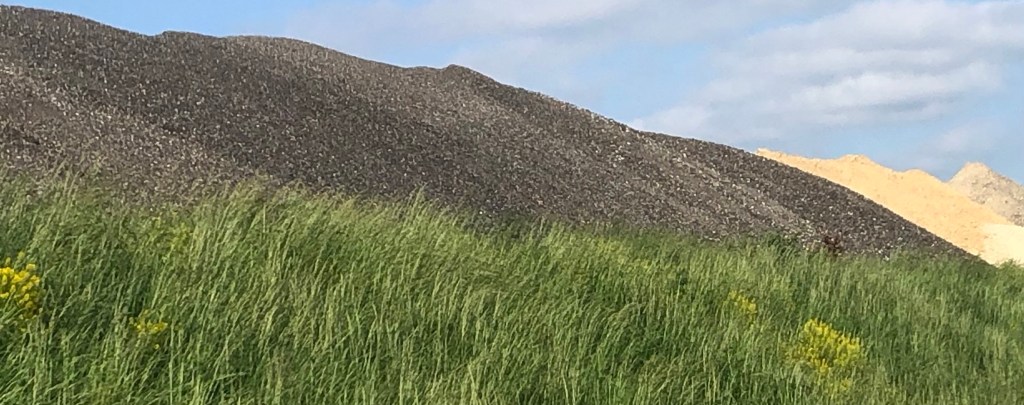
Hills of crushed stone & sand
Field after field of cereal crops, wheat and barley which I could recognize and also rapeseed – I stopped a farmer who told me what it was. Now I know!
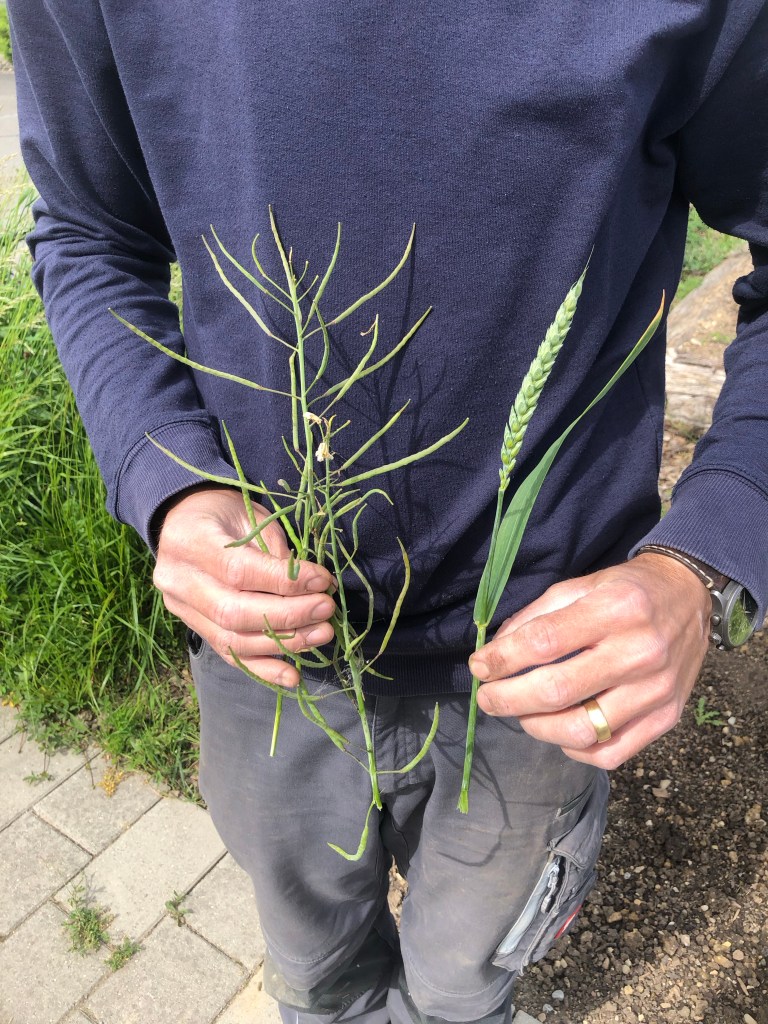
Rapeseed and Wheat
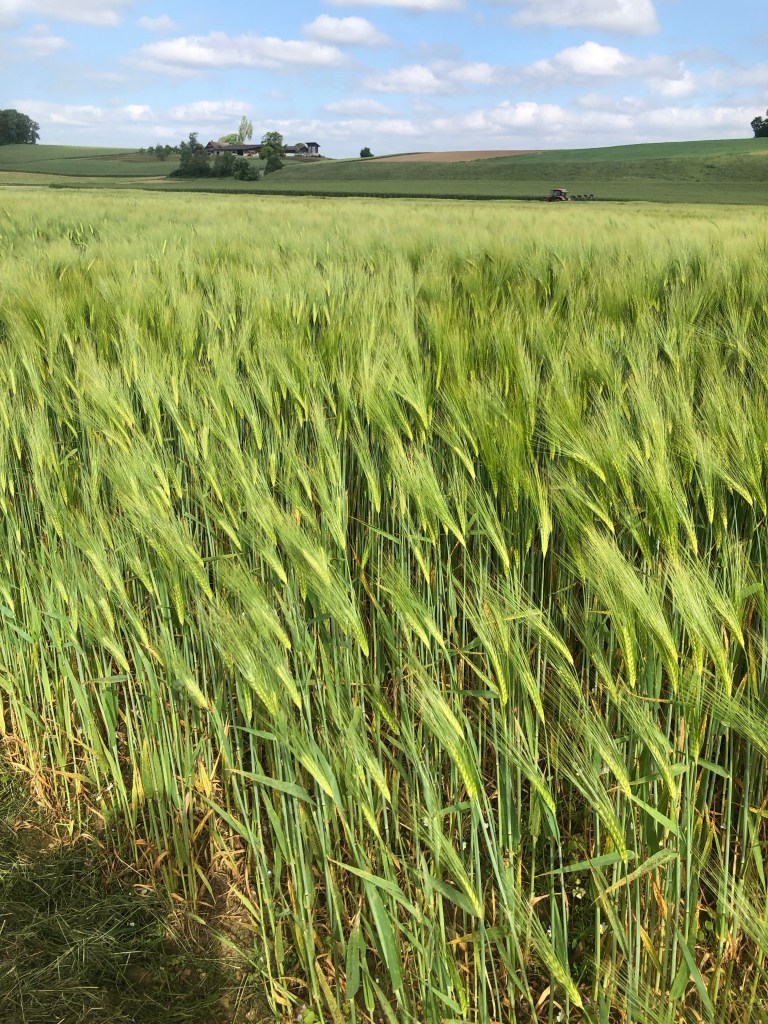
Fields of Barley (‘…You’ll forget the sun in his jealous sky
As we walk in fields of gold.’ Sting)
It’s strikes me that I’ve commented quite a bit on the rocks I’ve seen this past week and I’m thinking that this is very much how William Smith did much of his work in the late 1700s to ‘discover’ and map the geology of Britain in the late 1700s. Of course he did it from scratch when no one knew much at all about the various rocks which were laid down, and how. And he walked and rode by horse carriage to do it. Many hundreds of miles. No bike!
I also rode through softwood forests – I haven’t seen conifers since Chur. Pines and cedars.
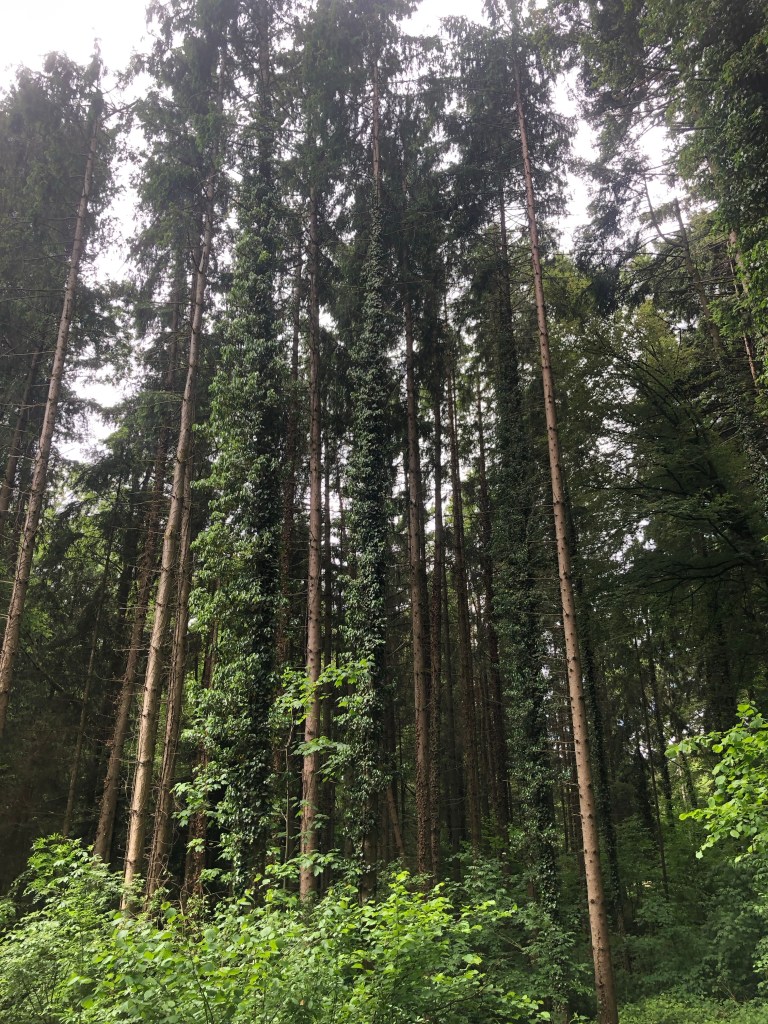
Pine forest
This afternoon I ran into the two Norwegians who I saw in Konstanz. they are camping here at Rhein-Camping. Rhein-Camping in Waldshut, where I have a room tonight, is right on the river bank. The water is 51 degrees C. This will be one of the very few photos of me in this blog but since it was so cold and I went swimming, here it is..
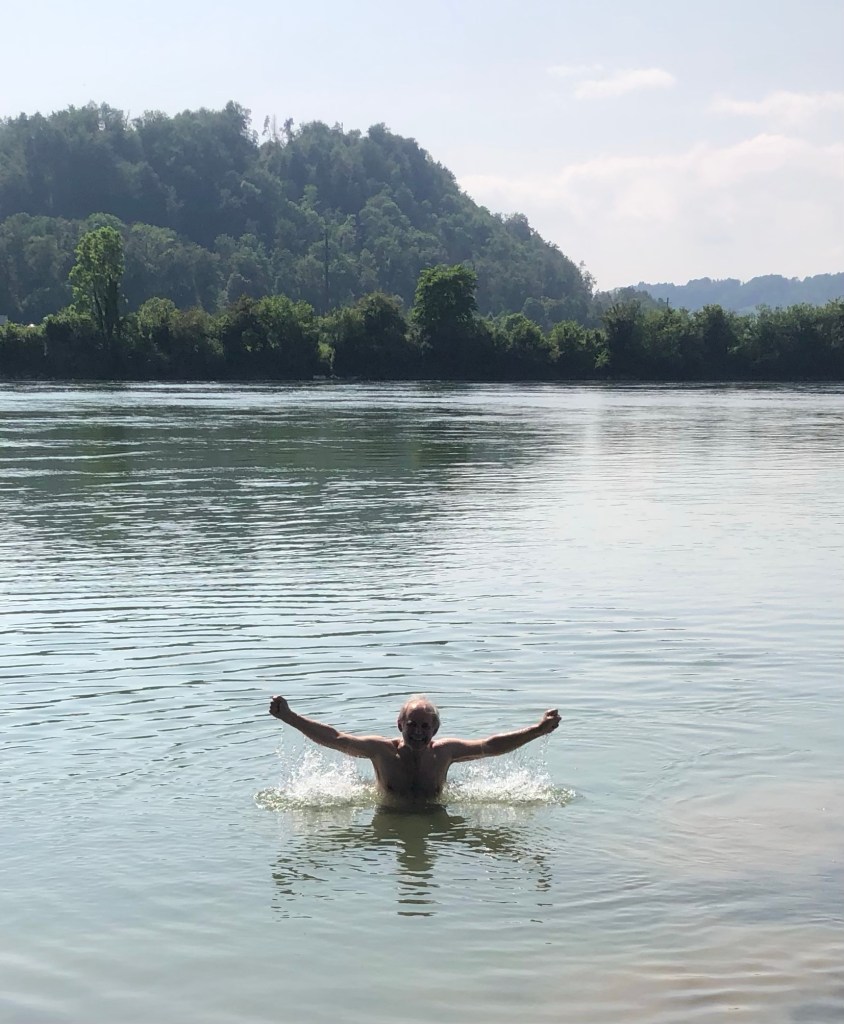
I’m in!
Signing out. Until next time…
(And RIP, Tina. You were so great, I saw you open for the Stones in 1966. I still remember when you first came on stage. A high point of my teenage hood.)
DAY 8
Every day has a label (‘snow’, ‘mountain’, ‘gorge’, ‘agriculture’ &etc). Today’s was ‘bedroom town / suburbia’ with a bit of agriculture thrown in. Picturesque, yes, very. Just not the most picturesque.
But Waldshut itself, as I left in the early morning, not so. Swans swimming happily in the eddies, evidence of overly ambitious beavers at work on an enormous tree on the riverbank…a bucolic scene.
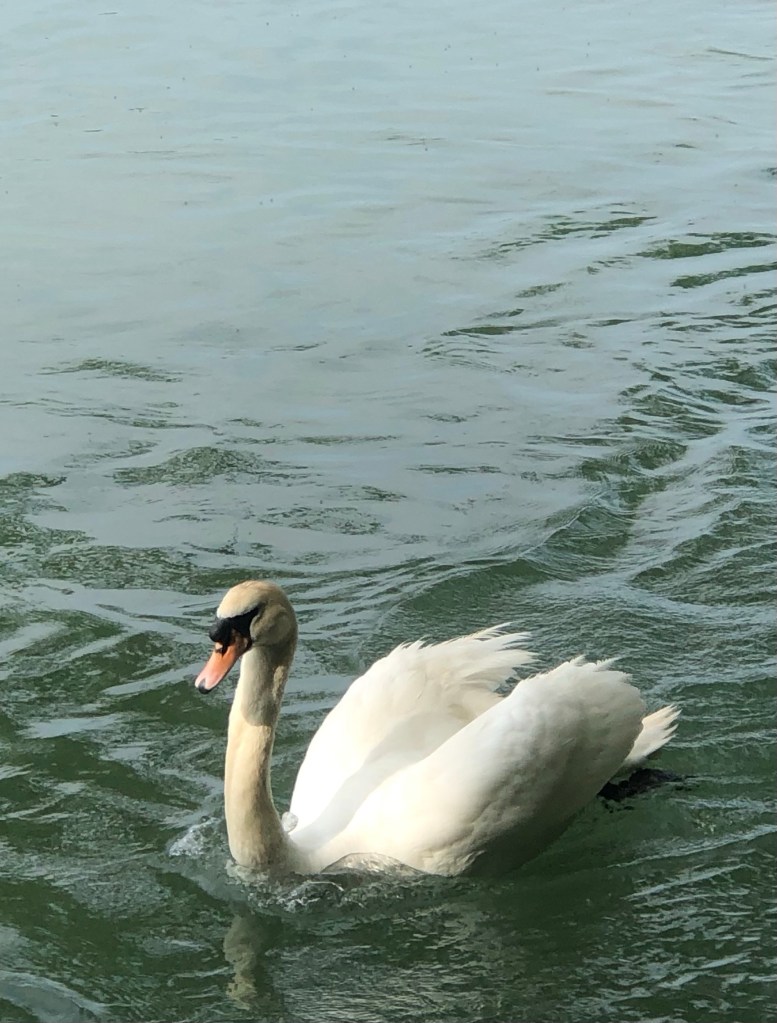
Swimming in a 3 kt. current
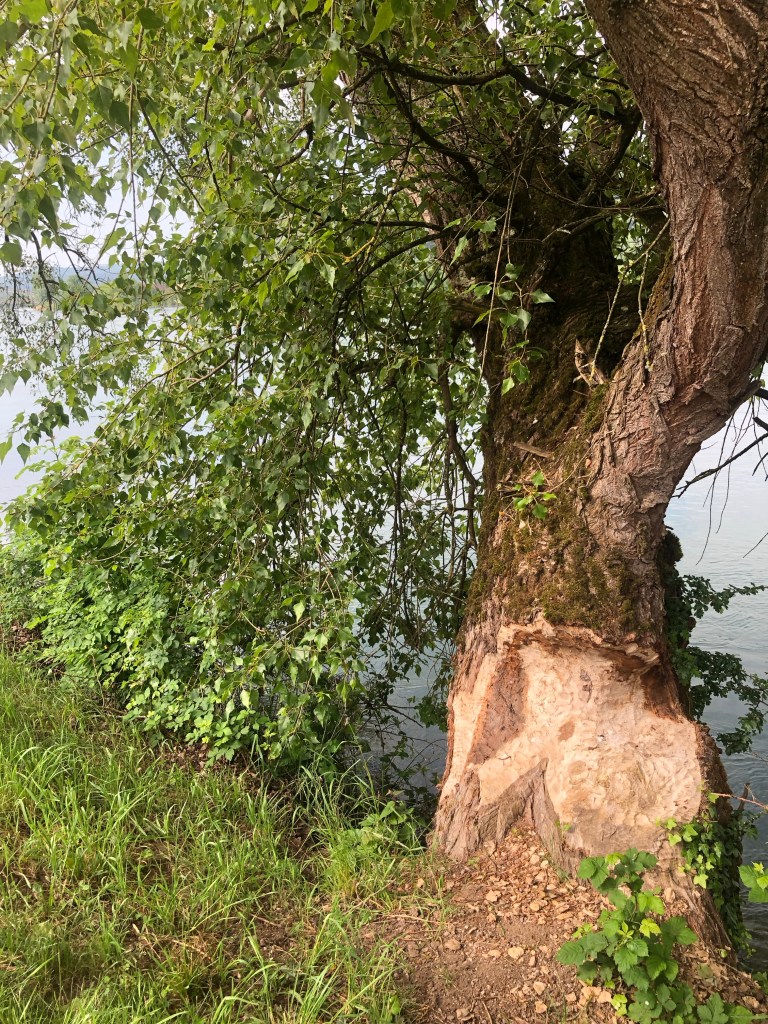
Ambitious Beavers, whew!
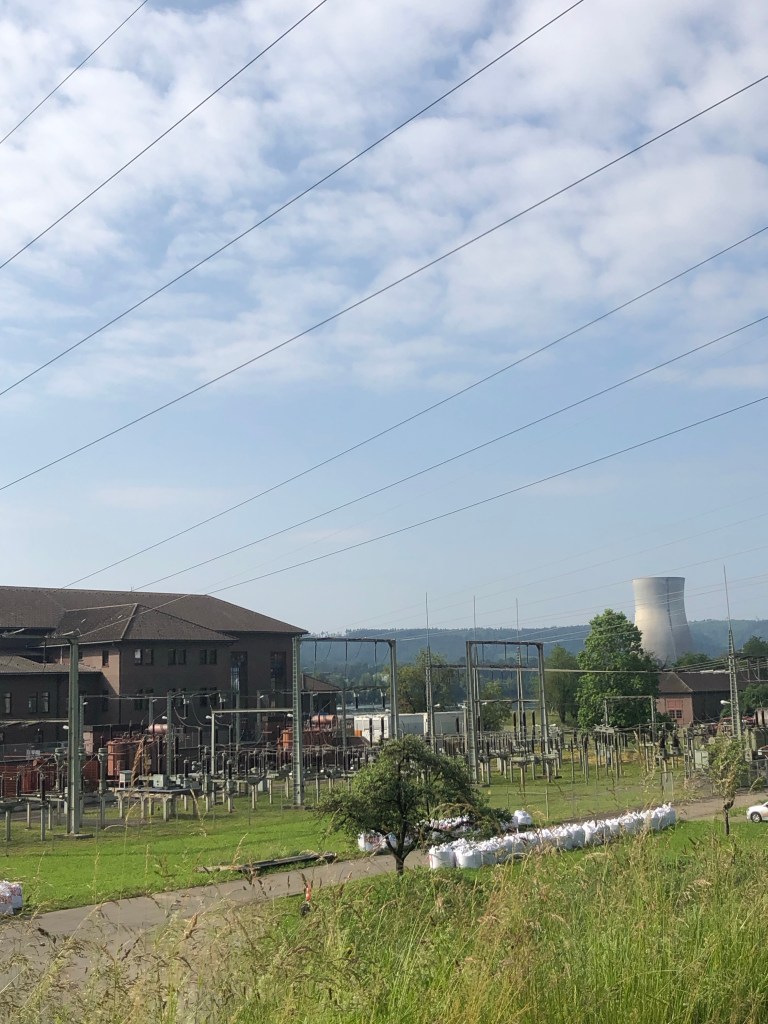
Rounding the bend though, is that a tidy looking nuclear power plant I see tucked away midst all this idyllic countryside? Yes!
I’ve passed many very large patches of stinging nettles over the past few days. But no Dock leaves. In Britain, invariably when you see nettles growing wild, you’ll find antidotal Dock leaves nearby, almost guaranteed. Here, none. Just nettles. Until today. I found the elusive Dock plant.
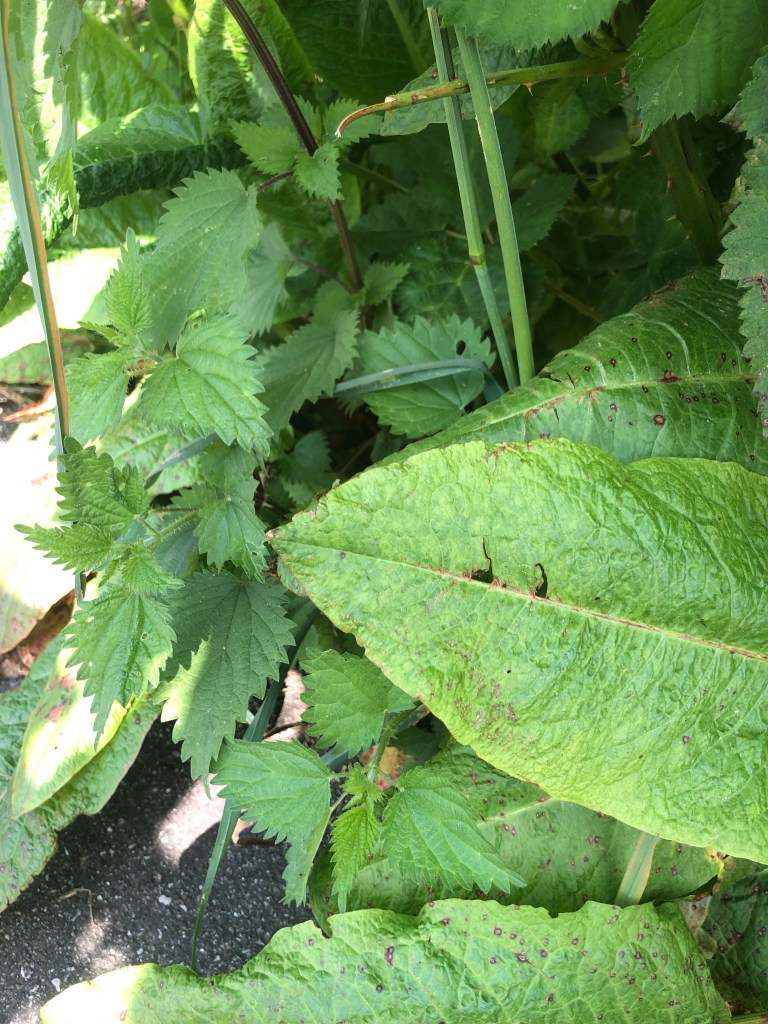
Nettles & Docks, Old Companions.
Made a couple of new friends today, Stella and Blue, both miniature Shetlands which their owner was taking for a walk like two huge dogs.
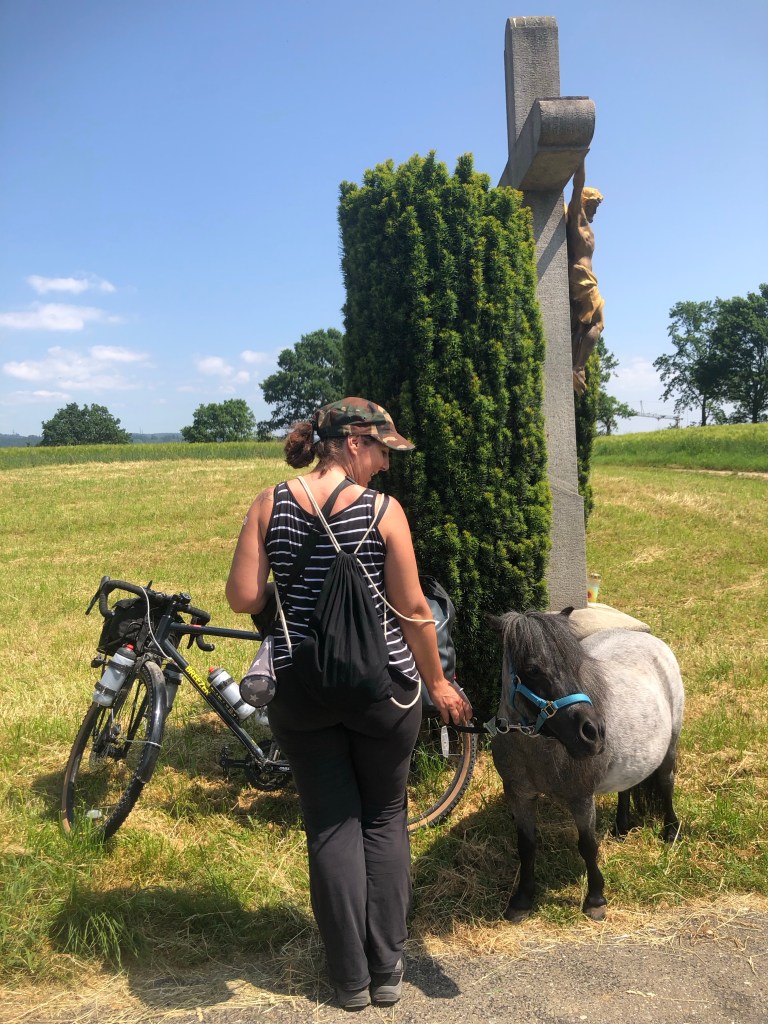
Friendly Miniature Shetland, ‘Blue’
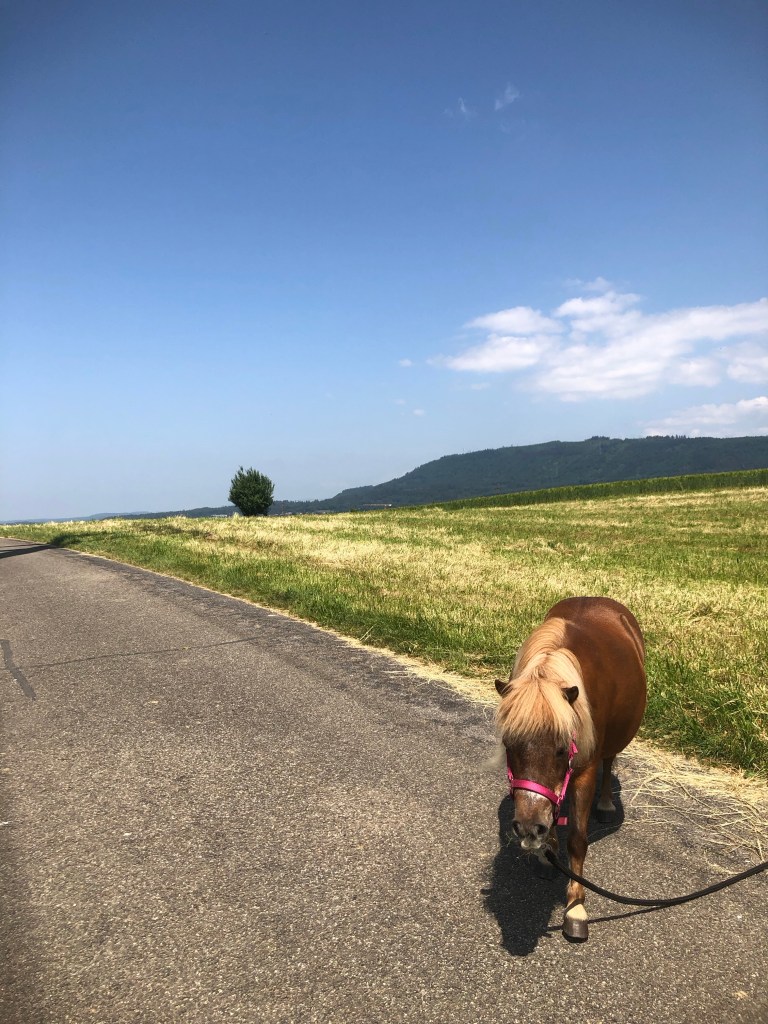
Stella
Speaking of friends, anyone reading who has done a similar kind of travel to this journey, gets it that ‘friends’ can mean simply those that you meet along the way, someone who might get you out of a tough spot, someone you find you have a connection to…someone you ‘click’ with. I have connected with so many people on this ride, it’s hard to imagine. Josh Boger, founder and former CEO of Vertex Pharmaceuticals was fond of quoting the African proverb, ‘If you want to go fast, go alone. If you want to go far, go with friends.’ I’m certainly going far on this ride. And the many people I’ve connected with have enriched the ride for me so very much.
An example…this morning at breakfast I met a cycling couple heading for St. Moritz, I believe. It turned out that, as well as a avid long distance cyclist, he is a retired physical chemist (that’s essentially a physicist who works with chemicals) who had worked at Novartis. We immediately had a lot to talk about and would have talked more except I was eager to get going. But I did mention my thoughts I’ve talked about here in an earlier post – anaerobic muscle fiber types in the top muscles of the leg and more oxidative in the larger muscles in the underside. He said he had been thinking exactly the same thing and, yes, that was almost certainly the case. Voila! They were happy for me to pass on the link to this blog, as have been quite a few others.
To reiterate, E-bikes are definitely the way it’s going. bike stores are becoming E-bike stores…
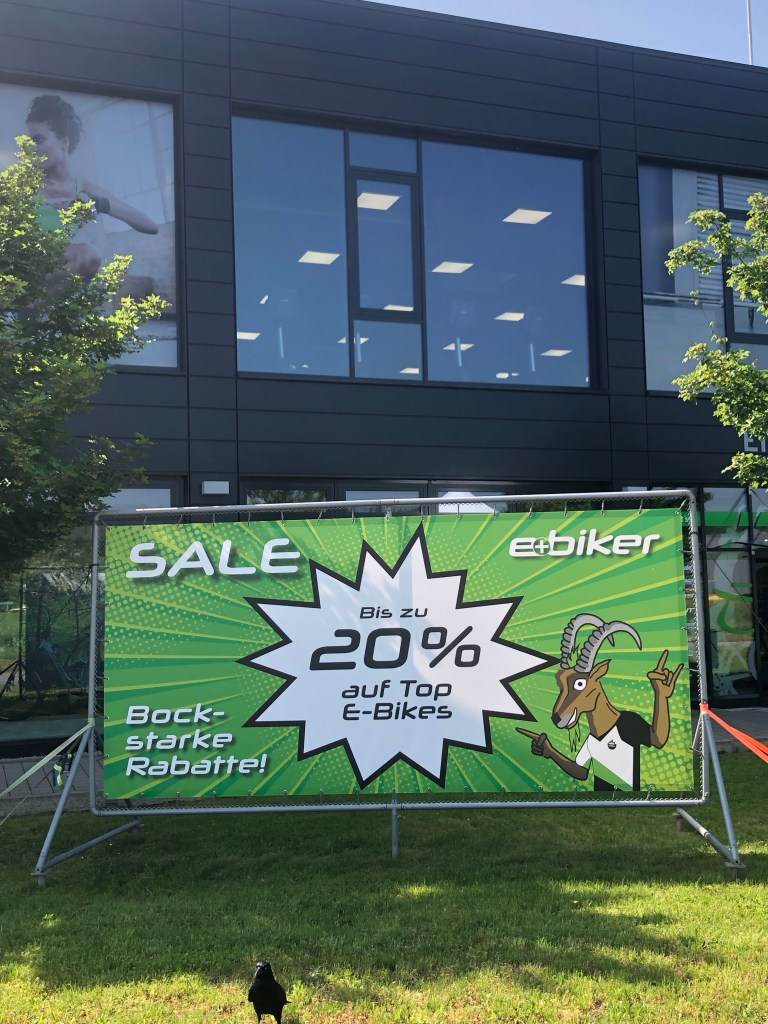
All they sell here are E-Bikes
I ended the day in Rheinfelden where Chris and I have been before. Rheinfelden is quite well known for its restorative waters and for Sole Uno, a state of the art ‘water park’, which doesn’t begin to describe it. A large spa facility with 20 or so water themed stations…heat, cold, streams of rushing / bubbling water, numerous kinds of saunas and steam rooms. Restorative and more. Worth a visit.
That’s it for today’s post, more later…
DAYS 9 AND 10
Left my bunker-like building (surprisingly top notch accommodation) in Rheinfelden for a halfday ride to Basel where I’ll have another night with the Basel Joneses. This morning I’ll be on the German side of the river.
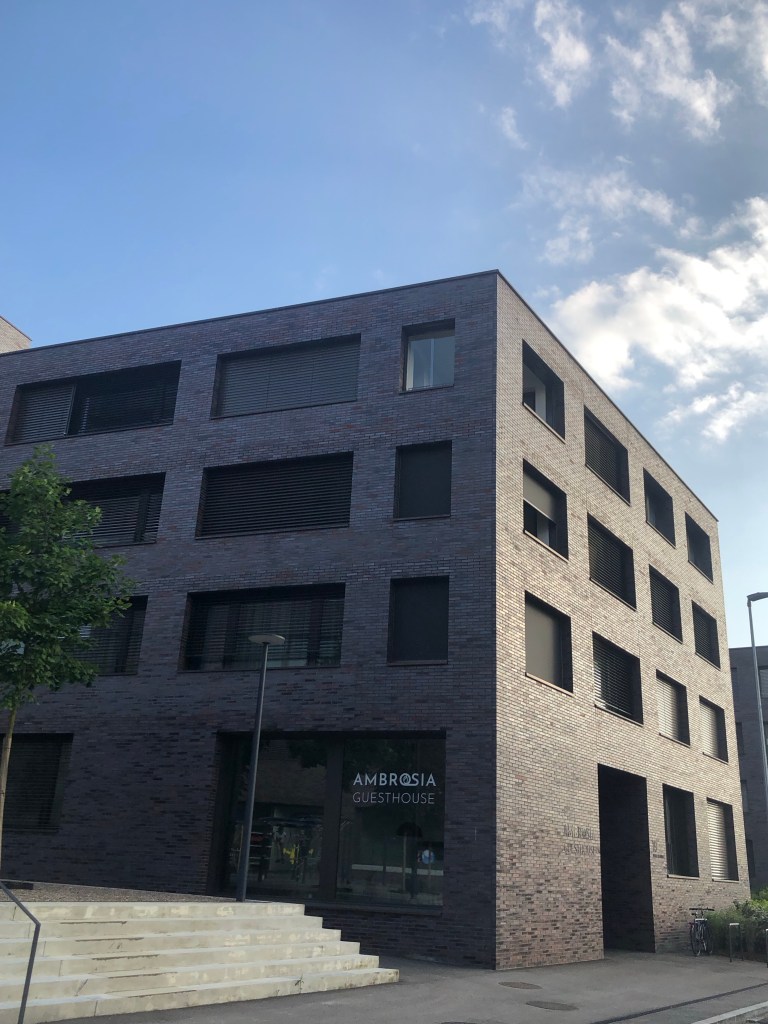
Bunker Mentality for one night
Some frustration occasionally when roadworks block the cycleway…where were you, Komoot Assistant??
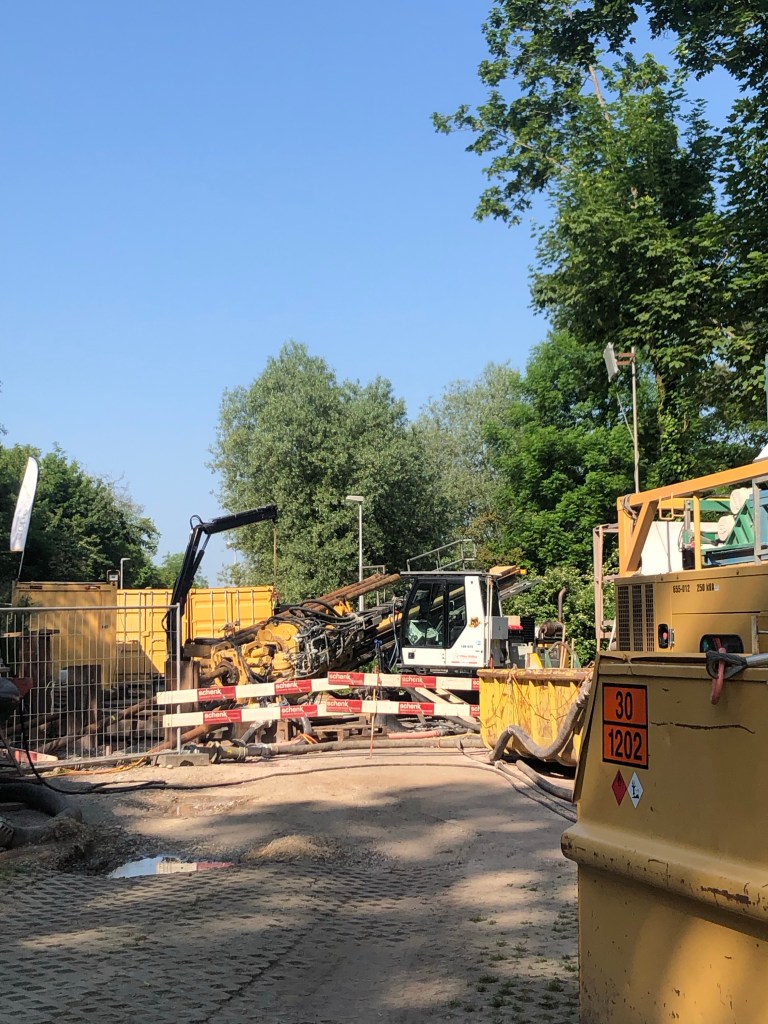
End of the road.
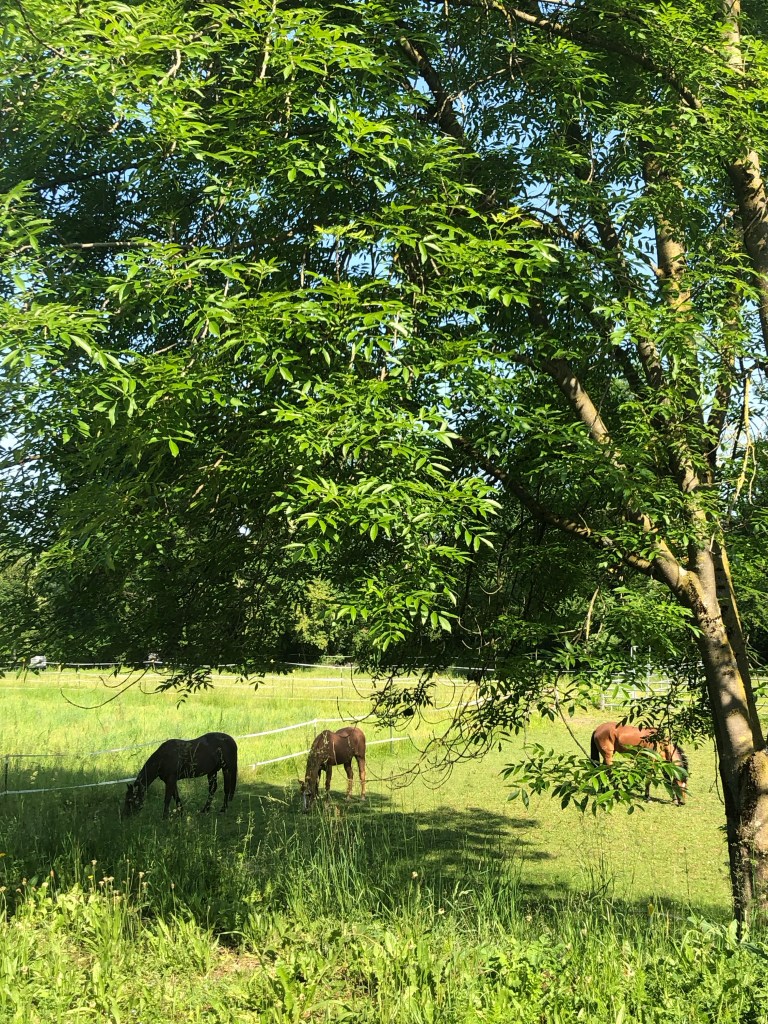
…but then into pastoral, Guy de Maupassant-like countryside.
And before long to the outskirts of Basel, dominated by the towering white, statement-landmarks of Roche Global Headquarters.
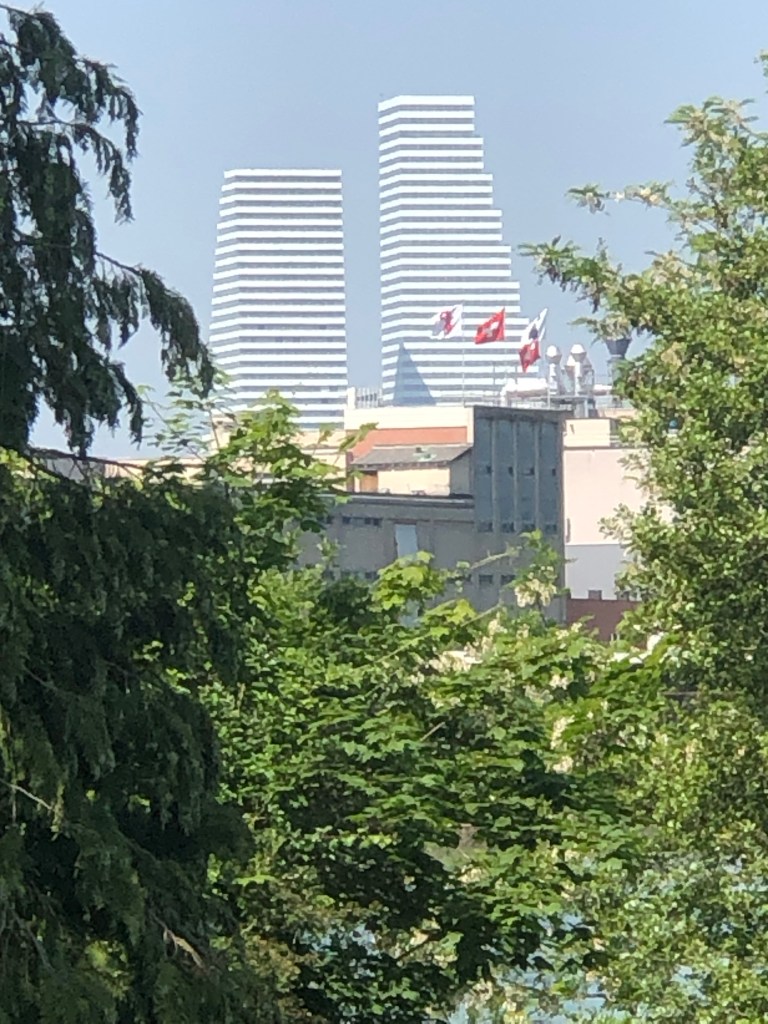
William Blake’s ‘Dark satanic mills’ they’re not.
Long before then, I knew I was getting close to Basel when I started seeing buildings of companies familiar to me like Thermo-Fisher and BASF and other supply chain companies for end-users like Roche and Novartis which is also headquartered here.
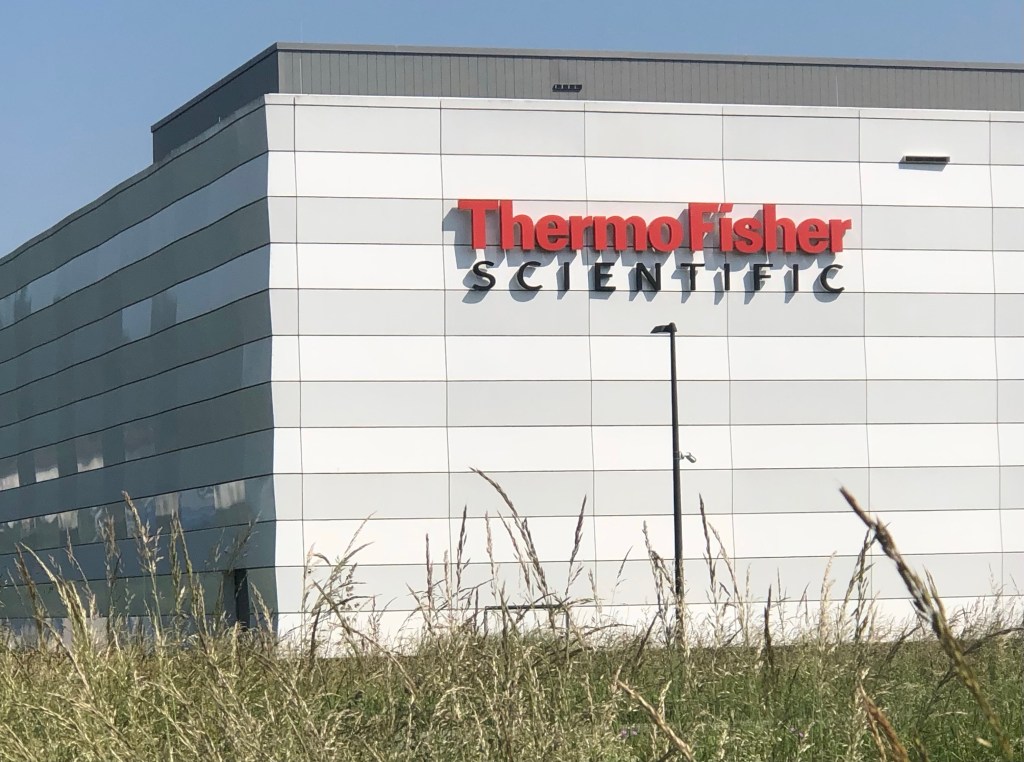
One of many pharma services companies in Basel
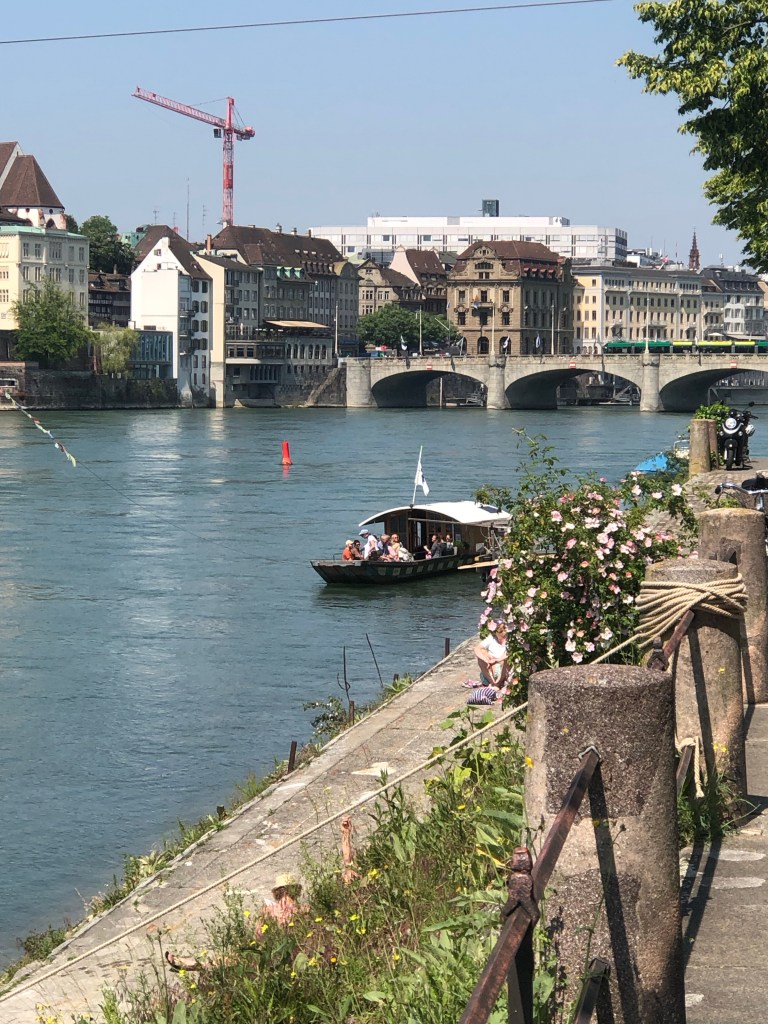
Nirvana – the Riverbank at Basel. It was just about here, almost exactly one year ago, where I first had an idea to do this ride.
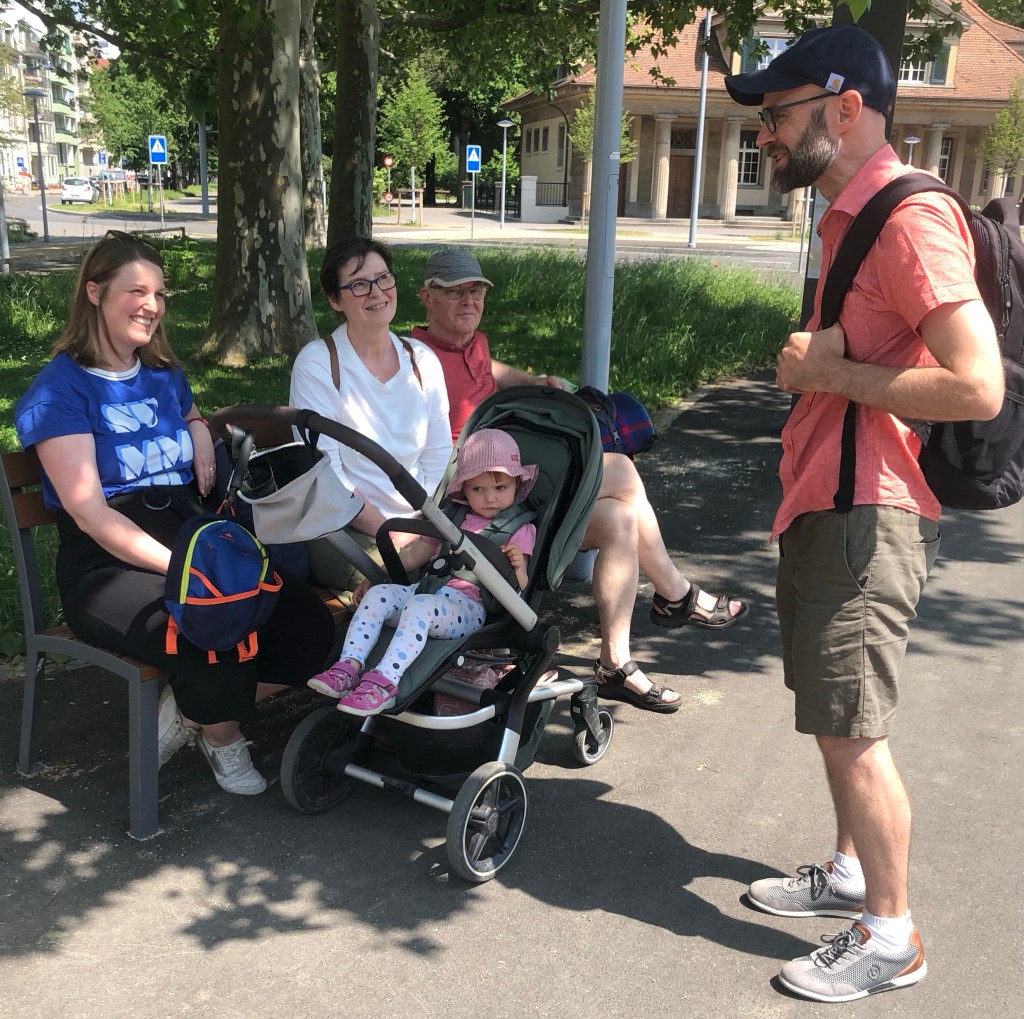
With the Gutsches and the Joneses. For some reason this photo brings to mind the line ‘The Hendersons will all be there’ from Paul McCartney’s ‘For the Benefit of Mister Kite’ track on the Sgt. Pepper album.
And now I begin the tenth day of the ride. To Neuf-Brisach on the west side of the Rhine. Neuf-Brisach is a garrison town, see more about the town later in this post. Built in the 1600s as one of the fortified towns along the Rhine in Alsace, the town was probably here many centuries before that, even as early as Roman times – built to keep out waves of oppressors, Saxons, Visigoths, etc attacking from the east.
The cycleway passes over the Rhine into France leaving behind the orderliness of Switzerland and the order of Germany.
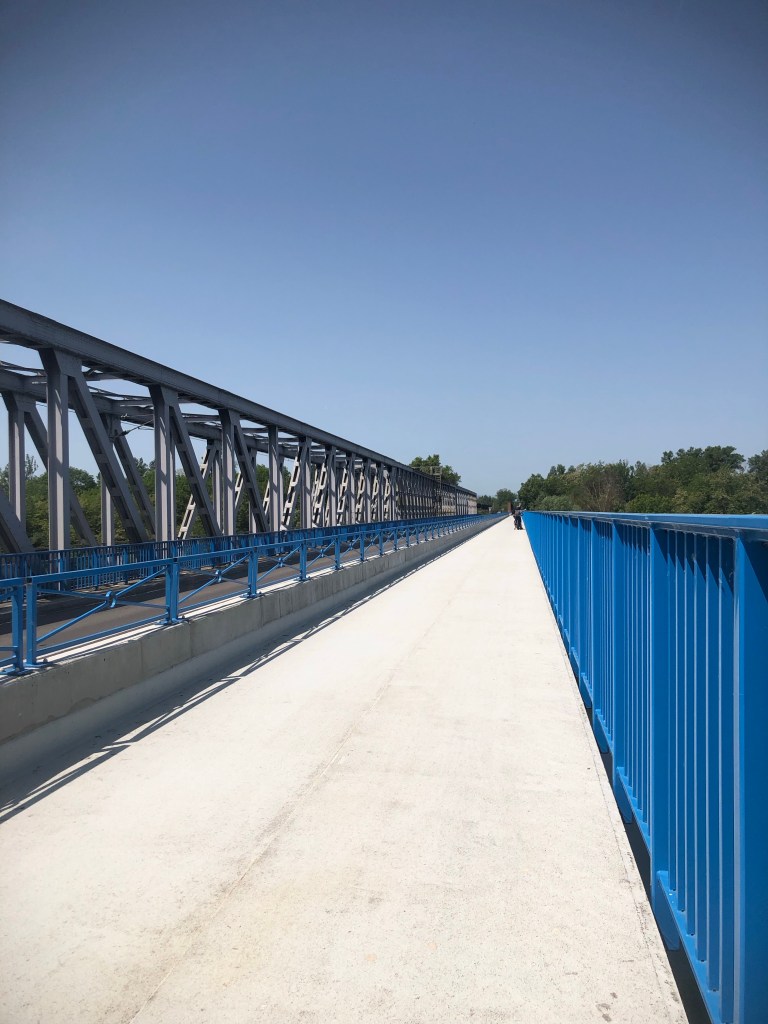
Saxon to Gaul
The farms in Alsace do not look as prosperous here. The soil is poorer, more stony and even more clayey. I see corn for the first time and potatoes for the first time, suggesting poorer soils. Irrigation gantries tower over the fields supported on sets of wheels that run up and down the fields spraying water and perhaps fertilizer. I dodge one as it sprays over the path. It smells…hmmm not too good.
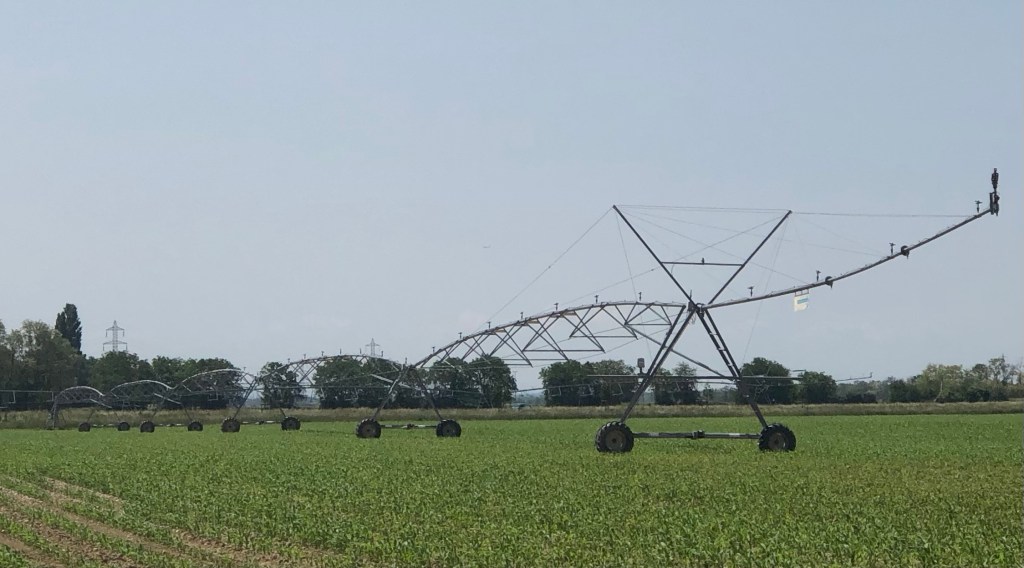
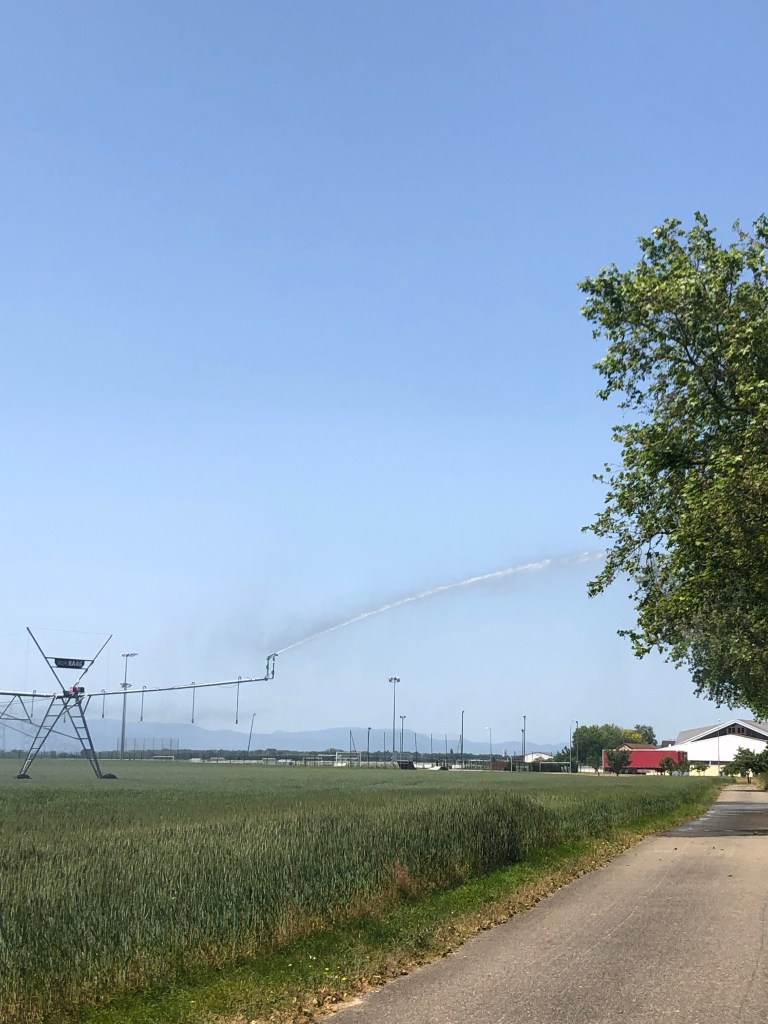
Spraying gantries.
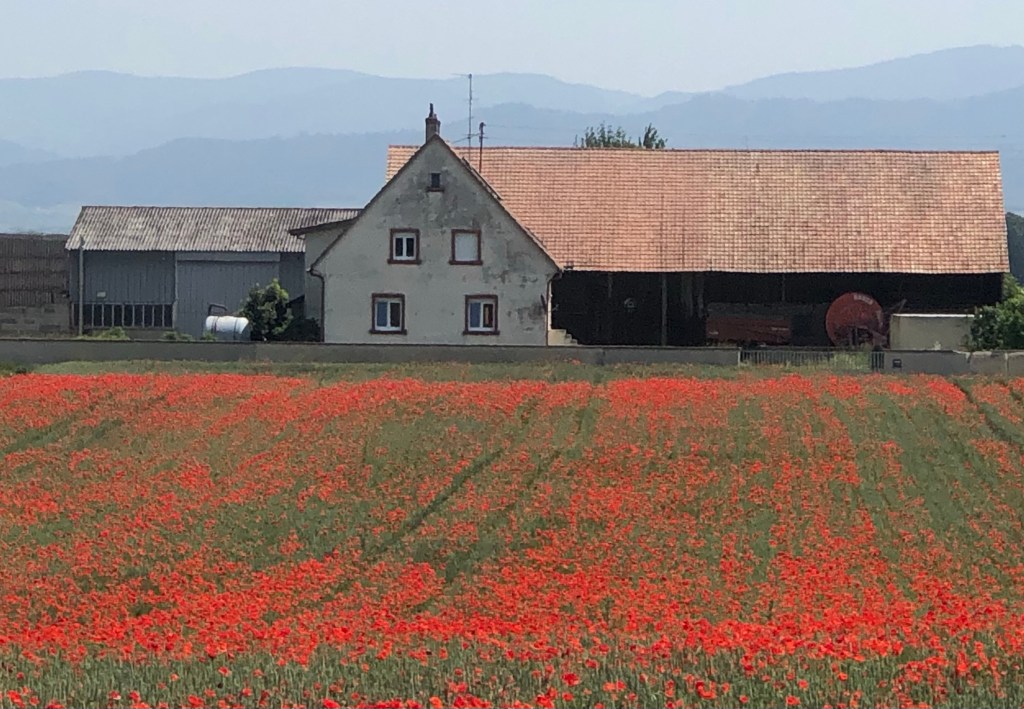
Poppy Field.
I’ve been giving some thought today to the rhythmicity of cycling. Long-distance walking, kayaking, sailing, they all have a meditative, contemplative quality. On this kind of ride your cycling cadence, or pedaling rate, approximates the resting heart rate of the average human. Which might have something to do with the meditative effect that long distance cycling has. What’s even more intriguing to me is that thoughts, dynamic free flowing stream of consciousness thoughts, can flow as of their own accord in a way unlike I’ve experienced. Akin to dreaming. Yet you are very much awake. And hyper alert. Sensitivity is heightened as scenes fly by on either side. We are evolutionarily designed to be in the outdoors and exposure to the outdoors at the speed of a galloping horse seems to heighten the sense of perception. Evolutionarily, that would make perfect sense, in the wild you would need to keep your wits about you to survive. It seems to me to be beyond meditative. I’m sure I am not the first to experience this sensation and to write about it.
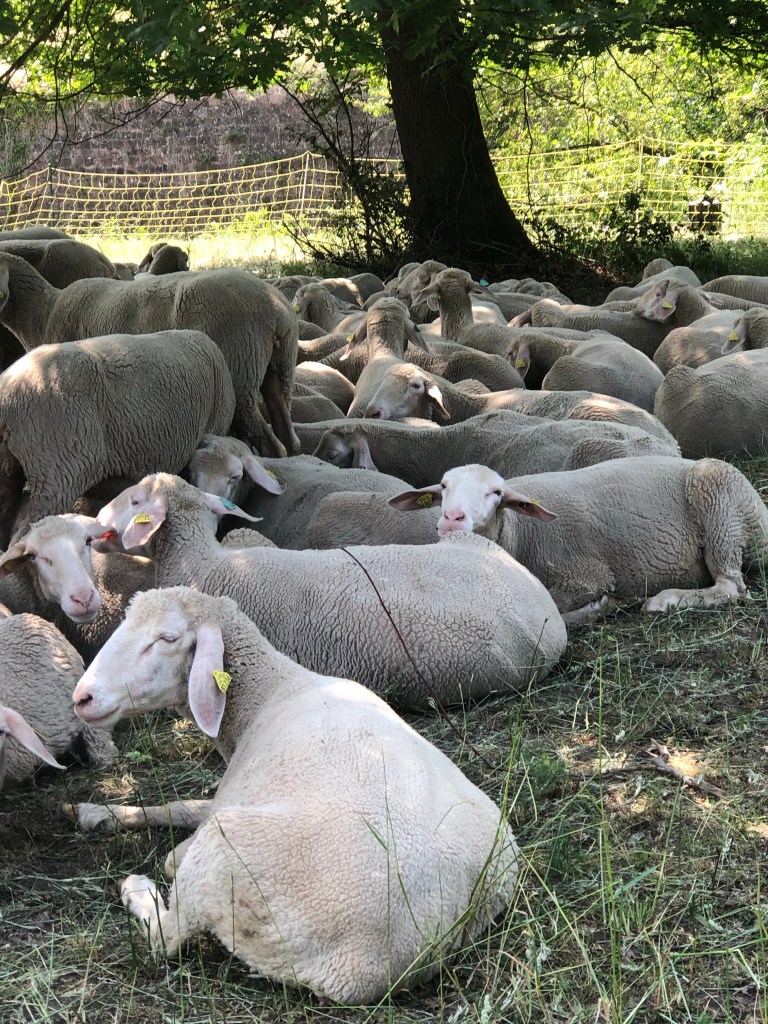
Sleepy, Warm-afternoon Sheep
While taking this photo of the sheep, I fell into conversation with Laura – and her son – who is from Ohio but lives here in Neuf-Brisach now. She told me there were many stories still told today of the Occupation. I asked her to tell me one of them. She told me, and I hope it’s OK to relate this here, of a lady who lives in the town, now in her late 80s who was here as a child when the town was invaded during the War. Her family farm was requisitioned and her family and adults of the town transported away to work in a munitions factory. Since she was only 10 years old she was too young for work. ‘Go off into the woods’ they told her. So she lived like that, fending for herself, essentially living wild, for the duration of the War. And never saw her family again. She survived…to tell the story.
On that note, a bitter sweet one, I’m ending this post. More next time. Au Revoir
DAY 11
Just take a look at the Googlemap view of the fortified town of Neuf-Brisach which I talked about in the last post. Fortified or what? It even has a moat around it.
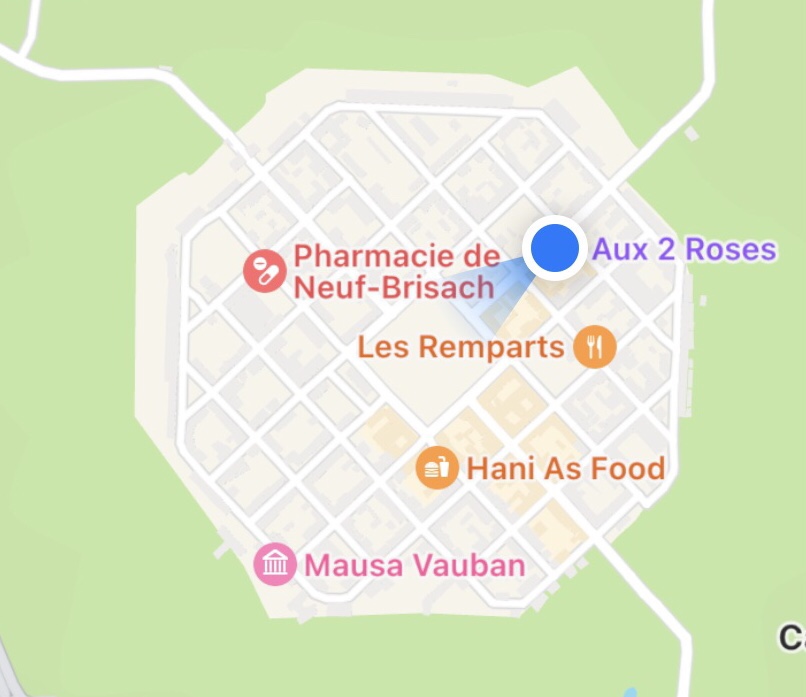
I leave the town alone, down a stony path through woods along a canal which connects the Rhine and the Rhone rivers.
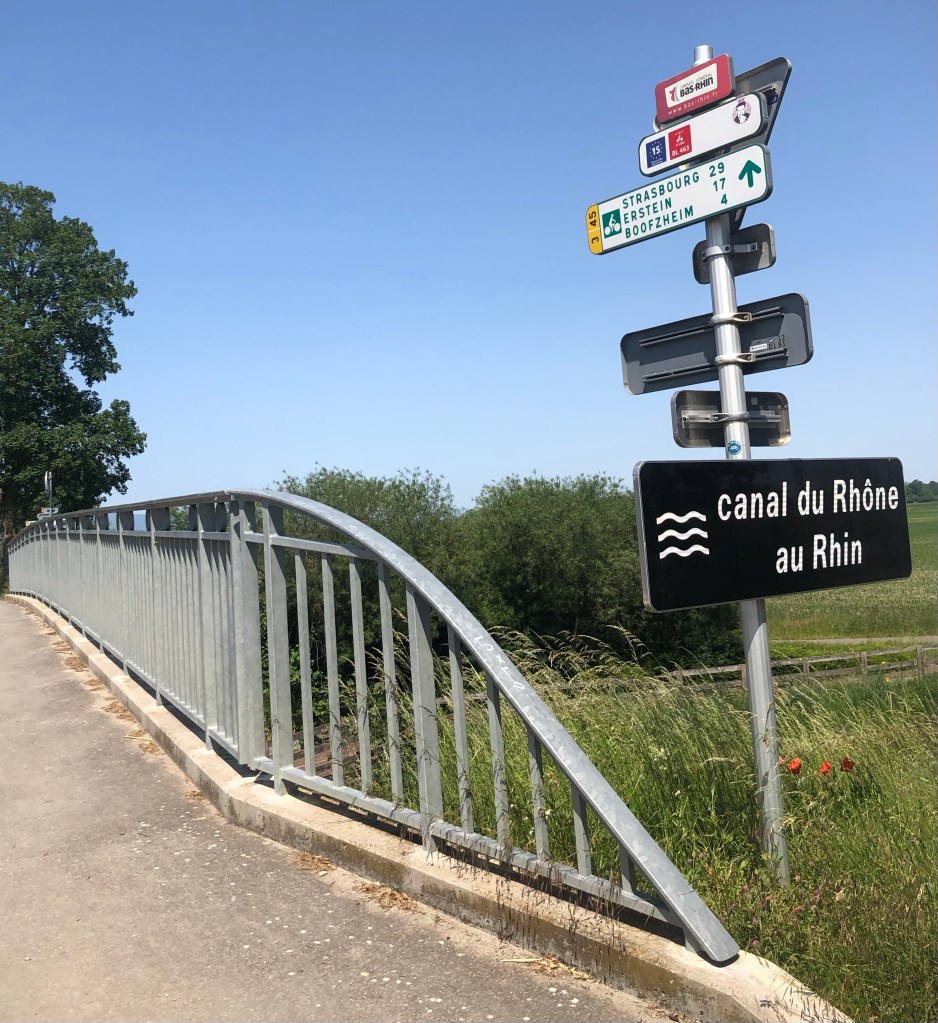
The Joining of the Two Rivers
Evidence of the fact that Alsace has been a much fought-over region for centuries, if not millennia, are everywhere. For many miles north of here there is a string of fortified towns, and remains of bunkers, lookout posts are all along the cycleway. I’m very much aware of the fact that I am cycling where armies marched, battles took place, soldiers and civilians died, where boundaries were shifted – this was French, then German, then French, then German and finally French. Basically, the region has been brutalized over and over. Paul Simon’s Graceland, ‘I am following the river down the highway through the cradle of the Civil War’ comes to mind. You can feel it here.
Not so many photos today, I’m relying on audio. Birdsong in the early morning…bullfrogs croaking.
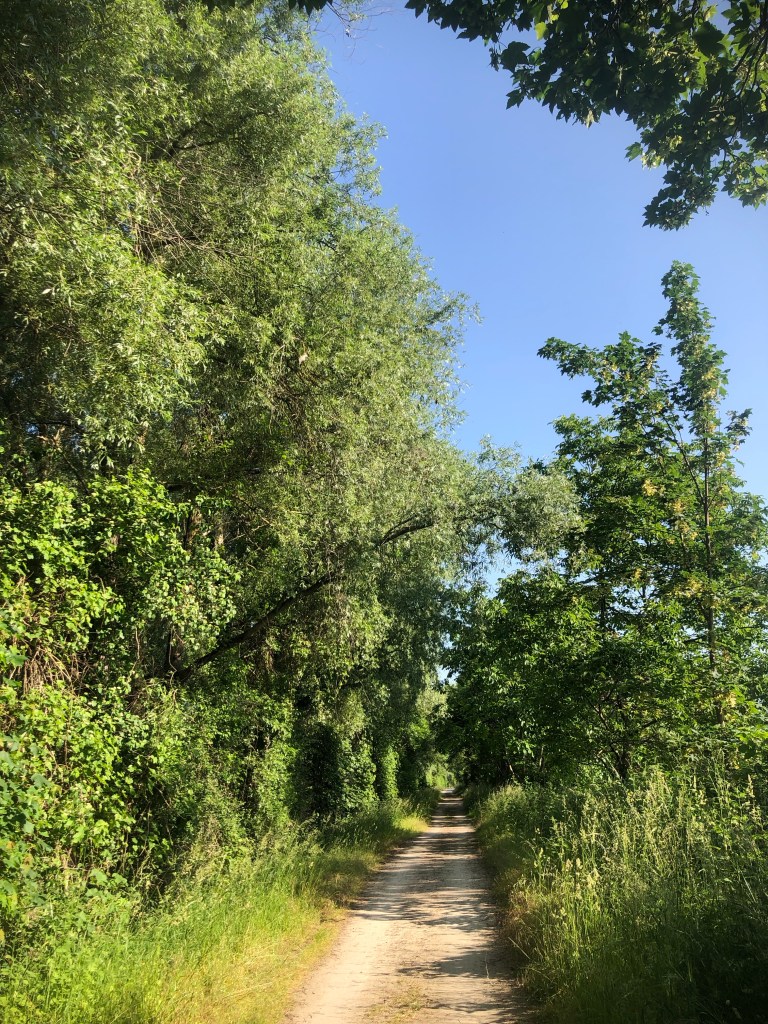
Stony Path Through Woods
I’m seeing more touring cyclists like me. At the hotel this morning at breakfast there were mostly touring cyclists. One couple from Vancouver are taking 6 weeks to do this ride, another couple from Strasburg also started from Oberalppass – one told me he tried to hike up to the small lake behind the hotel where the small stream exits to become the Rhine, but he gave up because the snow was thigh-deep. The Vancouver couple, experienced cyclists, have done many of the Eurovelo rides, later in the day, when pedaling, I hear coming up behind me ‘Hey Peter from Boston!’ It’s the Vancouver couple.
So this is a ‘canal day’. Canal locks , raising water level up and down again, every 5km or so, most with a cottage where the lock-man / lock-woman (should I say lock-person now?) lives or lived, perhaps now the cottage becomes a cafe.
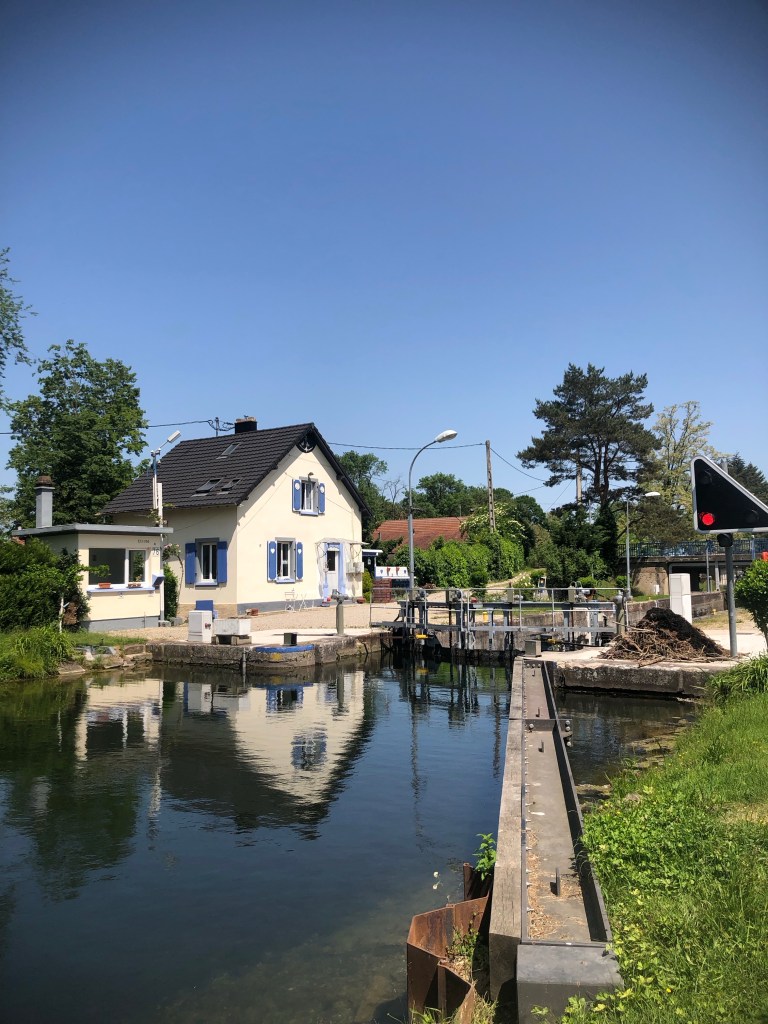
Lock with Cafe
Words I’ve used to describe this ride in earlier posts – bucolic, pastoral, timeless apply here. Sometimes it seems as though I’m pedaling through one enormous garden, now in late Spring, filled with flowers of all colors on both sides of the cycleway and next to the water, birds swooping and calling, insects buzzing, the bullfrogs. Monet would have painted here.
I’ve settled into something of a routine now, 75 km or so a day – from our conversations this morning, some do 50 km a day, some 100. I’m somewhere in the middle. 6 hours a day or thereabouts, speed around 12 mph or more depending on the surface. I stop for coffee mid morning and pretty much cycle through the rest of the day without a lunch. Just water and perhaps banana and apple, occasionally cucumber and tomato. Then a pretty major meal in the evening.
I saw a man walking towards me who looked as though he was a pelegrino (someone on a pilgrimage to a holy place) on his way to Santiago. He said, no, he was on a personal Camino, from Dunkirk to Venice. He said it would take him two and a half months!
This started me thinking about how people greet each other as they pass. It’s a singsong ‘Bonjour’ now, of course, in France, but then previously a ‘hi’ or a ‘yo’, ‘allo’ or ‘morga’ or ‘morgen. ‘Buena’ in Spain and Argentina. Then there are the hand greetings…open palm fingers up is the most common. But also thumb up, circle with thumb and forefinger, or a simple wave. All of these greetings are code for ‘friend not foe’.
That seems a little laughable today. However, right here, just 75 years ago and for decades and centuries before then, these kinds of things literally could mean the difference between life and death. The open palm, by the way, also means ‘I have no weapon’ and ‘I mean you no harm’. It’s also a sign of respect when done in a certain way. You acknowledged your land owner with a hand to the ‘forelock’. This persists in most military organizations where you salute a senior officer palm forward. I believe it was the British adventurer and acclaimed author Geoffrey Moorhouse who wrote about this.
Hah, and all the time I just thought I was just being nice!
So now it’s Strasburg, one of the largest cities on the Rhine.
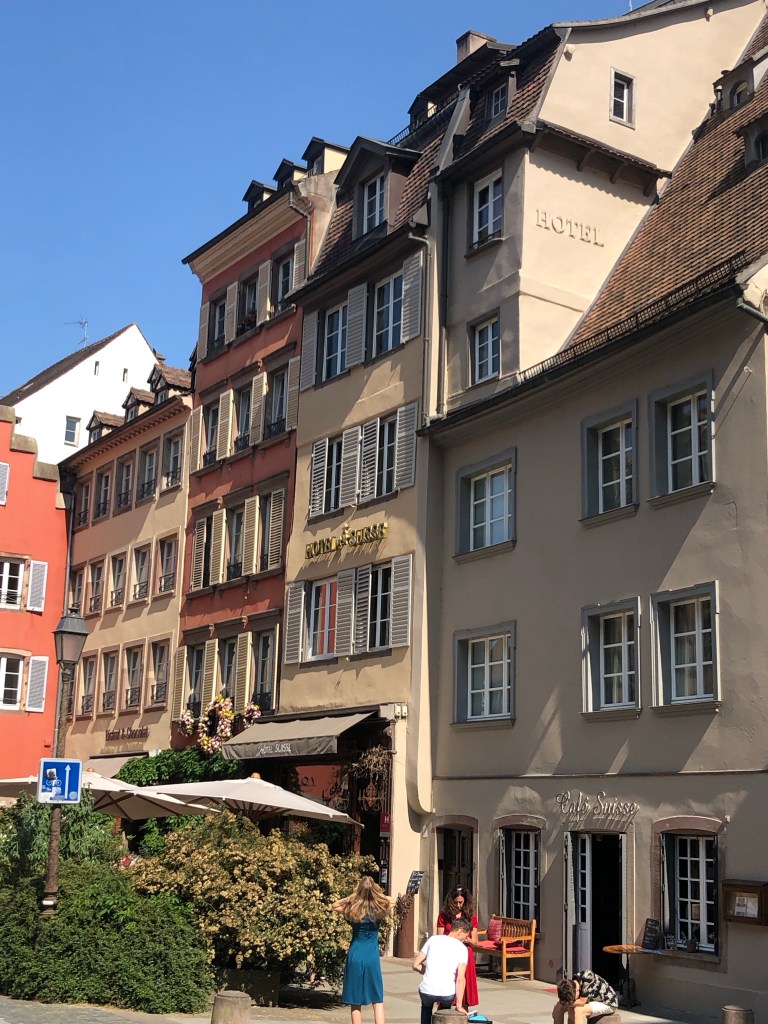
Strasburg…sort of French, sort of German.
That’s it for now. More next time.
DAY 12
This is the 12th day of cycling without a break so today I have a short day. Generally I enjoy making detailed plans (I spreadsheet everything!!) but for this trip the plan was always to take it day by day without a fixed schedule.
I’m short of a few days so I’m popping the bike on a train tomorrow morning so that I can make Cologne by the afternoon.
Well, I finished the ride for today and it’s been a mixed bag. Early morning in Strasburg was exquisite, the cycling out of the city not too bad at all and soon I was on country roads.
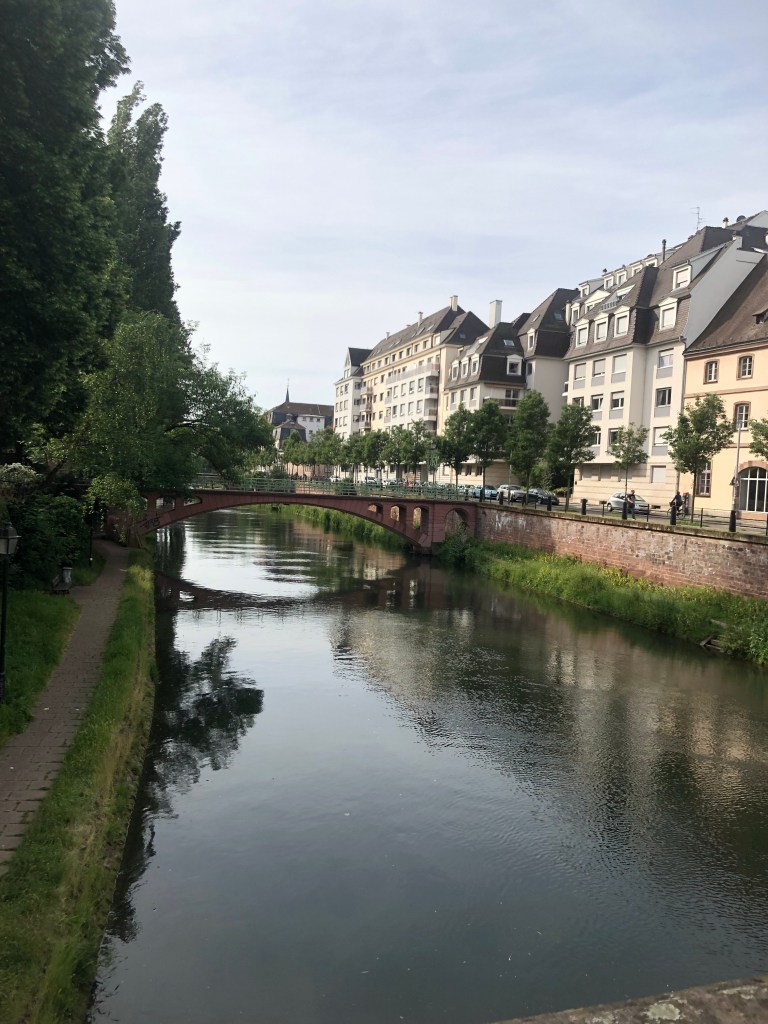
Early Morning Bridge
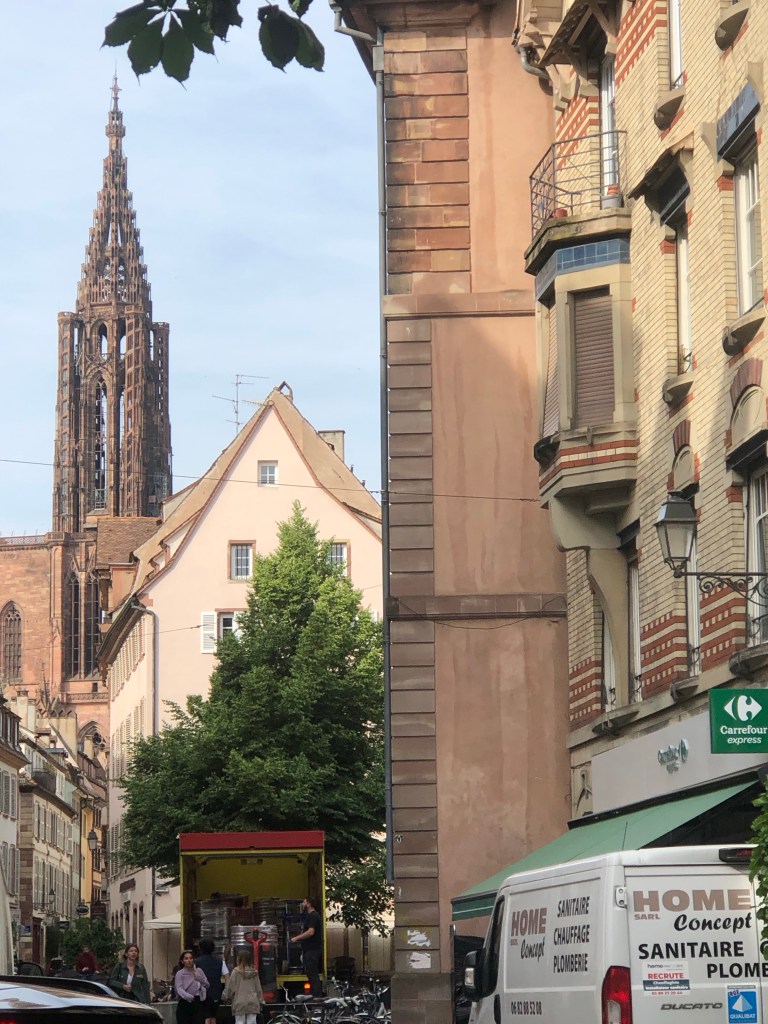
Cathedral
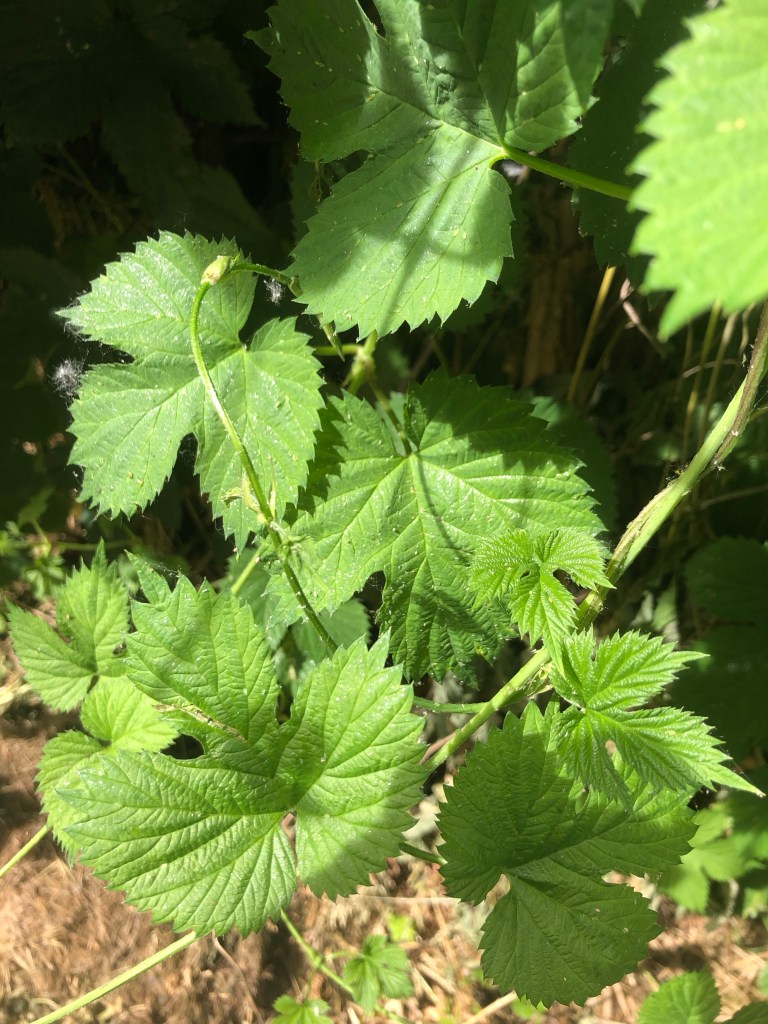
I stopped for a break and discovered the hedge at the side of the path was a mass of hops, not yet in flower…we’re in beer country.
I’m heading for a small village near Drusenheim, itself popn. only about 5000. Drusenhem has a poignant WWII history. Defended by Allied troops it was taken by the German advance then successfully stormed and retaken by American troops. At a cost. 85% of buildings were destroyed. It’s now a modern little town like the many new towns and villages in this area. Wonderful little places with well-kept, upscale houses and gardens, town centers etc. But I checked the train station today, the old building is still standing, disused now, bullet holes are still there. I hesitate to show this photo. But it serves as a reminder.
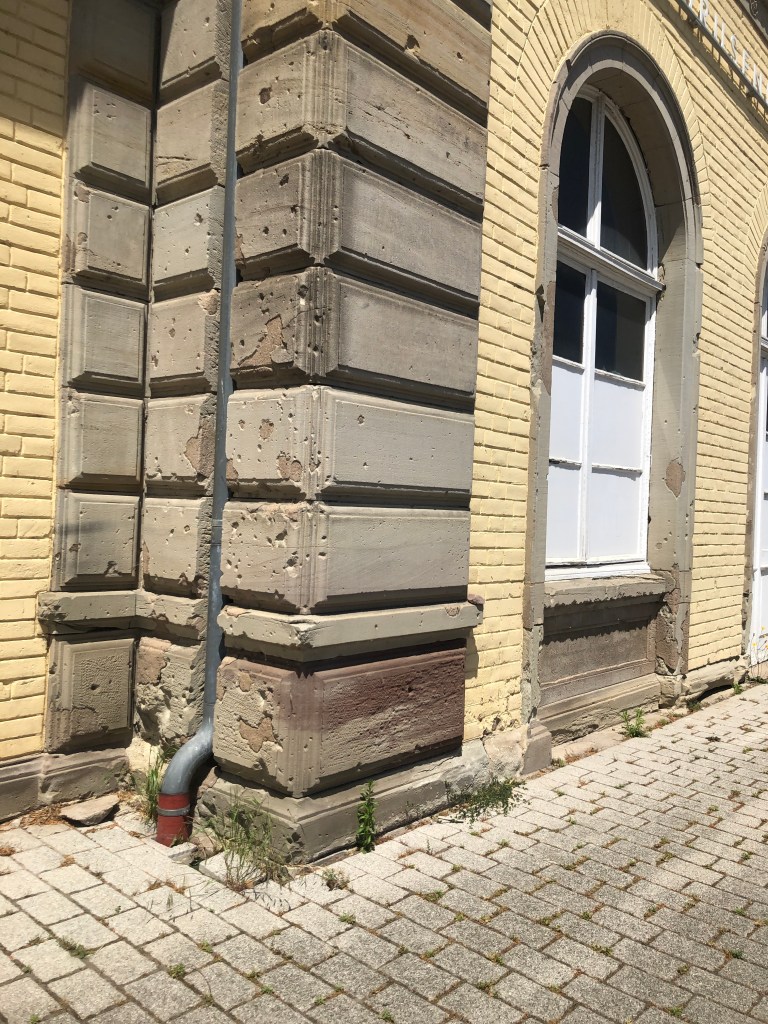
Corner of Drusenheim Railway Station
Tomorrow, assuming I make all my train connections, I will be back in Cologne with my old friend, The Rhine. Der Rhein. Le Rhin.
Au Revoir!
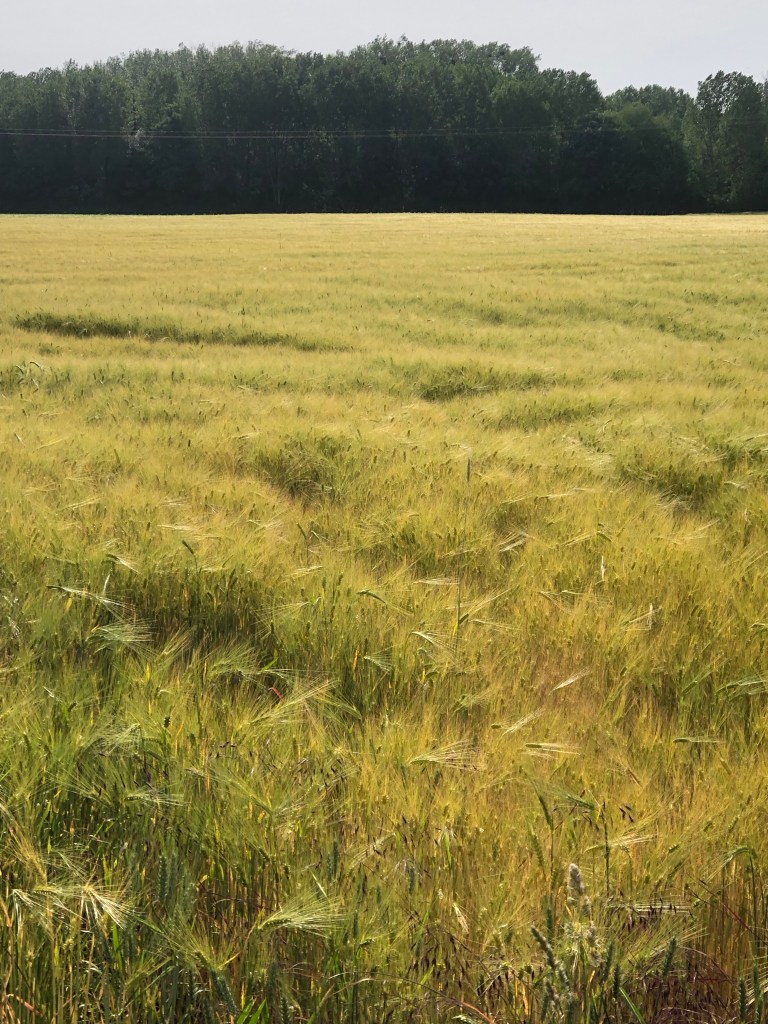
Finally, Fields of Golden Barley (Sting, where are you?)
DAY 13
The thirteenth day of cycling without a break. Change of plan, cycling today to Karlsruhe where I can pick up a train tomorrow for a straight run to Koln (thanks for the info, Axel and for the ticket, Ian)
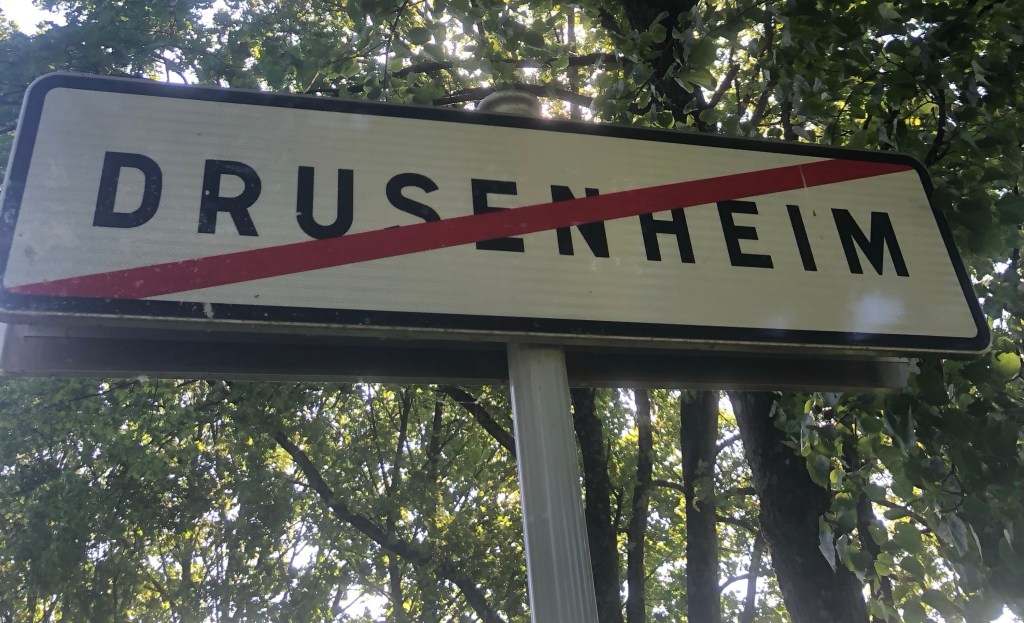
Leaving Rebuilt Drusenheim
The lady who owns the B&B where I stayed last night told me that during WWII, people left their homes for Vichy France. Many of the upscale and picture-perfect homes in these villages are owned by Swiss and Germans or by people who work in Switzerland & Germany. Wonderful that these villages have risen so perfectly from the ashes and rubble but not quite ‘To the victors, the spoils.’
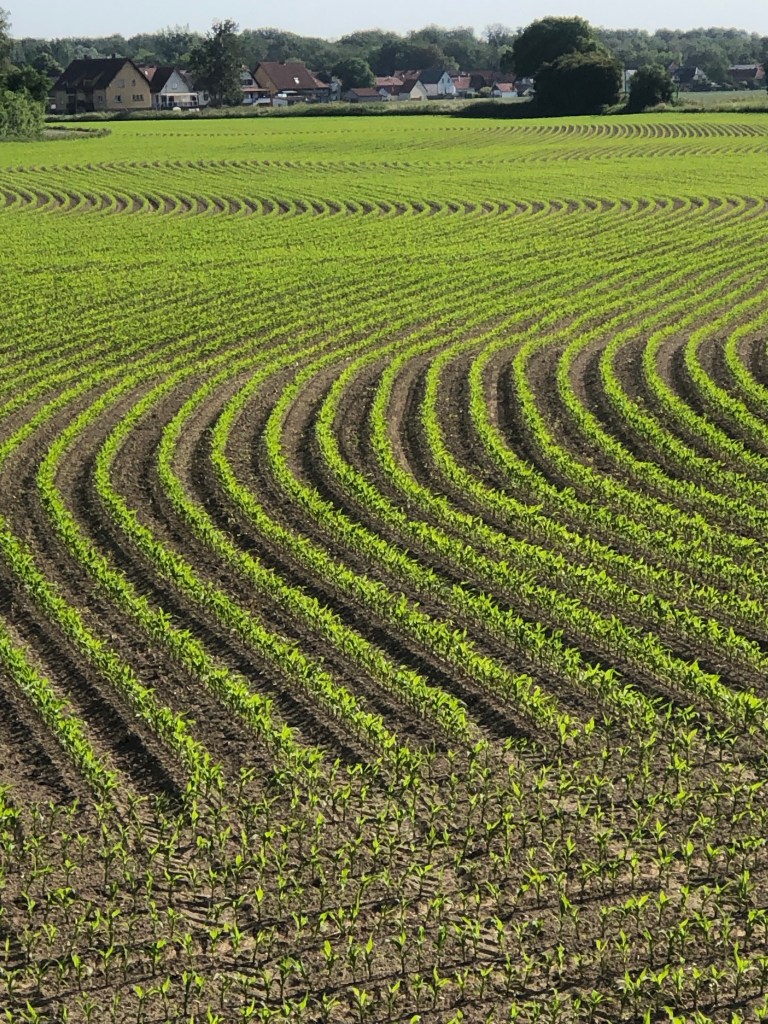
French Curves, Descartes would approve.
Here the Rhine widens to perhaps half a kilometer. We’re in a stable weather pattern. The wind picks up to around 15 knots, I’d say, from the northeast. Sky cover is close to zero. Temp. in the low 70s F. No precipitation for days now. Humidity low.
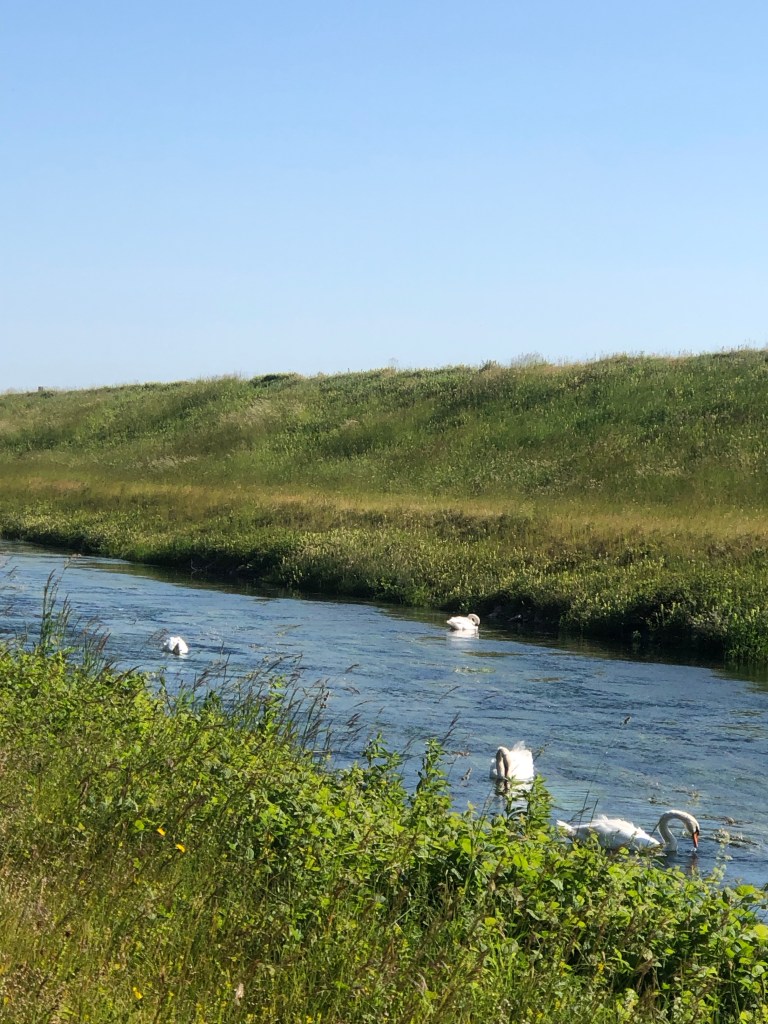
Swans swim upstream to catch a meal in the canal.
They’ve built a dyke, or a polder, to create a flowing canal on the west side of the Rhine. This is used to service various sand and gravel operations that feature here. Water from the Rhine, sand from the banks. This was once an enormous inland sea. Now one enormous miles-long sandbank.
Sand for the eroding beaches of Barcelona and southern Spain. Sand for the glass towers of Berlin. Sand for the concrete we all need, like it or not. I can actually see a glass making operation right here on the riverbank.
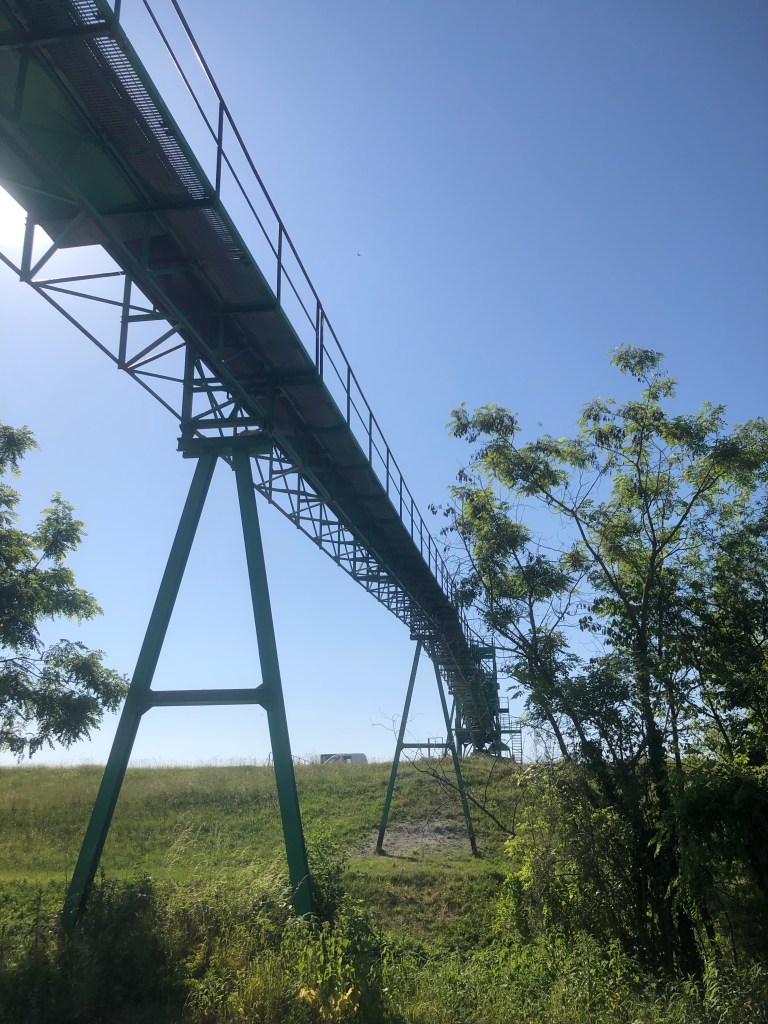
Runways for Moving Sand
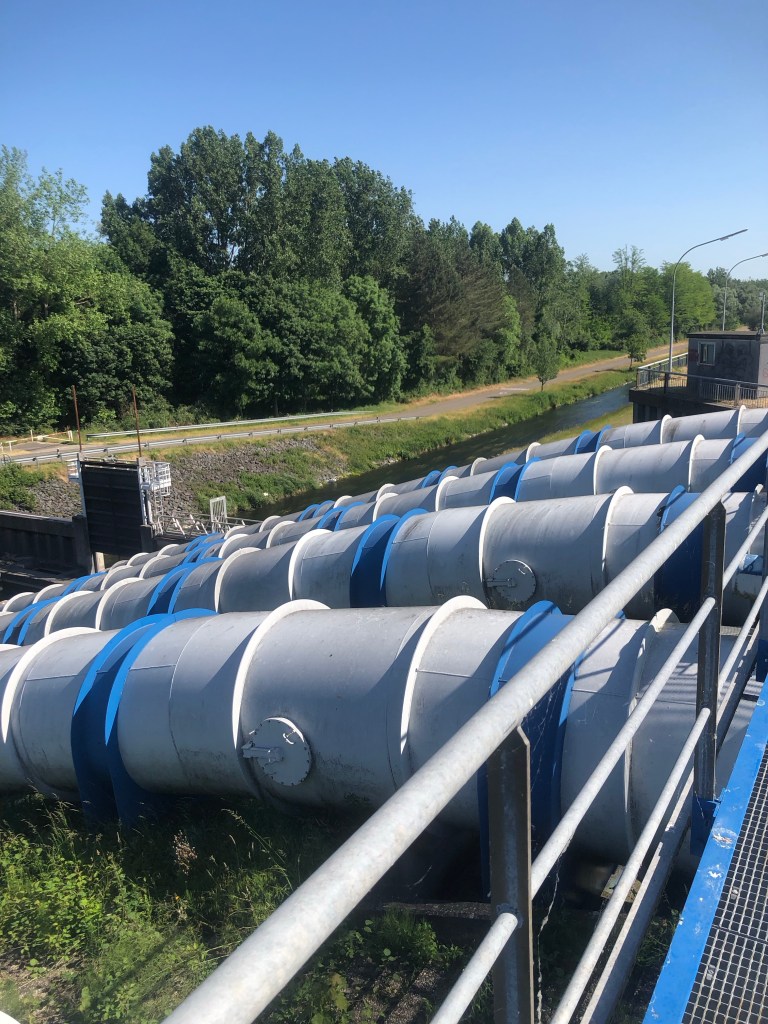
Industrial-scale quantities of water are pumped from the river for sandworks.
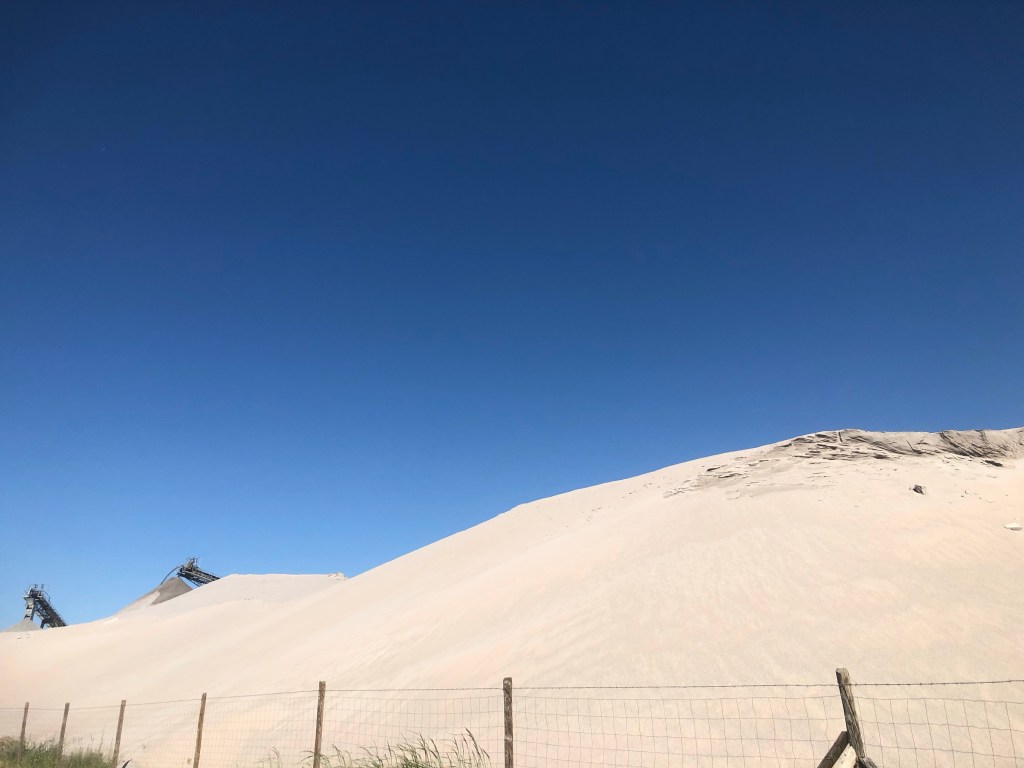
Sand for Spanish Beaches?
I run into Mike and Rose and their daughter, Hazel, 4 years-old. They too are cycling from the Alps to Amsterdam. They are taking 5 weeks. Hazel rides on an extra seat on Mike’s crossbar or she rides her bike. Which is quite amazing, she is only four!! We ride together for a time.
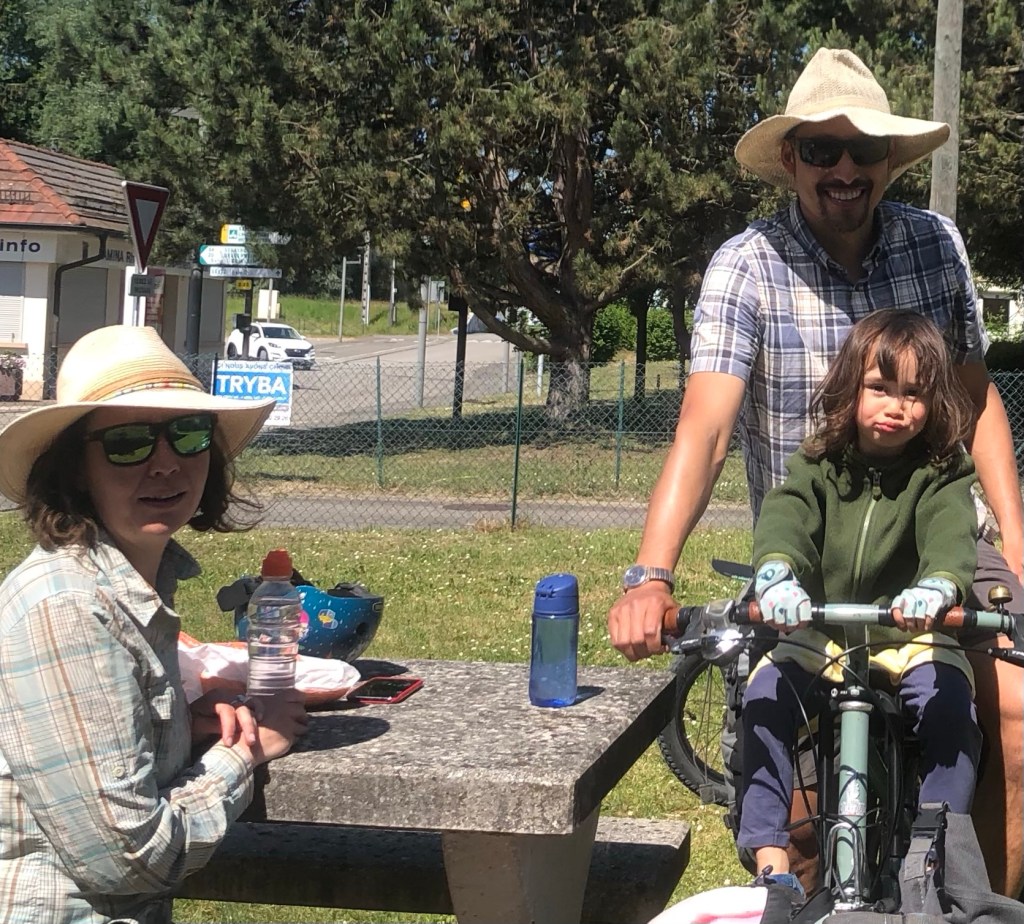
Riders on the Rhine: Rose, Mike, Hazel, from Vancouver
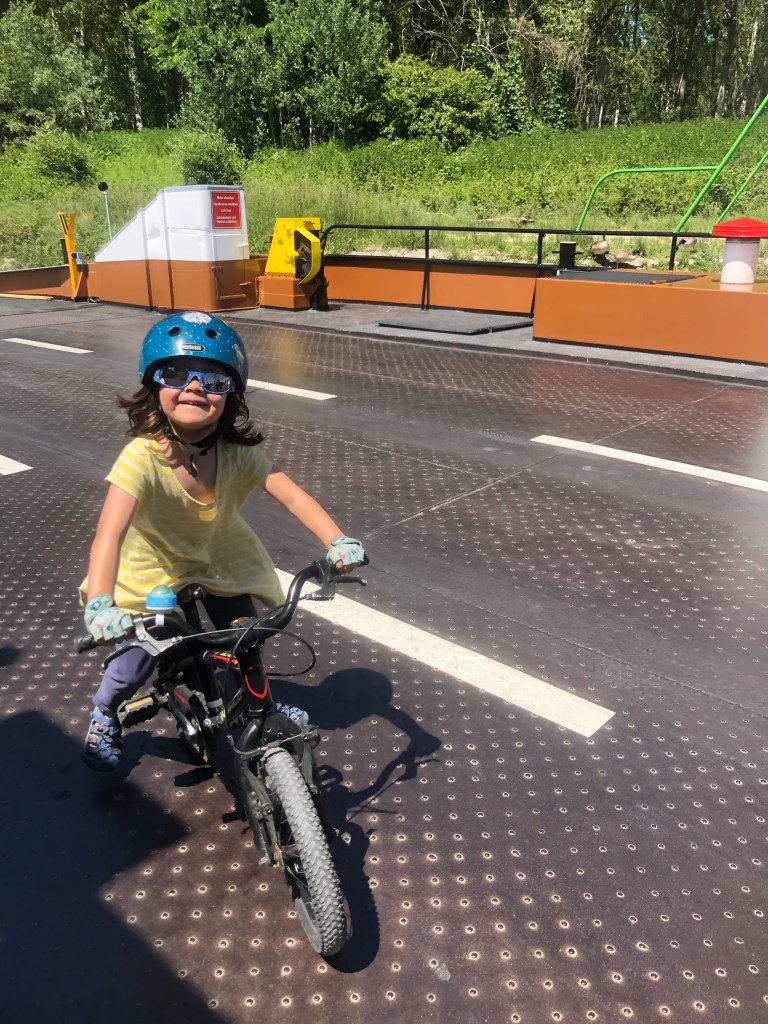
Ferryboat from France to Germany. Hazel is ready to cycle.
We ride together until after lunch. They leave for their campsite. I pedal on for Karlsruhe.
When I first started, it seemed to me that this ride was a really big deal for me. It’s no false modesty for me to say that, yes, it’s a big deal, but I have met cyclists who have done so many thousands of miles on much tougher bike trails that now this seems to me to be not so very much. You just get on your bike and pedal. I’m reminded of the story of Einstein who supposedly spoke to a young pupil of his who was having trouble with his arithmetic lessons. Einstein (reportedly) said, in a kindly fashion, ‘Persist in your studies, your difficulties are quite small compared to mine’. That’s how I feel, my difficulties on this ride are quite small.
Until the next post,
Caio…
DAY 14
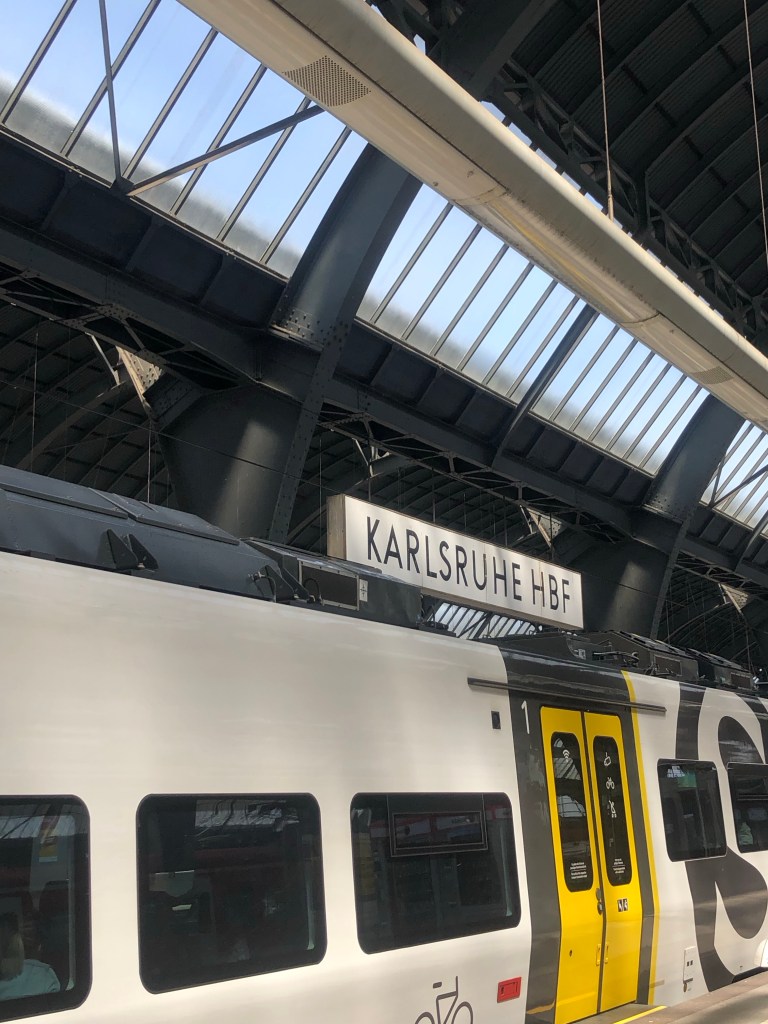
Leaving Karlsruhe with bike on Train
Bit of a hiatus today to make up some time on the train so that I can reach Amsterdam without having to make a mad dash at the end. I arrive in Cologne for a 16 hour layover with my kayaking friends, Axel & Gisela.
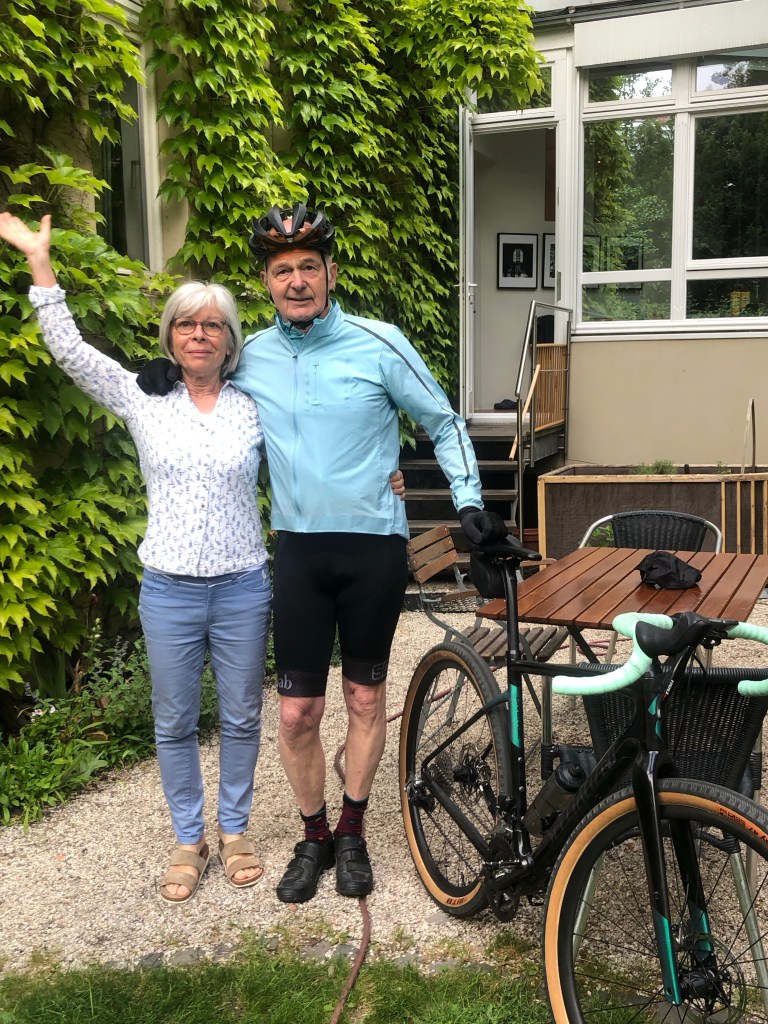
The next day, heading for Duisburg, Axel accompanies me for the first 20km.
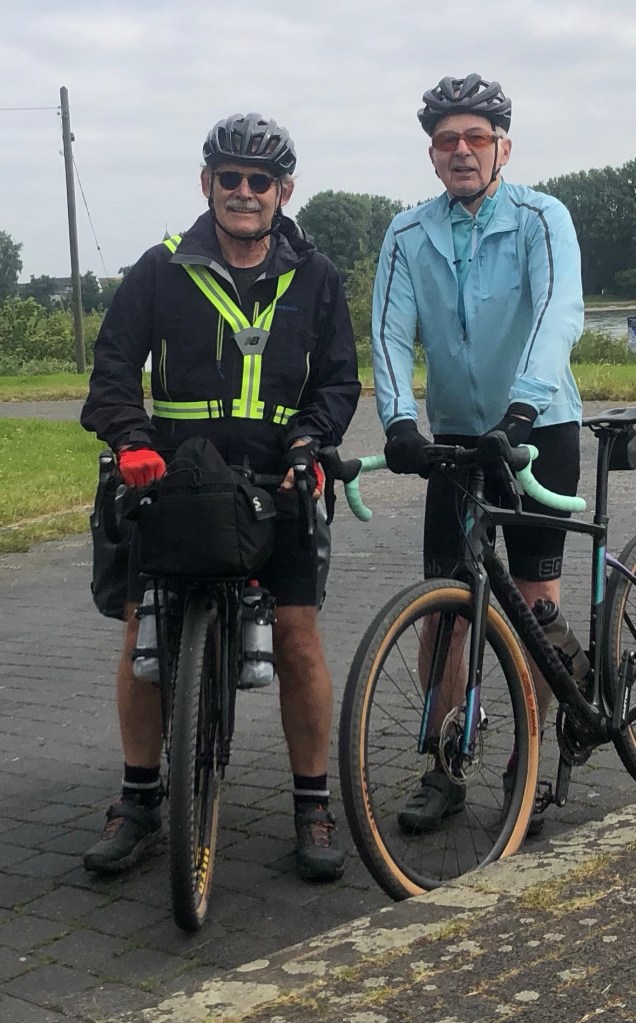
I leave the outskirts of Cologne for the east bank of the river by ferry.
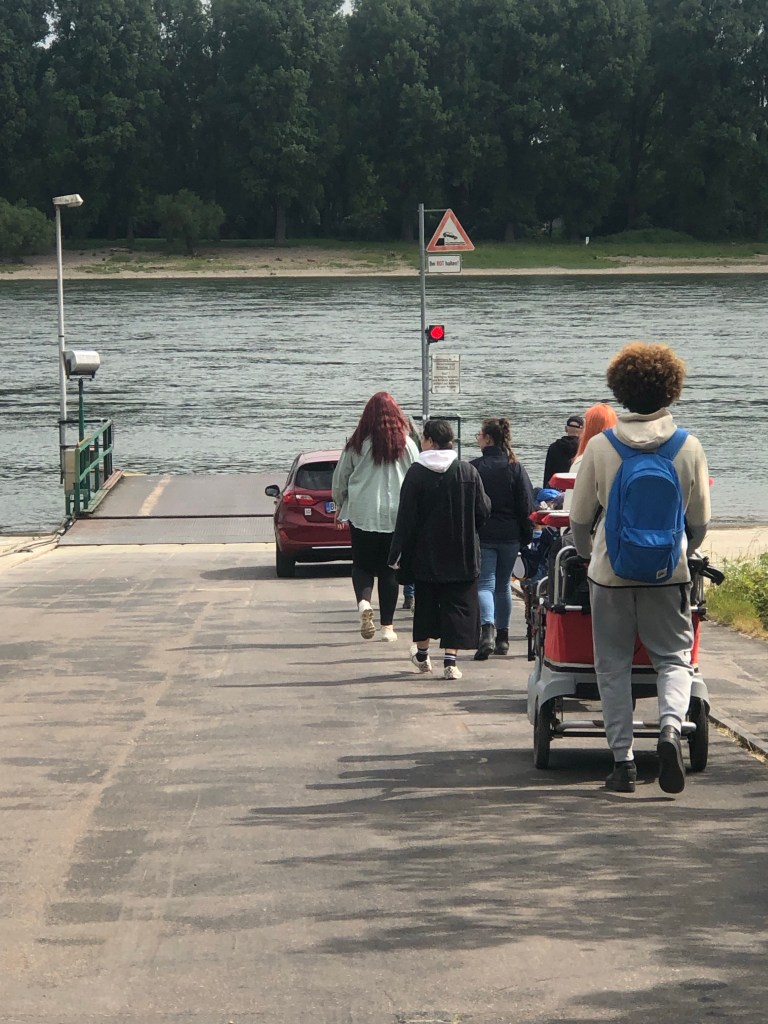
Waiting for the Ferryboat
I’ve heard about this section of the Rhine. To be frank, it ain’t pretty. Starting out with the sprawling production facilities of Ford and Bayer, I cycle through messy suburbs and overgrown river villages that become even uglier as I approach Duisburg late in the afternoon.
Duisburg is a steel town transforming itself into an post-industrial heritage town. It still has a way to go.
Cycling is going well though and I’m looking forward to the more open spaces north of here tomorrow.
DAY 15
Today I cycled out of the sad city of Dursburg, away from the forlorn cityscape to the wide open spaces to the north. It’s a sunny, Saturday morning in Spring, but the only word that comes to mind, cycling out of Duisburg, is ‘godforsaken’. And this is not just a town, it has a population of half a million people! Decades ago it was a bustling, prosperous city, churning out massive quantities of iron and steel as well as it having a vibrant ship building industry in the years before that.
I know from first-hand experience in South Wales what happens when heavy industry moves out. It leaves behind a shell – of the city itself and of people’s lives – which will take generations to build back. Generational trauma. I look at peoples faces here, I know these faces. They have the same ‘look’ as the faces of people of the forgotten valley towns of South Wales where coal and steel jobs have disappeared. George Orwell would have a field day. Surely he’d be quoting Karl Marx’s infamous ‘Environment Determines Consciousness’.
The city sits at a critical junction – at the confluence of the Ruhr and the Rhine. Centuries ago, they tried to build a canal to give Germany access to the North Sea shipping lanes without having to deal with Holland, then a powerful neighbor, by floating down the Rhine. The attempt failed.
Centuries later, Duisburg’s geographical position at the heart of the German iron and steel production region mean’t that the city would have been massively targeted from the air here during WWII – as were the steel towns in Wales of Swansea and Cardiff and the northern cities of England.
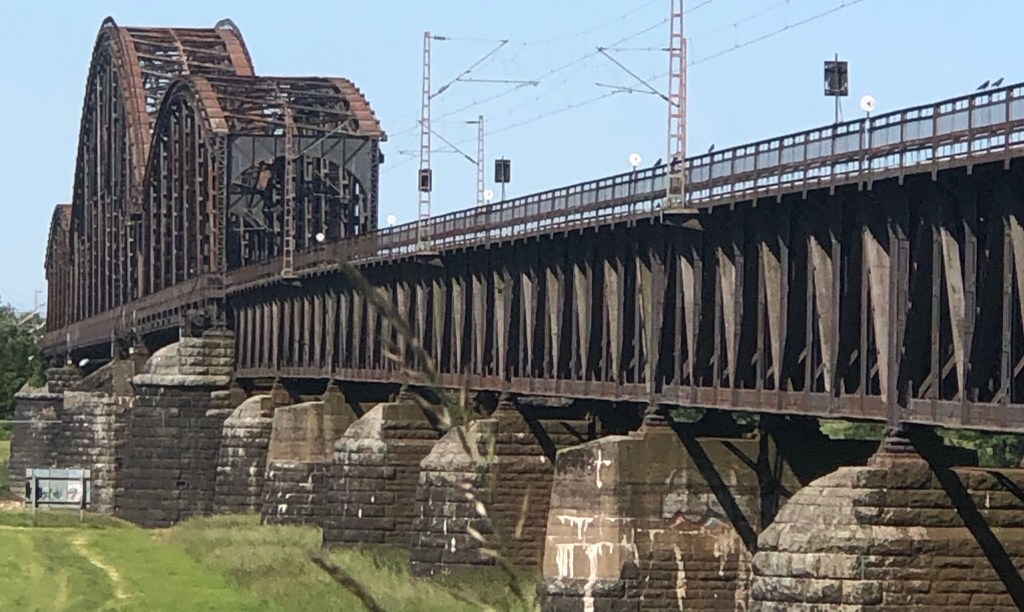
Bridge out of Nowhere. The stone piles are pre-WWII. I’m sure this bridge over the Rhine was destroyed then rebuilt during the war.
I only have that one photo of the city, that of the bridge I crossed which led out to open country. But I’m really glad I saw this first-hand – whoever visits Duisburg??
Back to the ride…not so many photos today, just a few. Y’know, I sometimes see some really odd things here. This morning, stopping for a water break under a tree in the shade, I looked down and saw….a whole pile of Monopoly money. Monopoly money???
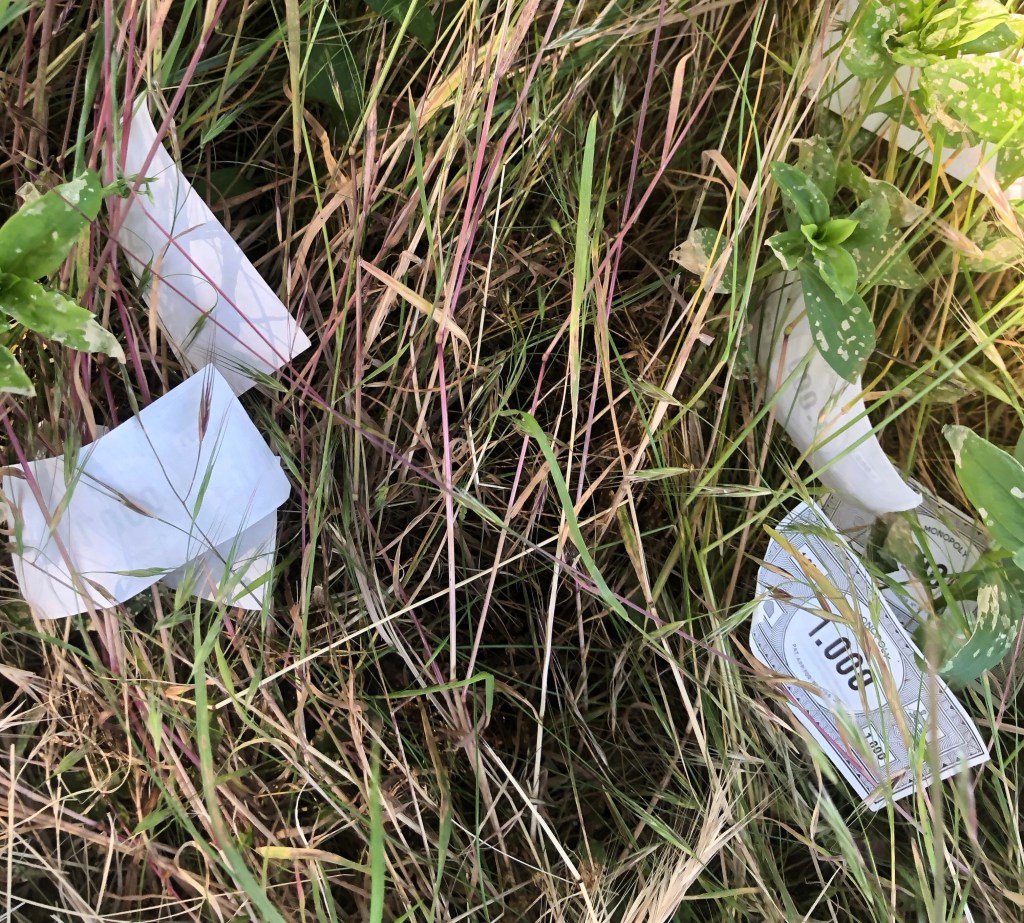
Who plays Euro Monopoly in the middle of nowhere?
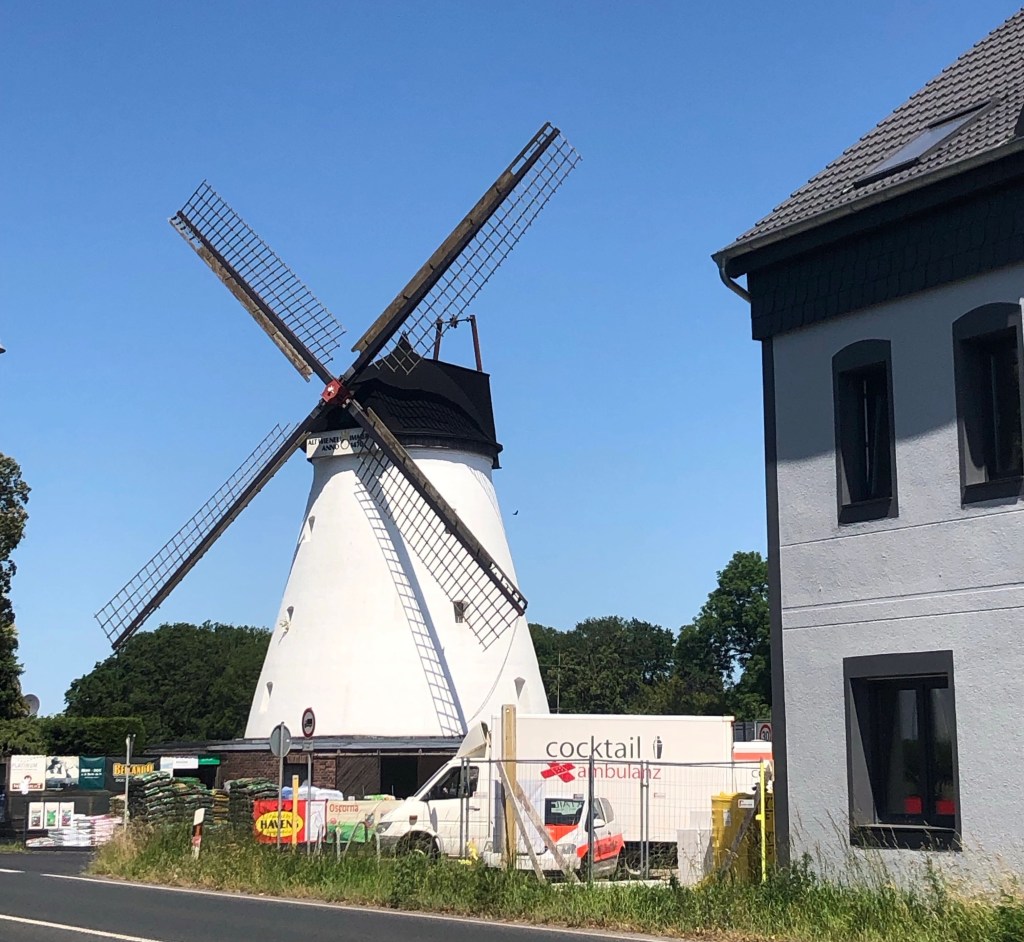
My first windmill sighting. Maybe it’s for show, its sails look like they’re not about to catch wind.
There are any number of sayings to do with the flow of a river. I don’t know that there are many about cycling. But you naturally come up with aphorisms that go through your head as you pedal along and it’s tempting to make a metaphor out of every cycling thought. Such as…’if you think the road ahead is too steep, carry on – it’ll level out before you get there’, and ‘if you think you’re going to fall, focus! If you don’t, you will.’ And ‘sometimes we need to look back to know where we’ve come from as well as looking ahead.’ The list goes on….
That’s it for this post, folks. Tomorrow will be the last day of the ride in Germany, tomorrow night I’ll be just south of the Dutch-German border.
DAY 16
Woken very early by the crowing of a rooster. Then the turkey started up (I’m in farmland).
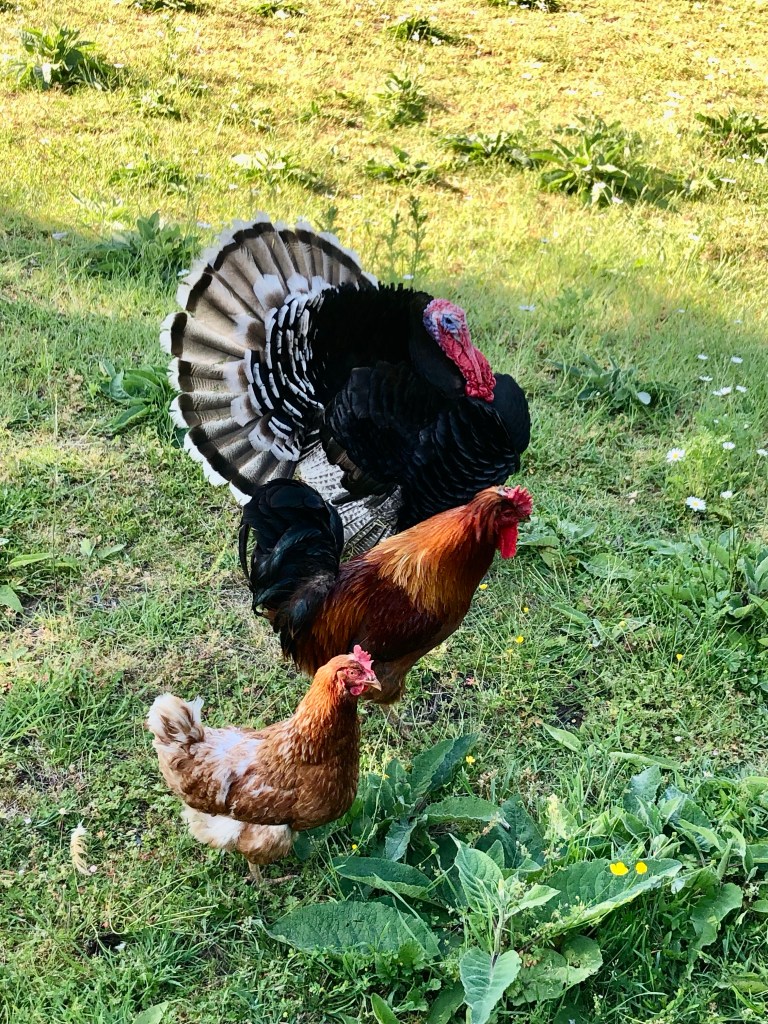
Gobbler & Rooster
An idyllic ride today through farmland and small villages. Fresh winds out of the north. Cereal and vegetable crops – wheatfields, potatoes, broccoli &etc. The sweet farmyard smell of cow manure…(In France, I’m pretty sure they laced the water for surface irrigation with human waste, didn’t smell so good.)
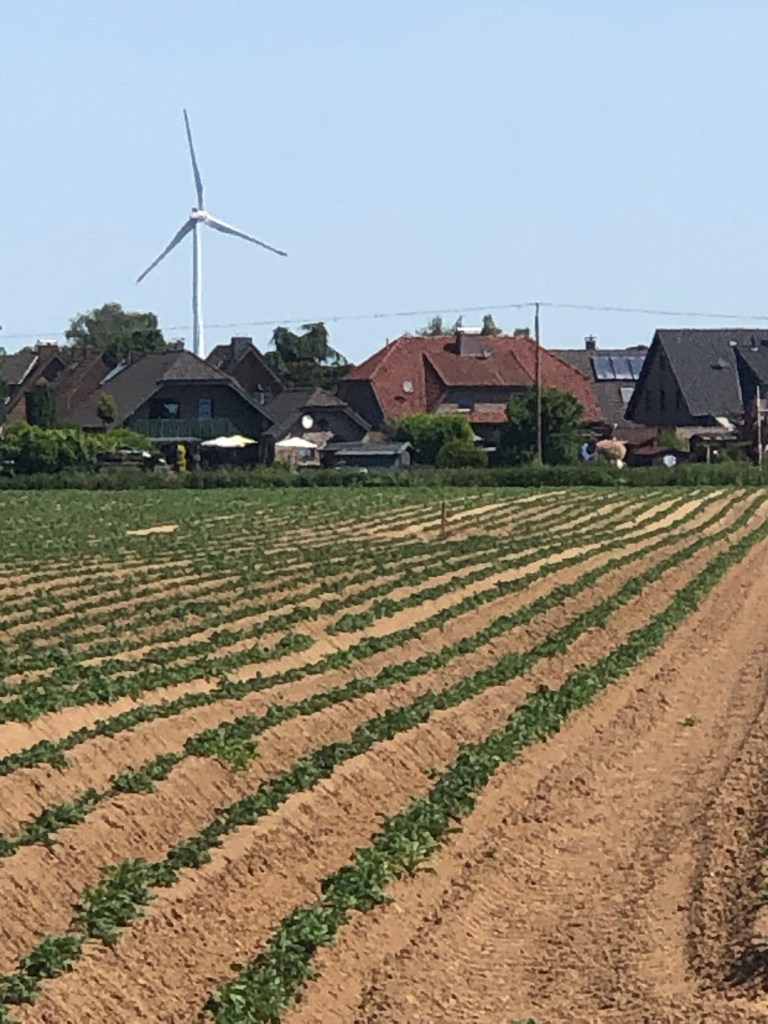
Potato fields
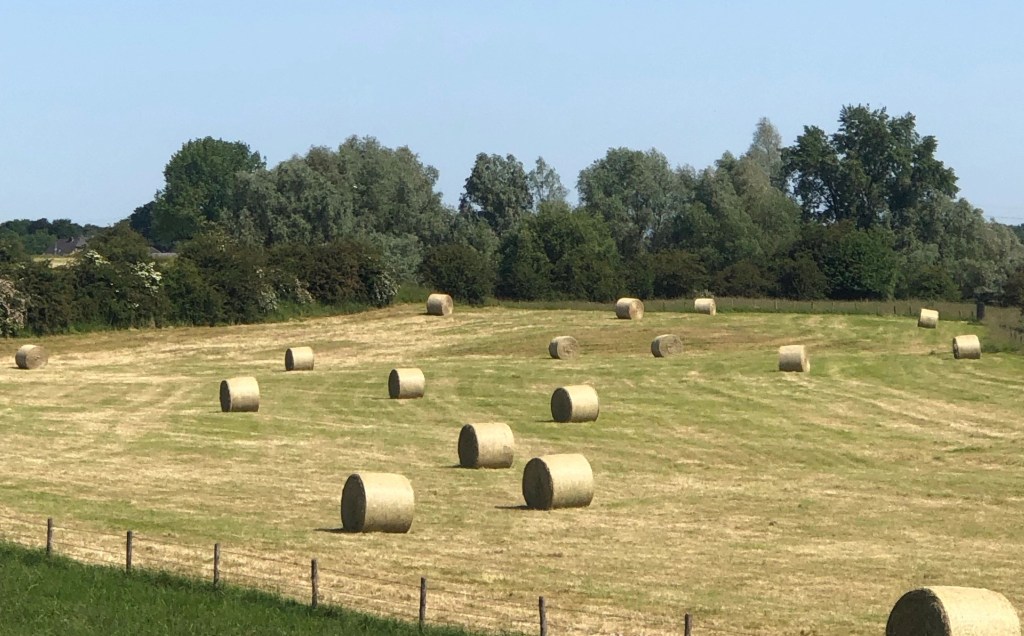
Baled Wheat
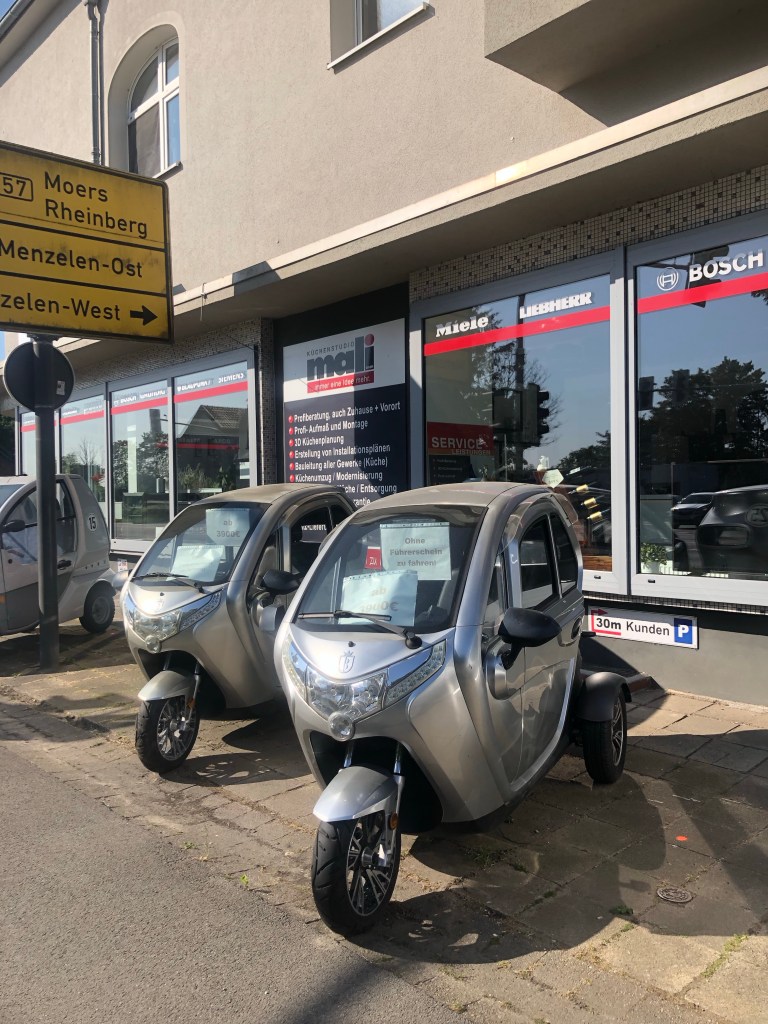
Noticed they still make 3-wheeler vehicles here. I remember they seemed to be everywhere here years ago. Especially in France, it seemed, in rural areas.
I would probably have been arrested years ago for taking the following photo…
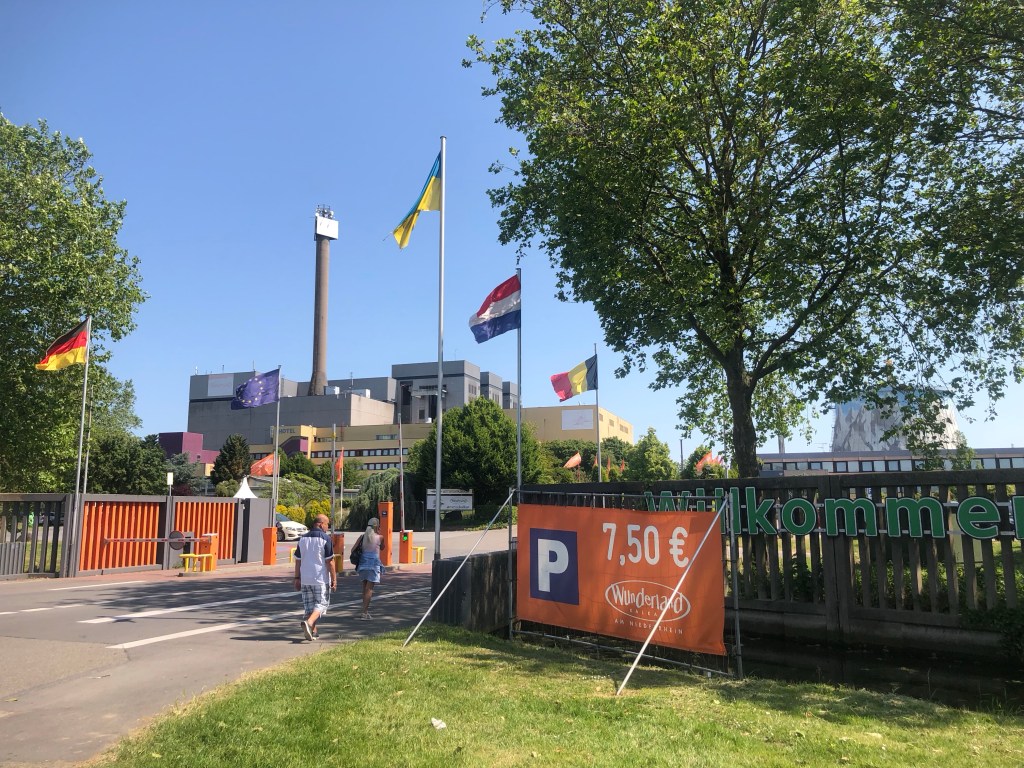
Today, it’s a Theme Park!
This was a multi-billion euro under-construction nuclear power plant in the 70s and early 80s. Then Chernobyl happened and the German government responded by scaling back on nuclear power and the project was halted. Years later it was redeveloped as a Fun Park. At least they’ll get at least some of those billions of euros back!
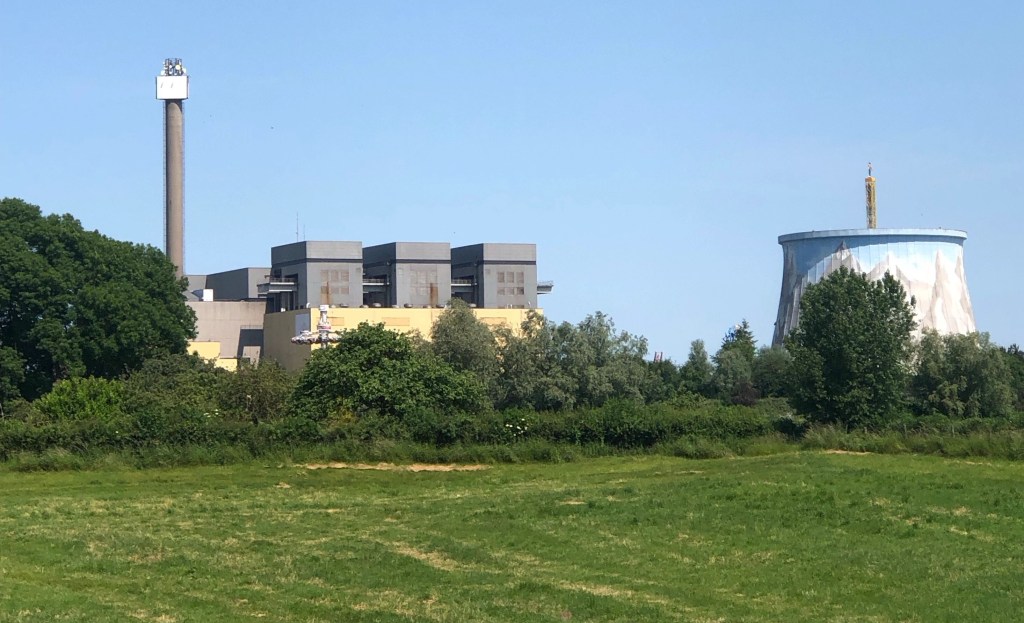
Isotopes to Roundabouts
There is constant barge traffic on the Rhine, all the way up to Basel and all the way down to Rotterdam. The barges are immense, each 100 meters long, I’d guess. Today I saw a tugboat pushing six of these tied together up river. Most of them are stacked with shipping containers delivered by sea to Rotterdam and other North Sea ports.
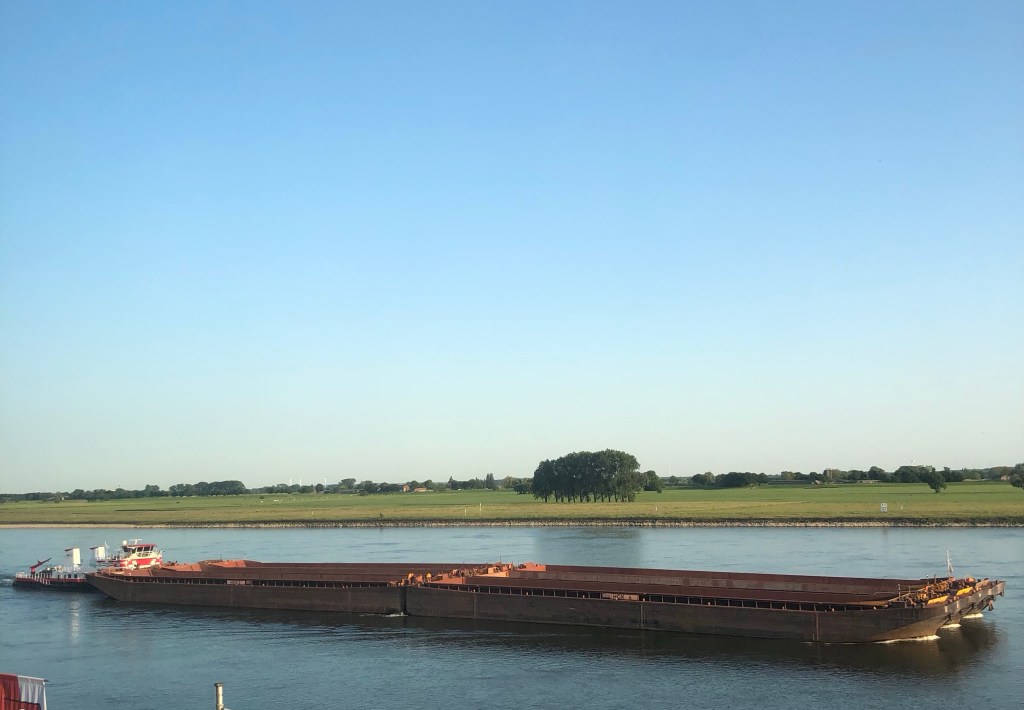
Six barges pushed upstream
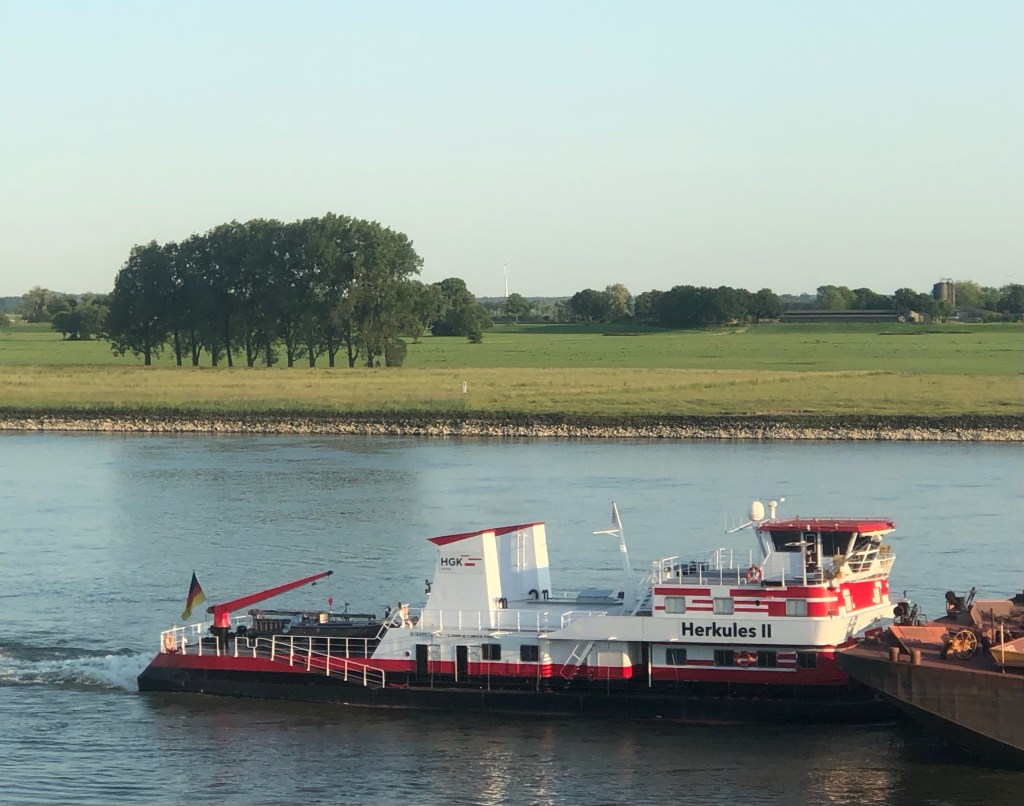
Tugboat Herkulis II
Tomorrow is the penultimate day of the ride. Just a few miles north of where I’m staying tonight, overlooking the river, is the Dutch border. The Rhine meanders west for the lowlands of Rotterdam where it empties into the North Sea at the Hoek van Holland. I’ll then say ‘goodbye’ to the river as I’ll be heading across country northwest for Amsterdam.
More tomorrow….
DAY 17
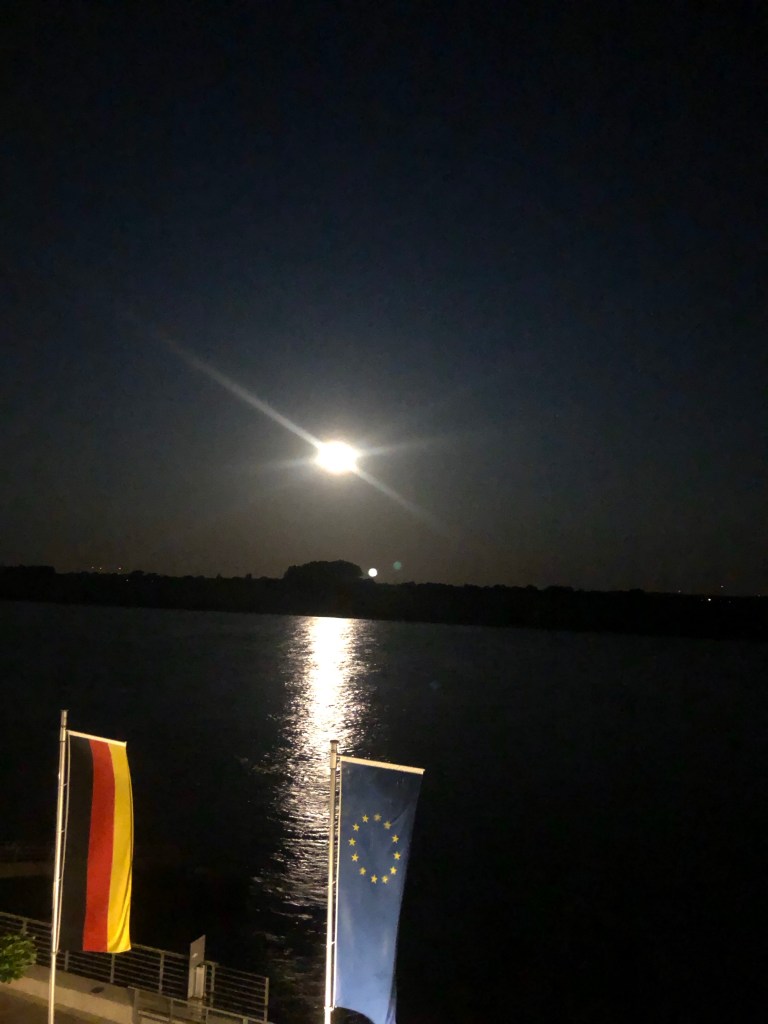
Moon Rising over Rhine with German & EU Flags. 1:00am.
My final photo of the river as I leave for Amsterdam, the river follows its course to Rotterdam.
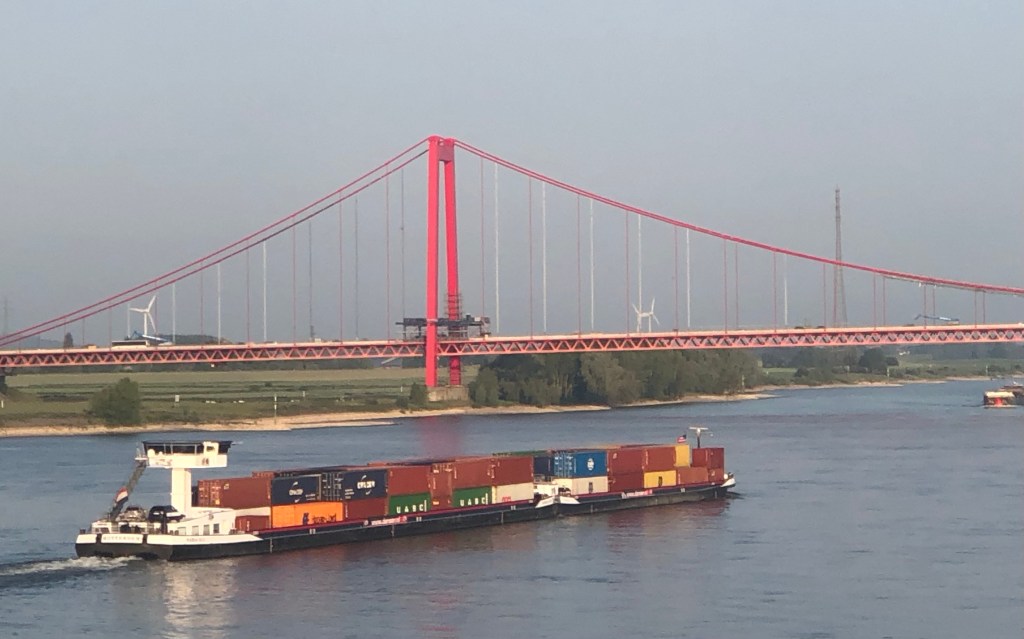
Heading for a Container Ship in Rotterdam.
I spent the morning cycling through several small Dutch villages. The tone of the place has changed since I left Germany. I was never aware of where the border actually was since both countries are EU members (unlike Switzerland, which is not). But somehow here in The Netherlands there’s a positive sense here…on the German side not so. Again, can’t put my finger on, it’s just a sense.
Bike paths, for example. It’s as though in The Netherlands they laid down the bike paths then they built the towns and villages next! No, seriously, cycling here is child’s-playingly easy. The cycle path surface is consistently good blacktop, or rather redtop. Black for motorized vehicles, red for bikes. Look at this, for example…they take a road, blacktop the middle one lane and redtop the two side lanes. If a car approaches a car from the opposite direction it can temporarily move into a bike lane. Brilliant!
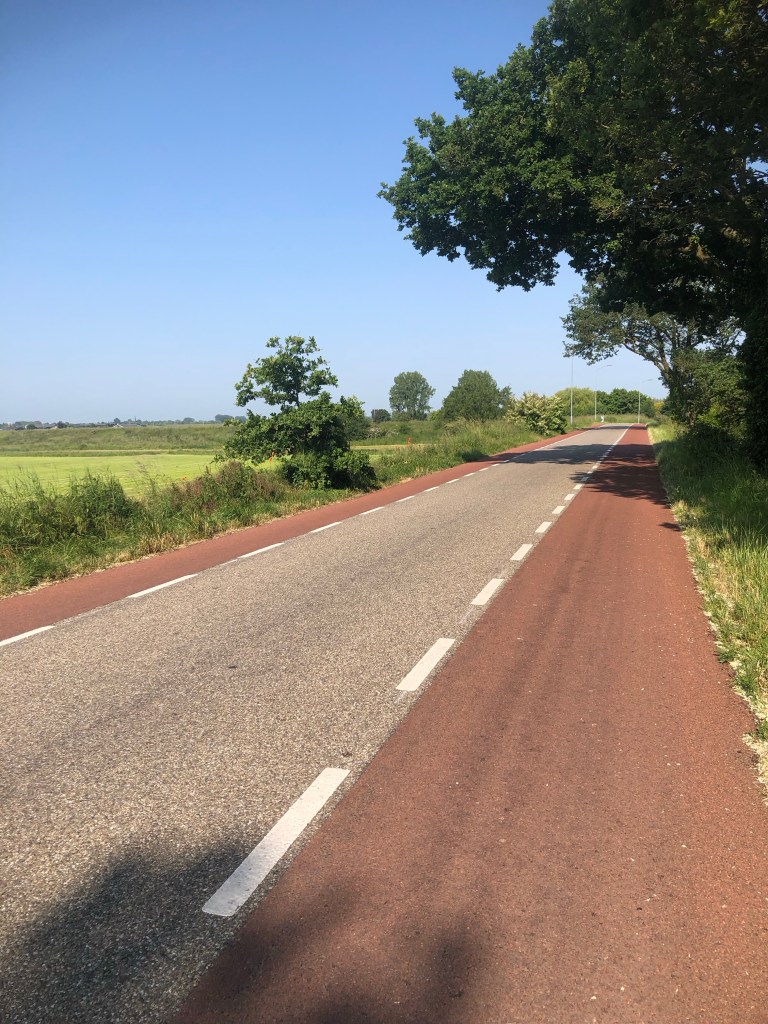
Amazing, right?
Another example…bike lanes have separate barriers for train junctions…
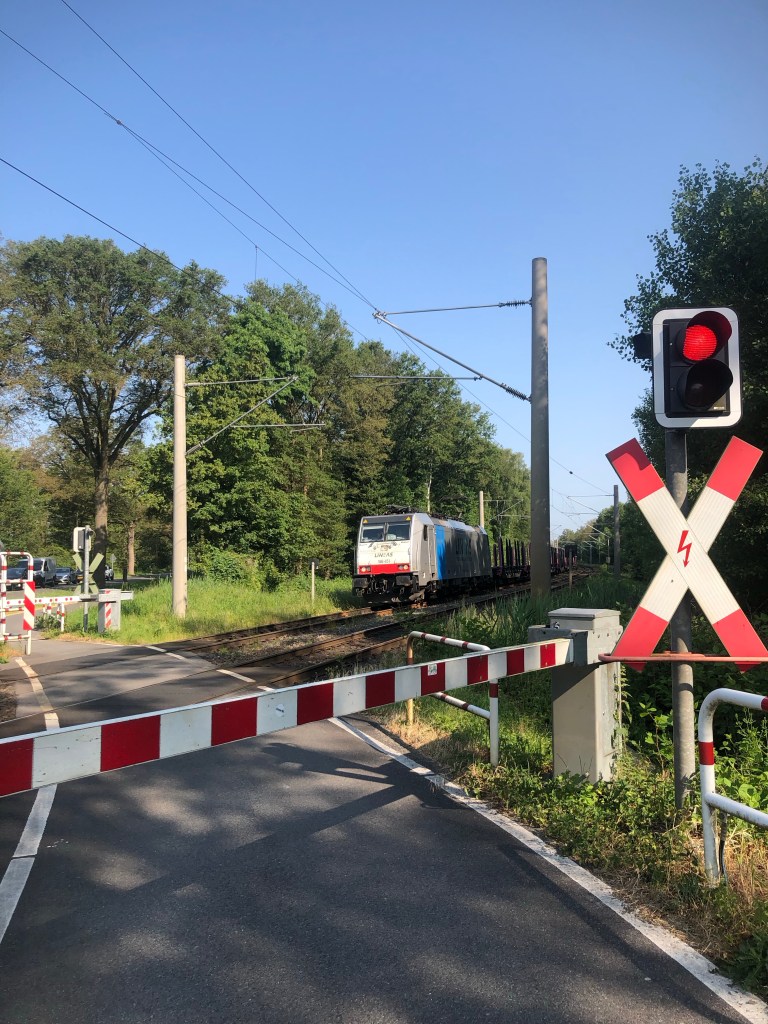
The photo doesn’t quite show it, but this short barrier is just for bikes!
Then of course it’s so very flat here with just a few hills north of Arnhem. There is the sheer mileage of bike lanes, they are everywhere. And at road junctions, stop and go lights at almost every junction. All these things add up, making biking tremendously efficient, enjoyable and fast. I had no trouble keeping a good average speed today.
I stopped for some lunch materials at Arnhem. No signs now, of course, of the disastrous events (for the Brits) that happened here during WWII. Thousands of British paratroopers were dropped behind enemy lines here, the plan being to hold and defend the bridge over the Rhine at Arnhem until the arrival of the main force. Which never came, or came too late. Story is well known now due to the movie and the book ‘A Bridge Too Far’.
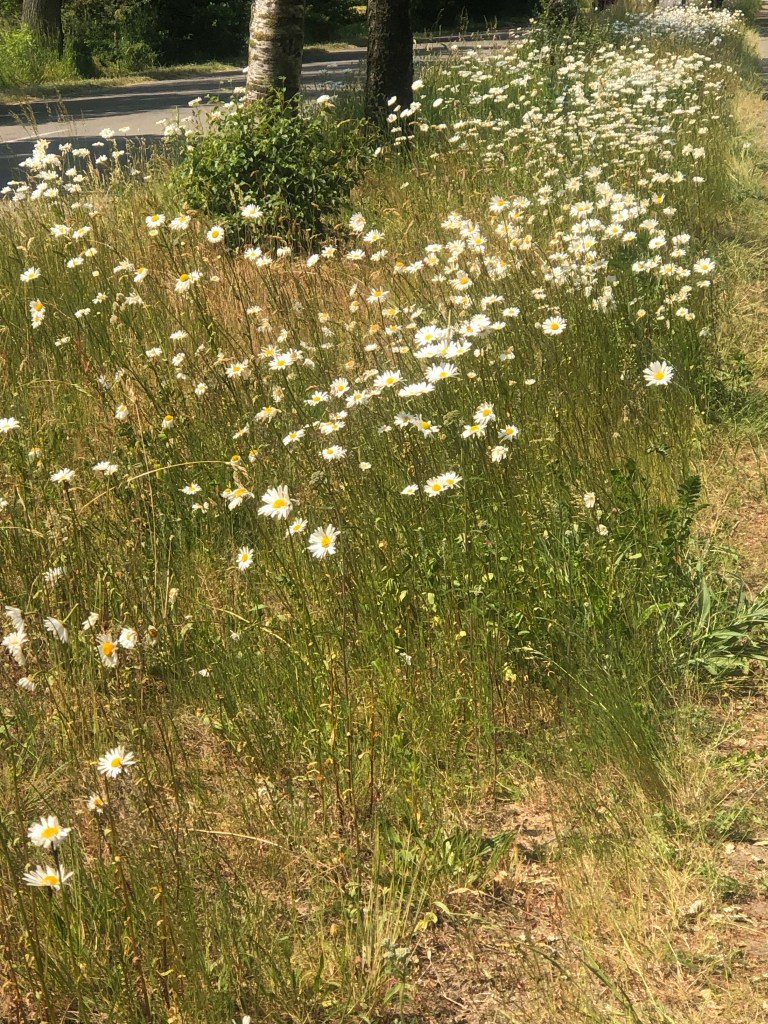
Roadside ‘Dog’ Daisies. It must be June.
I’ve started thinking about descriptors for the countries I’ve passed through on this ride. Here they are…The Netherlands: efficiency and openness; Switzerland: sufficiency and tradition (some might say excellence); Germany: order and control (sorry guys); France: well, France would explain to you how and why these are good descriptors. Or not.
Came across a field of mini longhorn cattle….
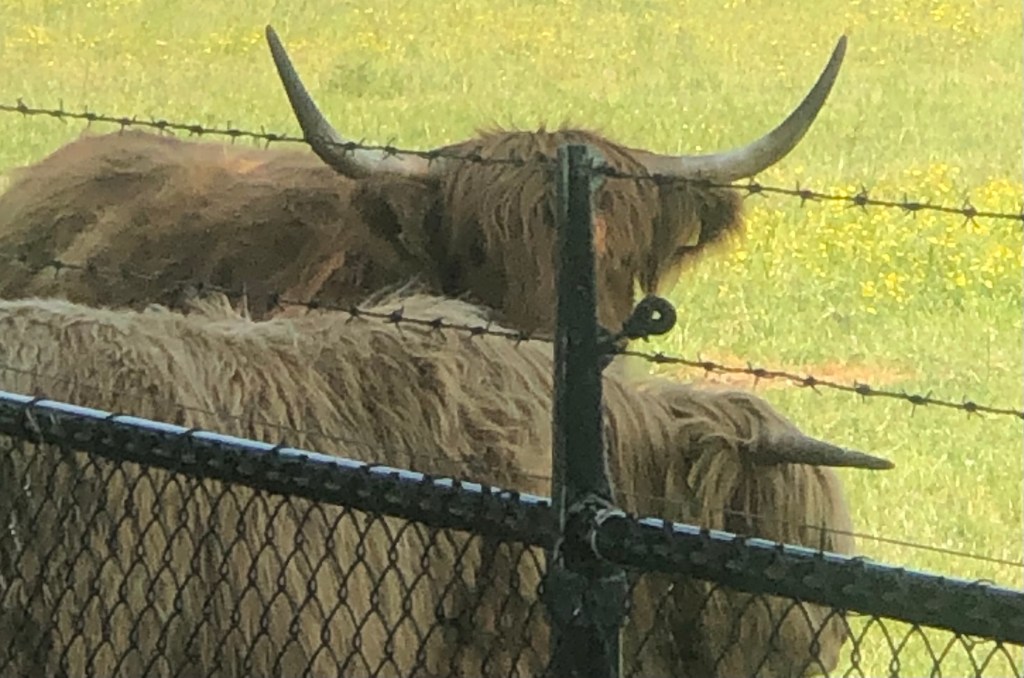
Salvador Dali Cows
Well, tomorrow is my last cycling day. I should pull into Amsterdam some time during the afternoon. I will update the blog with the last post at the end of the week.
Until then…
DAY 18
Wow, the last cycling day!
It’s soon over, the ride done!
On the final day there were two kinds of rides. The morning, through several small, classically Dutch villages, so neat & tidy, cycling along the tops of polders, canals on either side, flat fields separated by more polders (no hedges) as far as you can see in all directions. Flat, unending, big skies, herons, marsh birds calling, no one about even though it’s only 30 or so kms from the western outskirts of Amsterdam.
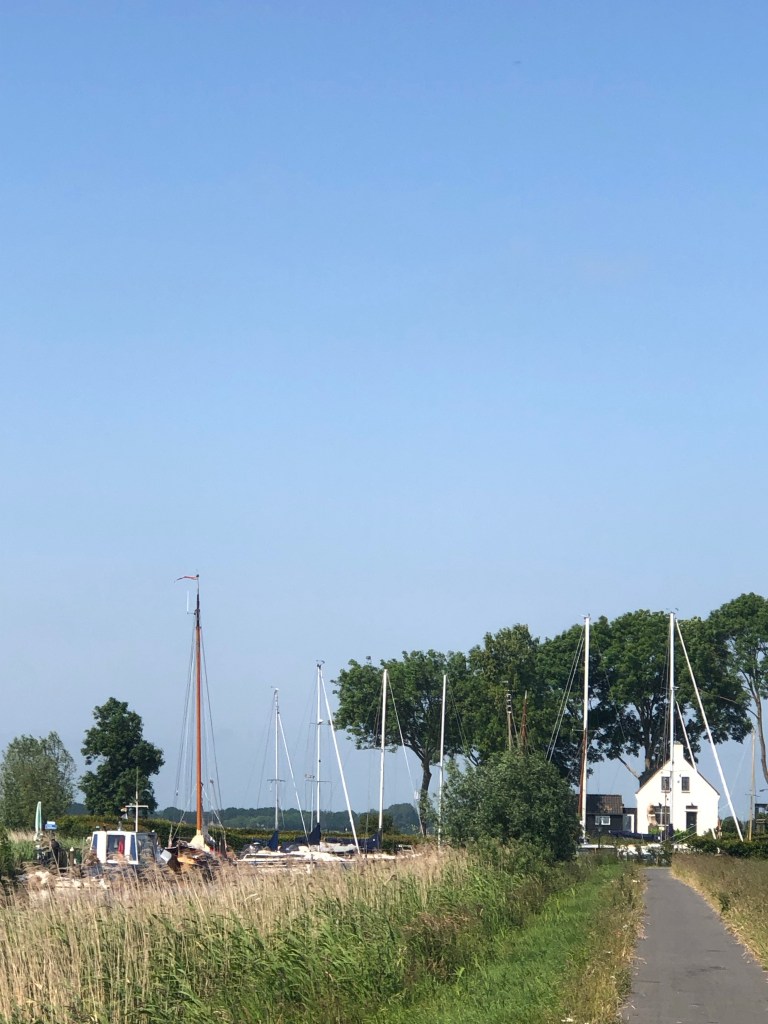
Inland Harbor
‘First gradually, then suddenly…’ I’m seeing ‘bike highways’ and modern Dutch cycleways looping over roads, through tunnels, on overpasses. Concrete and lots of it. Suddenly I’m in the city proper where cycling is almost a contact sport. But not quite. Now I’m in groups of 10, 20 cyclists stopping at bike traffic lights, crossing intersections, turning right, left, go straight, right again &etc. getting closer to my hotel.
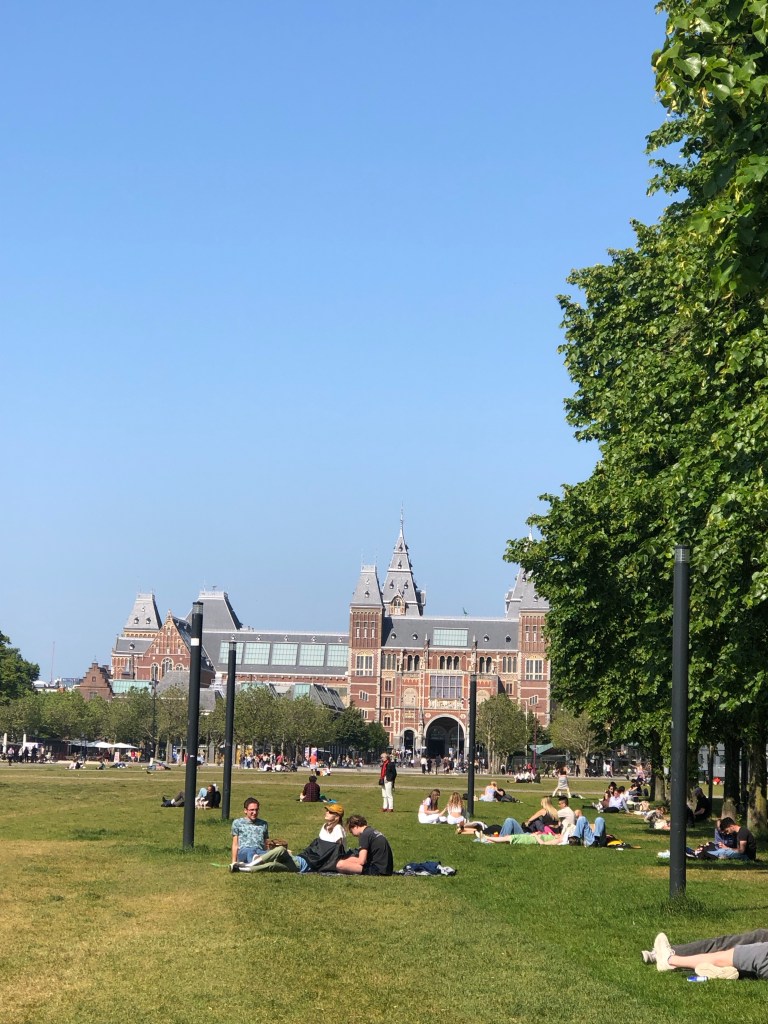
Rijksmuseum
The Netherlands has millions of bikes. With a population of almost a million, there are 100s of thousands of bikes in Amsterdam, one of (if not the) bike capital(s) of the world.
And I can’t but help thinking that when I left Oberalppass just a few weeks ago, that morning there was just one bike.
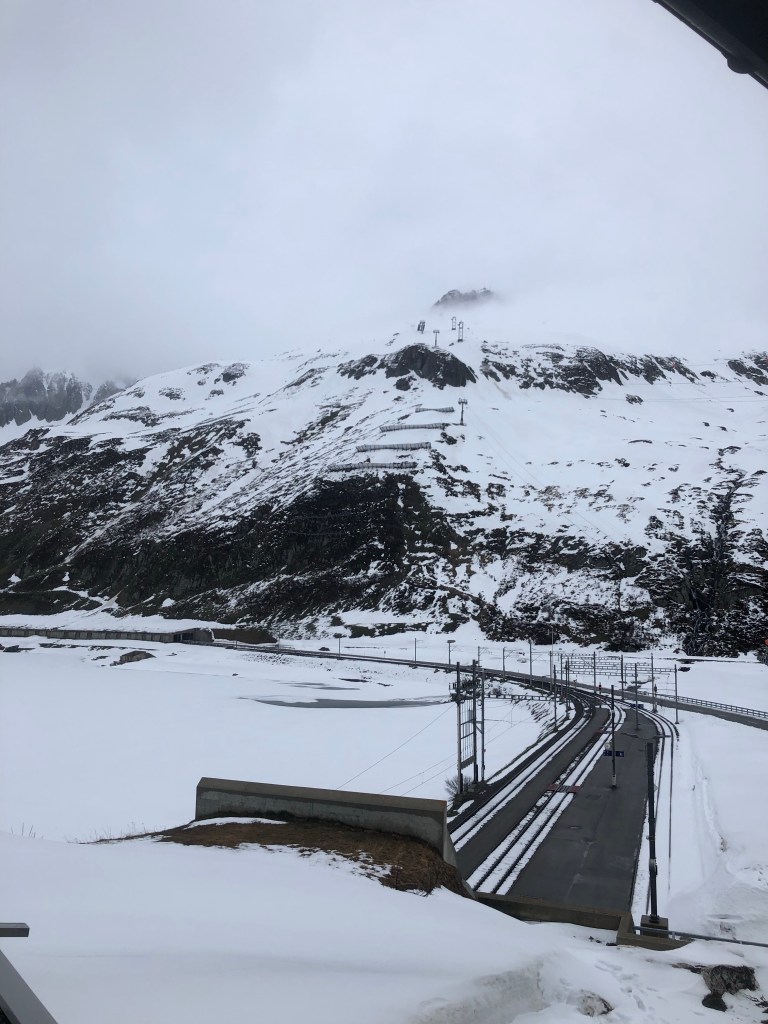
Oberalppass 20 days ago.
The next morning I cycle through Vondelpark to Amsterdamsefietswinkel where Ali agrees to box the bike for shipping home in a week.
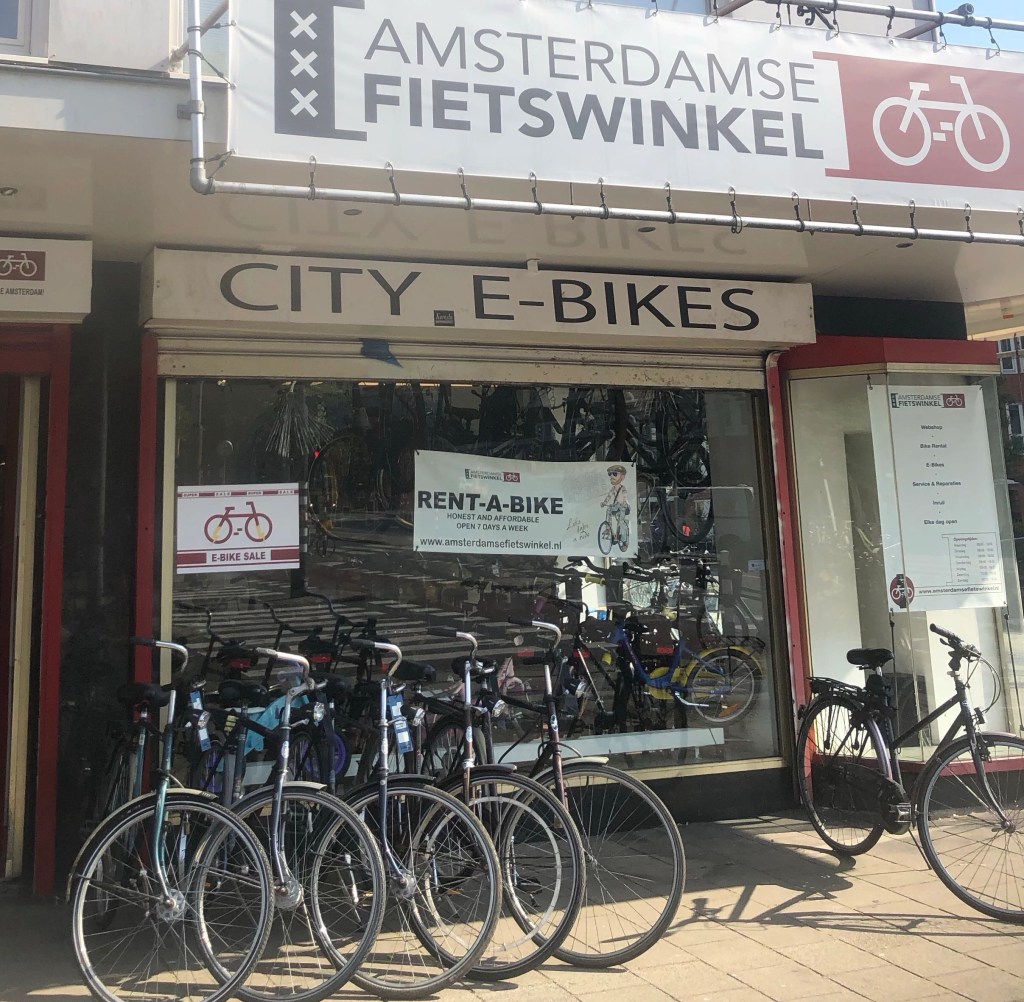
Ali’s Bike Shop
I spent the night with some very old friends, Ralph and Cheryl, from my long, lost Amsterdam days. It was Ralph who had hired me to work as a Desk Editor for Elseviers Scientific Publishing Company, as it was then known, many moons ago. Ralph and Cheryl graciously offered me a room and some wonderful curry (beer & etc) and conversation which did indeed end the trip on a high note.
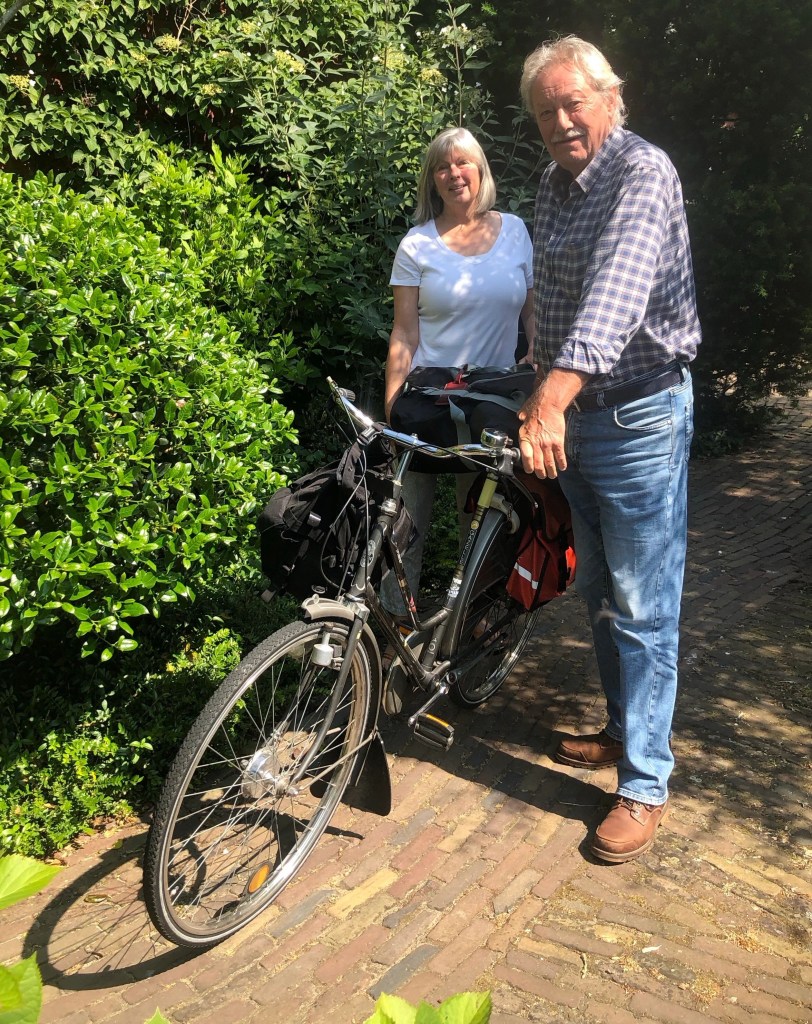
Ralph & Cheryl
So that’s it. The end. So many people to thank for this trip, from the folks at Riverside Cycle in Manchester for helping me get kitted out, to all the other cyclists and fellow travelers I met over the last weeks, to those who followed the blog and sent encouraging emails, to Ylva in Gloucester (originally from The Netherlands herself) who suggested that I write this blog. And to Chris who supported me fully from the start.
EPILOGUE
It first seemed like this ride would be the only one. But stay tuned, there are a few more interesting European rivers!